On this page
Hang five metal tubes of different lengths from a ring, let the breeze hit them, and you hear five different notes. The long tube hums low and the short one rings high. One formula explains the notes.
What actually vibrates in a wind chime?
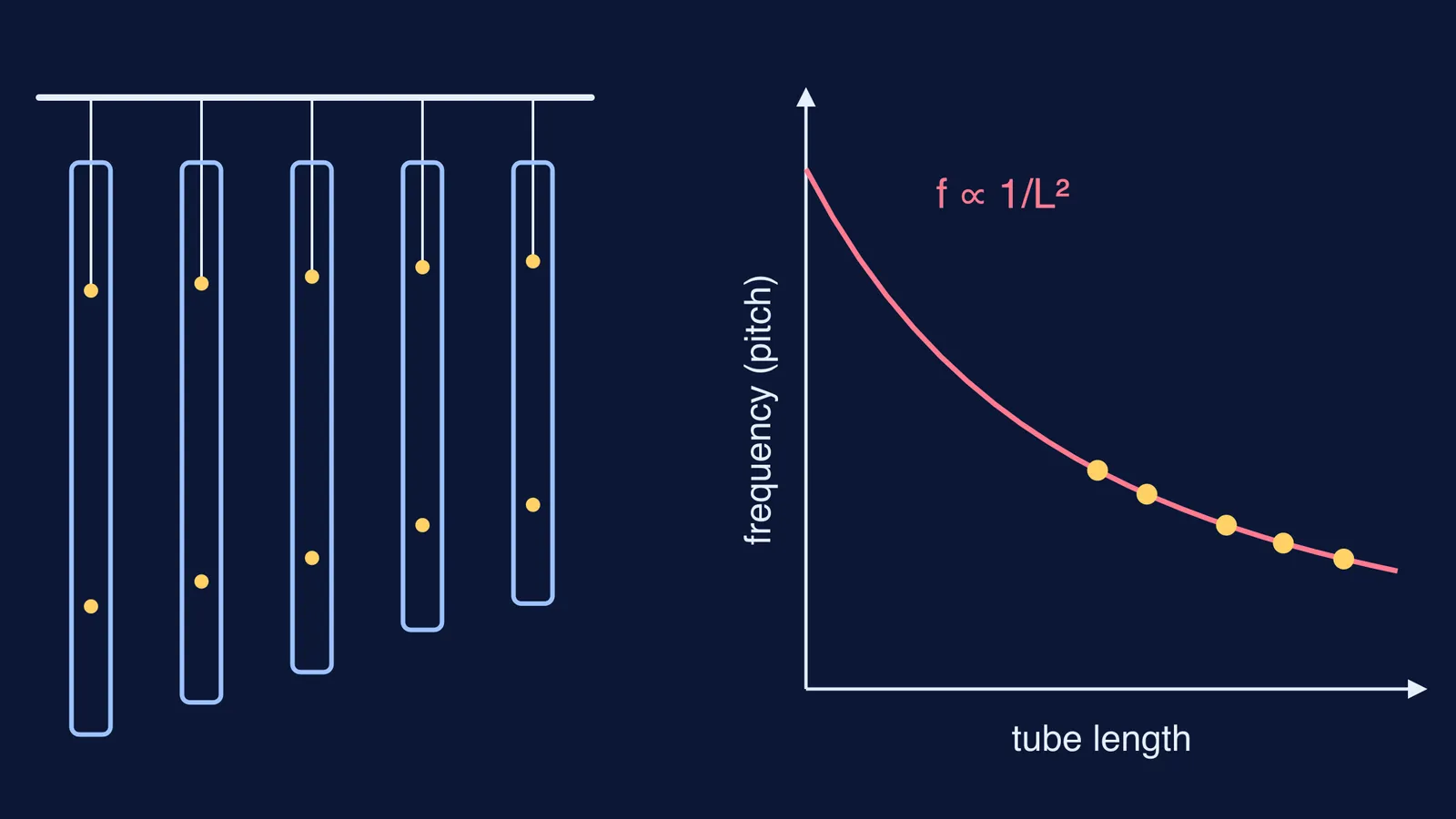
When the clapper strikes a tube, the metal itself bends from side to side, like a twanged ruler with neither end held. Physicists call this a free-free bar. The Rose-Hulman acoustics notes on wind chime tube frequencies treat the chime as exactly this kind of bar and give its lowest note as the lowest transverse (sideways bending) frequency.
A bending bar does not wobble everywhere equally. For the lowest note there are two points that stay still, called nodes, and the same Rose-Hulman page puts them about 0.225 of the length from each end. Chime maker Lee Hite's chime design guide gives the same point as 22.4% from either end and says supporting the tube there gives the best bell-like sound.
Why do longer tubes make lower notes?
The frequency of the tube's lowest note follows a simple rule from the Rose-Hulman formula: it is proportional to one over the length squared, multiplied by the speed of sound in the metal and by a measure of the tube's width.
In symbols, f ∝ κV/L², where L is the length, V is the speed of sound in the metal (about 5,105 m/s for steel conduit, says the same page) and κ is half the square root of the inner radius squared plus the outer radius squared.
The L² is the important part. A longer tube is floppier, so it bends fewer times per second. Because length is squared:
Make a tube twice as long and its frequency drops to one quarter.
Make it half as long and its frequency rises four times.
Divide its length by about 1.41 (the square root of 2) and its frequency doubles.
How are frequency and pitch connected?
Pitch is what your ear makes of frequency. HyperPhysics on pitch puts it plainly: for most practical purposes the pitch is just the frequency.
Musicians count notes in octaves, and an octave is a doubling of frequency; HyperPhysics on cents divides each octave into 1200 cents and each equal-tempered semitone into 100 of them. Put that together with the L² rule and you get a neat result: to go up one octave, divide the tube length by about 1.41; to go up two octaves, halve it.
How do you work out chime lengths for a scale?
Each equal-tempered semitone multiplies frequency by the twelfth root of 2. Since frequency goes as 1/L² (the free-free bar formula), each semitone up divides the length by the 24th root of 2, about 1.029. So every semitone higher needs a tube roughly 2.9% shorter.
Start with a 40 cm tube as your lowest note and build a five-note pentatonic set (the notes do, re, mi, so and la):
Do (0 semitones up): 40.0 cm
Re (2 semitones up): 40 ÷ 2^(2/24) = 37.8 cm
Mi (4 semitones up): 40 ÷ 2^(4/24) = 35.6 cm
So (7 semitones up): 40 ÷ 2^(7/24) = 32.7 cm
La (9 semitones up): 40 ÷ 2^(9/24) = 30.8 cm
Hang each one 22.4% from the top, the support point in Lee Hite's guide: about 9.0 cm down on the 40 cm tube and 6.9 cm on the 30.8 cm tube. The same guide says calculated lengths get you to about 1% of the target note; for exact tuning, cut slightly long and grind down.
Notice how the lengths shrink by less than the notes rise. Going from do to la raises frequency by about 68%, but the tube is only 23% shorter. That is the square at work.
Can you test this at home?
Collect three or four metal tubes or rods of the same material and width: old curtain rods, steel straws or conduit offcuts.
Measure each length, hang it by a thread at its top node (worked out above), and tap it with a spoon.
Read the frequency on any free tuner or spectrum app on a phone.
Plot frequency against 1/L². If the physics holds, you get close to a straight line.
This is a good small project for a Class 9 or 11 science file, because you are testing a formula rather than just describing one. If you would rather see an idea move before you build it, the Fermi Simulation Lab has interactive simulations for ideas that are easier to see than to read. If the algebra of 1/L² is the sticking point, Fermi's AI tutor can work through it with you, writing on a board and checking your understanding as it goes.
Next time you hear chimes on a balcony, look at the lengths: a scale written in metal.