

On this page
What is the Tishchenko reaction?
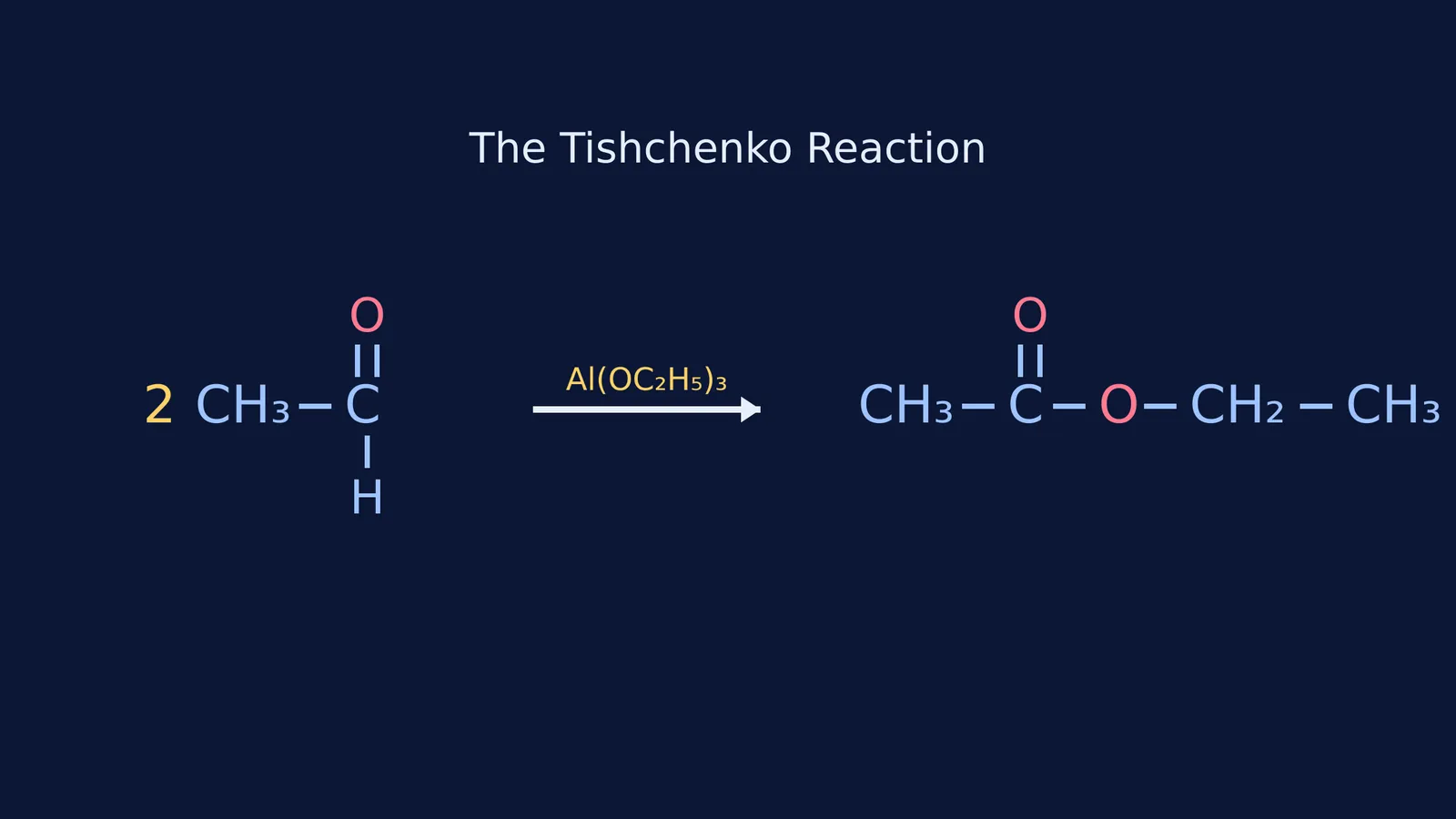
The Tishchenko reaction is an organic disproportionation reaction where two molecules of an aldehyde combine to form an ester. The Russian chemist Vyacheslav Tishchenko established this reaction in 1906 when he found that aluminium alkoxide catalysts could drive the process cleanly. During the reaction, one aldehyde molecule acts as the oxidised half to become the acyl part of the ester, while the second acts as the reduced half to become the alkoxy part.
The classic example of this process is the industrial synthesis of ethyl acetate from ethanal (acetaldehyde).
2 CH₃CHO → CH₃COOCH₂CH₃
Because the reaction produces esters directly from aldehydes without external oxidising or reducing agents, it remains a highly efficient method in organic synthesis. You will often see it covered after learning the basic methods of preparation of aldehydes and ketones.
How did Claisen and Tishchenko develop the method?
The reaction was actually first observed with benzaldehyde by the chemist Ludwig Claisen, who used a sodium alkoxide base (specifically sodium benzylate) to produce benzyl benzoate. However, Claisen's original conditions were strictly limited to aldehydes that do not possess alpha-hydrogens.
Tishchenko's major contribution was discovering that aluminium alkoxides are uniquely effective catalysts for this transformation. Crucially, he proved that aluminium alkoxide catalysts allowed the reaction to work with enolisable aldehydes—those containing alpha-hydrogens, such as ethanal. These enolisable aldehydes were not amenable to Claisen's original strong-base conditions because they would rapidly undergo aldol condensation instead.
How does aluminium ethoxide drive the mechanism?
The mechanism revolves around the aluminium atom in aluminium ethoxide, which acts as a Lewis acid.
The aluminium coordinates with the carbonyl oxygen of the first aldehyde molecule. An ethoxide group from the catalyst then attacks the carbonyl carbon, forming a hemiacetal-like aluminium intermediate.
A second aldehyde molecule coordinates to the same aluminium centre, bringing the two reactants close together.
An intramolecular 1,3-hydride shift occurs. The hydride ion (H⁻) from the first aldehyde fragment transfers directly to the carbonyl carbon of the second aldehyde.
This shift simultaneously oxidises the first fragment and reduces the second, breaking the intermediate apart to yield the final ester and regenerate the aluminium alkoxide catalyst.
Why is it better than the Cannizzaro reaction for ethanal?
The Cannizzaro reaction is typically limited to aldehydes without alpha-hydrogens, such as benzaldehyde or formaldehyde. If you treat ethanal with a strong base like sodium hydroxide, the base easily deprotonates the alpha-carbon, leading to a competing aldol condensation instead of disproportionation.
Aluminium ethoxide is a much weaker base. It triggers the nucleophilic addition and the 1,3-hydride shift without pulling off the alpha-hydrogens. Therefore, the Tishchenko reaction successfully converts enolisable aldehydes into esters without forming unwanted aldol side products. Knowing why aldehydes are more reactive than ketones helps explain why this initial addition happens so cleanly.
Once the ester is formed, its stability and reactions are entirely different from the starting aldehyde. For instance, the resulting ethyl acetate can be broken down later via acid vs base hydrolysis of esters.
What are the variations and industrial applications?
Beyond the simple conversion of ethanal to ethyl acetate, the Tishchenko reaction has several variations and uses in the chemical industry.
Benzyl benzoate synthesis: The reaction is used to produce benzyl benzoate from benzaldehyde, following Claisen's initial discovery.
Boric acid catalysis: Paraformaldehyde can react in the presence of boric acid to form methyl formate.
Aldol-Tishchenko reaction: In this variation, an initial aldol reaction is followed by a Tishchenko-type reduction. This cascade is often used in organic synthesis to create 1,3-diols or their monoesters.
Mixed Tishchenko reaction: Two different aldehydes can be used to produce a variety of esters, though separating the resulting mixture can be a challenge due to poor selectivity.
The 1,3-hydride shift mechanism seen here also appears as a key step in other vital redox systems, such as the Meerwein–Ponndorf–Verley (MPV) reduction and the Oppenauer oxidation.
How can Fermi help you master organic mechanisms?
Keeping track of hydride shifts, Lewis acids and reaction conditions can easily overwhelm a student. The Fermi Concept Library contains every concept in physics, chemistry, biology, mathematics and computing, each with its own lesson and its place in the map. This visual map helps you see exactly how starting materials like aldehydes connect to products like esters through specific reagents.
If you are confused about why a reaction yields an aldol product instead of an ester, the Fermi Problem Library provides worked problems with a step-by-step solver that explains the reasoning rather than printing an answer. You can learn to identify alpha-hydrogens and choose the right catalyst every time.


