

On this page
When halogens dissolve in water, their reactions diverge sharply. In inorganic chemistry, examiners frequently test what happens when fluorine and chlorine react with water. While both belong to Group 17 of the periodic table, fluorine vigorously oxidises water to oxygen gas, whereas chlorine undergoes a reversible disproportionation into two acids. The contrast demonstrates how standard electrode potentials and solvation thermodynamics govern halogen reactivity.
Why does fluorine oxidise water instead of disproportionating?
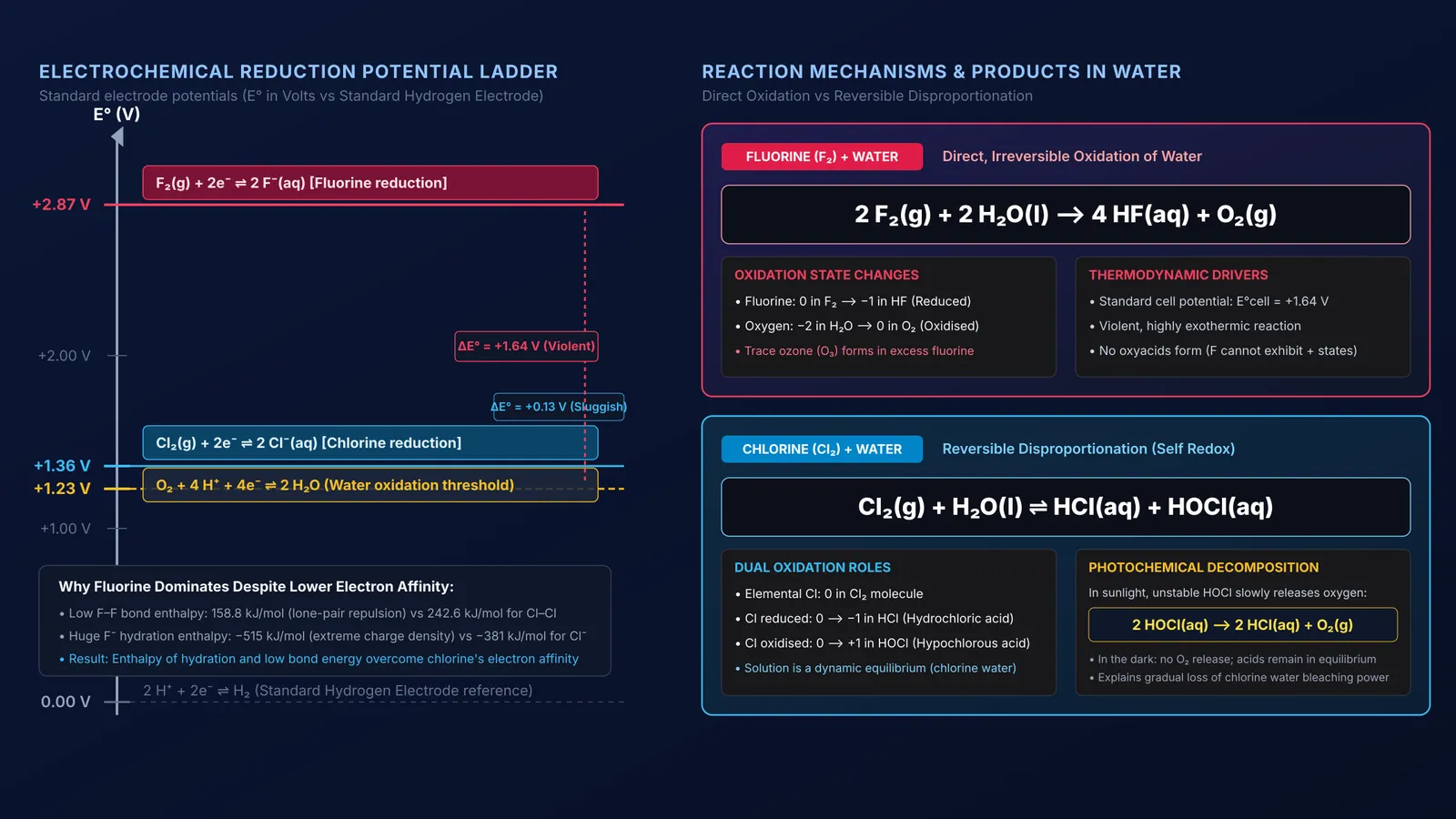
Fluorine (F₂) is the most electronegative element in the periodic table, making it an exceptionally powerful oxidising agent. According to electrochemical data documented in Chemistry LibreTexts/Electrochemistry/Redox_Chemistry/Standard_Reduction_Potential), the standard reduction potential (E°) for fluorine gas reducing to fluoride ions is +2.87 V at 298.15 K:
F₂(g) + 2e⁻ → 2F⁻(aq) (E° = +2.87 V)
By contrast, the standard electrode potential to oxidise water to molecular oxygen is only +1.23 V:
O₂(g) + 4H⁺(aq) + 4e⁻ → 2H₂O(l) (E° = +1.23 V)
Because fluorine's reduction potential (+2.87 V) exceeds the oxygen-water threshold (+1.23 V) by +1.64 V, the oxidation of water is strongly spontaneous and exothermic. As verified on PubChem, fluorine strips electrons directly from oxygen:
2F₂(g) + 2H₂O(l) → 4HF(aq) + O₂(g)
Fluorine is reduced from an oxidation state of 0 to −1 in hydrofluoric acid (HF), while oxygen is oxidised from −2 to 0 in molecular oxygen (with trace amounts of ozone, O₃, forming in excess fluorine). Fluorine cannot form stable oxyacids in water because its extreme electronegativity prevents it from adopting positive oxidation states.
How does chlorine react with water through disproportionation?
Chlorine (Cl₂) reacts through an entirely different pathway. As described in OpenStax Chemistry 2e, dissolving chlorine gas in cold water produces a reversible disproportionation reaction, where chlorine acts simultaneously as oxidising and reducing agent.
As detailed on PubChem, the reaction reaches a dynamic equilibrium forming hydrochloric acid and hypochlorous acid:
Cl₂(g) + H₂O(l) ⇌ HCl(aq) + HOCl(aq)
Tracking the oxidation states highlights this dual role:
Elemental chlorine begins at an oxidation state of 0 in Cl₂.
In hydrochloric acid (HCl), chlorine reduces to −1.
In hypochlorous acid (HOCl), chlorine oxidises to +1.
According to electrochemical tables in OpenStax Chemistry 2e, chlorine's standard reduction potential of +1.36 V is only slightly above the water-oxidation potential of +1.23 V. Although direct oxidation of water to oxygen is thermodynamically possible, it is kinetically sluggish at room temperature. However, as noted on PubChem, hypochlorous acid is photochemically unstable. When exposed to sunlight, chlorine water slowly decomposes:
2HOCl(aq) → 2HCl(aq) + O₂(g)
To review similar reaction mechanisms, explore our guide to disproportionation reactions and our article on using the electrochemical series to predict redox outcomes.
Why is fluorine a much stronger oxidising agent than chlorine?
A standard chemistry question asks why fluorine is a stronger oxidising agent than chlorine in aqueous solution, even though chlorine has a more exothermic electron gain enthalpy (−349 kJ/mol for chlorine versus −333 kJ/mol for fluorine).
The solution lies in the thermodynamic Born-Haber cycle for aqueous halogens. As analysed by chemist Alan G. Sharpe in the *Journal of Chemical Education* (Sharpe, 1990), standard reduction potentials depend on three additive enthalpy factors:
Atomisation enthalpy: Breaking the halogen-halogen bond.
Electron gain enthalpy: Gaining an electron in the gas phase.
Hydration enthalpy: Solvating the resulting halide ion in water.
Two key factors explain fluorine's dominance:
Bond dissociation enthalpy: Breaking the F–F bond requires only 158.8 kJ/mol (79.4 kJ per mole of atoms), compared to 242.6 kJ/mol for Cl–Cl. The small size of fluorine atoms forces lone pairs in compact 2p orbitals close together, creating severe inter-electronic repulsion that weakens the bond.
Hydration enthalpy: The tiny fluoride ion (F⁻) has an exceptionally high charge density, releasing an immense −515 kJ/mol during hydration, compared to only −381 kJ/mol for chloride (Cl⁻).
These two thermodynamic advantages more than compensate for fluorine's lower electron affinity, giving it an unmatched reduction potential (+2.87 V). To see how halogen reactivity influences bonding shapes, see our explainer on interhalogen compounds and halogen reactivity.
For students working through multi-step thermodynamic calculations, the Fermi Problem Library provides worked problems with a step-by-step solver that explains the reasoning rather than printing an answer.
How can you track oxidation states and predict halogen redox outcomes?
When analysing halogen redox reactions in water, apply this systematic decision framework:
Check the reduction potential against water (+1.23 V): As documented in Chemistry LibreTexts/Electrochemistry/Redox_Chemistry/Standard_Reduction_Potential), fluorine (+2.87 V) oxidises water immediately to oxygen. Chlorine (+1.36 V) and bromine (+1.09 V) disproportionate under neutral conditions, whereas iodine (+0.54 V) is non-spontaneous with water.
Assign oxidation numbers: Fluorine drops from 0 to −1 while oxygen rises from −2 to 0. Chlorine splits from 0 into −1 in HCl and +1 in HOCl.
Account for sunlight: Hypochlorous acid decomposes photolytically into hydrochloric acid and oxygen gas over time.
To explore how electrode potentials and chemical principles integrate across the syllabus, the Fermi Concept Library covers every concept in physics, chemistry, biology, mathematics and computing, each with its own lesson and its place in the map.


