

On this page
Basicity in organic chemistry depends on how easily a molecule can donate its lone pair of electrons to a proton (H⁺). When comparing nitrogen-containing aromatic rings, the availability of that lone pair makes all the difference.
Why is pyridine more basic than pyrrole?
Hückel's rule states that for a planar, cyclic molecule to be aromatic, it must contain 4n + 2 delocalised π electrons (where n is an integer like zero, one, or two). For both pyridine and pyrrole, n equals one, meaning they need exactly six π electrons to achieve the deep energetic stability of an aromatic ring.
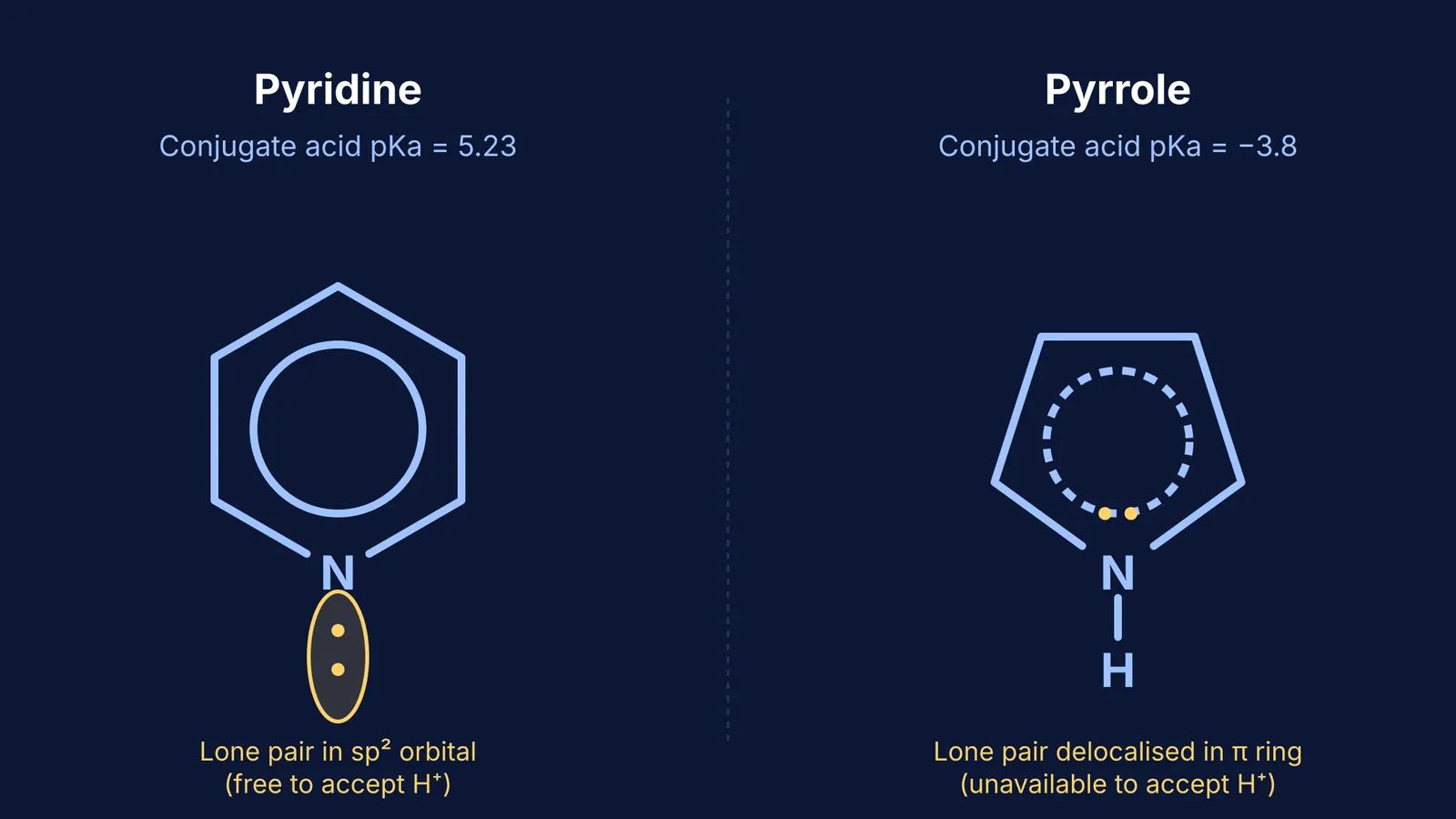
In pyridine (C₅H₅N), the six-membered ring consists of five carbon atoms and one nitrogen atom. Each of these six atoms contributes one electron from an unhybridized p-orbital to the π cloud. This perfectly sums to six electrons, satisfying Hückel's rule without needing the nitrogen's lone pair. The lone pair is therefore left sitting in an sp² orbital that points outward, in the plane of the ring.
Because this lone pair is not part of the aromatic system, it is completely free to bond with a proton. Protonating pyridine yields the pyridinium ion, which remains fully aromatic because the six π electrons were left completely undisturbed. As a result, pyridine acts as a weak base, with its conjugate acid having a pKa of 5.23 (Source).
Pyrrole (C₄H₅N), on the other hand, is a five-membered ring. Its four carbon atoms each contribute one electron to the π system. To reach the required six electrons for aromaticity, the nitrogen atom must contribute its two lone pair electrons into the ring's π cloud.
Because the lone pair is delocalised and tied up in the aromatic system, it is effectively unavailable to accept a proton. If pyrrole accepts a proton at the nitrogen atom, the lone pair is used to form the new N-H bond and can no longer participate in the π system. The ring is left with only four π electrons, completely destroying the molecule's aromaticity. Consequently, pyrrole is an extremely weak base; its conjugate acid (the pyrrolium ion) has a pKa of −3.8 (Source).
What happens to the aromaticity when pyrrole is protonated?
In strong acidic conditions where pyrrole is forced to protonate, it actually prefers to accept the proton at a carbon atom (usually the C2 position adjacent to the nitrogen) rather than the nitrogen itself.
While protonating the carbon still breaks the aromaticity of the continuous ring, the resulting cation is slightly more stable. The positive charge can be shared across the molecule through resonance, with the nitrogen's lone pair shifting to stabilise the positive charge. Even with this resonance stabilisation, it remains a highly unfavourable reaction compared to protonating pyridine.
If you struggle to spot which lone pairs are free and which are delocalised, the Fermi Problem Library has worked problems with a step-by-step solver that explains the reasoning rather than printing an answer. The AI tutor can help you draw the resonance structures to see exactly where the electrons go.
Why is pyridine less basic than aliphatic amines?
Students often wonder why pyridine (conjugate acid pKa 5.23) is a weaker base than an aliphatic amine like piperidine, which has a conjugate acid pKa of 11.22 (Source).
The answer lies in hybridization (which also explains differences in bond angles in other molecules). When you look at piperidine, the nitrogen atom is bonded to two carbons and one hydrogen, and holds one lone pair. This makes the nitrogen sp³ hybridized. In an sp³ orbital, the geometry is constructed from one s-orbital and three p-orbitals, meaning it has one-quarter s-character.
The nitrogen in pyridine, however, is sp² hybridized, which means its lone pair orbital is formed from one s-orbital and only two p-orbitals, giving it one-third s-character.
Why does s-character matter for basicity? Orbitals with more s-character are physically rounder and hold their electrons closer to the positively charged nucleus than the more elongated p-orbitals. Because the electrons in an sp² orbital are pulled tighter to the nitrogen nucleus, they are less available to reach out and attract a passing proton. This renders sp² nitrogens noticeably less basic than their sp³ counterparts.
A checklist for evaluating nitrogen basicity
When comparing the basicity of different nitrogen-containing compounds in an exam, you can find the right answer by checking these three rules in order:
Is the lone pair part of an aromatic ring? If yes (like in pyrrole), it is an extremely weak base. Protonation would destroy the molecule's aromatic stability.
What is the hybridization of the nitrogen? If the lone pair is free, an sp³ hybridized nitrogen (like in piperidine) will be more basic than an sp² hybridized nitrogen (like in pyridine). More s-character holds the electrons tighter to the nucleus.
Are there electron-withdrawing groups nearby? If the hybridization is the same, look for nearby atoms like oxygen or halogens that pull electron density away, making the lone pair less available to a proton.


