

On this page
All 12 questions are original and follow NCERT Class 11 Biology Chapter 18. For notes, see our Neural control and coordination Class 11 guide.
Where does neural control sit in the NEET syllabus?
The NMC syllabus for NEET (UG) 2026 lists it under Biology Unit 5, Human Physiology. The NEET (UG) 2026 Information Bulletin has 90 Biology questions of 180 in 180 minutes, marked +4 if correct and −1 if wrong.
How do you attack Statement I and Statement II questions?
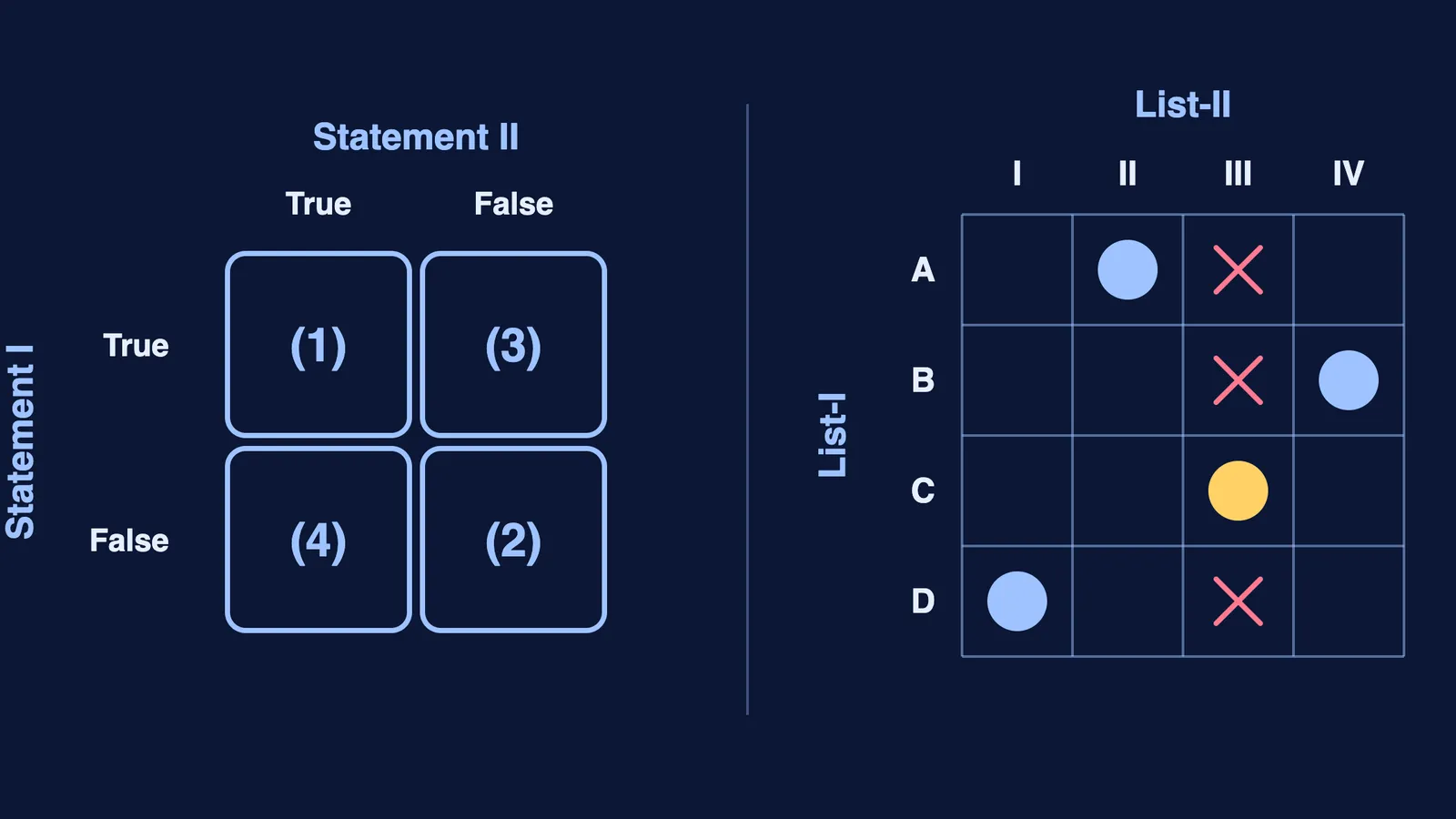
Judge each statement alone. Key for Q1 to Q4: (1) Both correct. (2) Both incorrect. (3) I correct, II incorrect. (4) I incorrect, II correct.
Q1. Statement I: Dendrites carry impulses away from the cell body. Statement II: Unipolar neurons typically occur in the adult cerebral cortex.
Answer: (2). Dendrites carry impulses towards the cell body; unipolar neurons are usually embryonic.
Q2. Statement I: Spinal and cranial nerves contain myelinated fibres. Statement II: The far end of an axon is unbranched and ends in one synaptic knob.
Answer: (3). The distal end branches, each ending in a knob.
Q3. Statement I: A resting axonal membrane lets Na+ through more easily than K+. Statement II: Negatively charged axoplasmic proteins cannot cross the resting membrane.
Answer: (4). At rest the membrane favours K+ over Na+.
Q4. Statement I: After an impulse, K+ diffusing out restores the resting potential at that site. Statement II: Electrical synapses are rare in the human body.
Answer: (1). Both match section 18.3.
How do you attack "which statements are correct" questions?
Mark each statement T or F, then strike out options containing an F.
Q5. Which statements about a chemical synapse are correct?
A. Synaptic vesicles release neurotransmitters into the cleft.
B. Neurotransmitters bind to receptors on the pre-synaptic membrane.
C. Receptor binding opens ion channels.
D. The new post-synaptic potential is always excitatory.
(1) A and C only (2) A, B and C only (3) A, C and D only (4) B and D only
Answer: (1). Receptors are post-synaptic; the potential may be excitatory or inhibitory.
Q6. Which statements about the forebrain are correct?
A. The corpus callosum joins the cerebral hemispheres.
B. The thalamus lies at the base of the hypothalamus.
C. Association areas are neither clearly sensory nor motor.
D. The hypothalamus contains neurosecretory cells.
(1) A and B only (2) B, C and D only (3) A, B, C and D (4) A, C and D only
Answer: (4). B is reversed: the hypothalamus lies at the thalamus's base.
Q7. How many statements are correct?
A. The PNS comprises all nerves associated with the CNS.
B. Efferent fibres carry impulses from the CNS to organs.
C. The visceral nervous system carries impulses only from CNS to viscera.
D. The ANS has sympathetic and parasympathetic parts.
(1) One (2) Two (3) Three (4) Four
Answer: (3). C fails: traffic runs both ways.
How do you solve match-the-list questions faster?
Fix your surest pair, strike out options without it, then test the pair that splits the rest. The diagram above works Q10 this way.
Q8. Match the brain regions.
List-I: A. Pons, B. Hypothalamus, C. Midbrain, D. Thalamus
List-II: I. Coordinates sensory and motor signals, II. Cerebral aqueduct passes through, III. Fibre tracts linking brain regions, IV. Temperature, eating and drinking centres
(1) A-III, B-IV, C-II, D-I (2) A-I, B-IV, C-II, D-III (3) A-III, B-I, C-II, D-IV (4) A-II, B-IV, C-III, D-I
Answer: (1). The aqueduct marks the midbrain.
Q9. Match the neuron parts.
List-I: A. Synaptic knob, B. Dendrite, C. Schwann cell, D. Node of Ranvier
List-II: I. Carries impulses to the cell body, II. Gap between adjacent myelin sheaths, III. Axon ending holding synaptic vesicles, IV. Forms the myelin sheath
(1) A-II, B-I, C-IV, D-III (2) A-III, B-IV, C-I, D-II (3) A-III, B-I, C-IV, D-II (4) A-I, B-III, C-IV, D-II
Answer: (3). A-III plus B-I leaves one option.
Q10. Match each term with its role.
List-I: A. Resting potential, B. Action potential, C. Sodium-potassium pump, D. K+ diffusing out after a stimulus
List-II: I. Restores resting potential at the excited site, II. Potential difference across the resting membrane, III. 3 Na+ out for 2 K+ in, IV. Potential difference at a depolarised site
(1) A-IV, B-II, C-III, D-I (2) A-II, B-III, C-IV, D-I (3) A-II, B-IV, C-I, D-III (4) A-II, B-IV, C-III, D-I
Answer: (4). The pump keeps the gradients; K+ outflow resets the site.
Q11. Match the structures.
List-I: A. Dura mater, B. Arachnoid, C. Pia mater, D. Limbic system
List-II: I. Inner layer touching brain tissue, II. Outer layer, III. Very thin middle layer, IV. Includes amygdala and hippocampus
(1) A-I, B-III, C-II, D-IV (2) A-II, B-III, C-I, D-IV (3) A-II, B-I, C-III, D-IV (4) A-III, B-II, C-I, D-IV
Answer: (2). D-IV is in every option; the meninges decide.
What does a single-correct question look like?
Rule out options that describe other animals.
Q12. In Hydra, the neural system is:
(1) Brain with ganglia (2) A network of neurons (3) Brain and spinal cord (4) Absent
Answer: (2). Brain plus ganglia describes insects.
What should you do with the questions you missed?
Scored 11 or 12? Move on. Otherwise find each missed line in NCERT and retry in two days. For another format, try our assertion-reason set on neural control. This is a study summary, not medical advice.
Not sure what to revise first? Fermi's AI tutor works out what you already know and builds a plan for the session.


