On this page
These 10 original questions cover Neural control and coordination, Chapter 18 of NCERT Class 11 Biology (Reprint 2026-27). The topic sits in Unit 5, Human Physiology, of the NMC syllabus for NEET (UG) 2026, which includes the generation and conduction of nerve impulse.
How do you answer assertion-reason questions?
Judge each statement on its own, then ask whether R causes A. These keys apply throughout.
For assertion-reason items:
(A) Both A and R are true and R is the correct explanation of A.
(B) Both A and R are true but R is NOT the correct explanation of A.
(C) A is true but R is false.
(D) A is false but R is true.
For Statement I and Statement II items:
(A) Both statements are correct.
(B) Both statements are incorrect.
(C) Statement I is correct, Statement II is incorrect.
(D) Statement I is incorrect, Statement II is correct.
Assertion-reason questions on neural control and coordination
Facts are from sections 18.3 and 18.4 of NCERT Chapter 18.
Q1 (easy). Assertion (A): A neuron is an excitable cell: its membrane can generate and conduct an electrical impulse. Reason (R): At rest, the outer surface of the axonal membrane is positively charged and the inner surface negatively charged.
Answer: (A). Both are true. R describes the polarised membrane, and NCERT gives the polarised state as the reason neurons are excitable.
Trap: picking (B) because R talks about charges at rest, not about stimuli.
Q2 (easy). Assertion (A): Bipolar neurons are found in the retina of the eye. Reason (R): A bipolar neuron has one axon and two or more dendrites.
Answer: (C). A is true. R is false: that describes a multipolar neuron (cerebral cortex); a bipolar neuron has one axon and one dendrite.
Trap: mixing up the dendrite counts of bipolar and multipolar neurons.
Q3 (medium). Assertion (A): The inner part of each cerebral hemisphere is called white matter. Reason (R): The cerebral cortex looks grey because neuron cell bodies are concentrated there.
Answer: (B). Both are true, but R explains the grey cortex. The inner part looks white because its tract fibres are covered with myelin sheath.
Trap: accepting any true sentence about the cerebrum as the reason.
Q4 (medium). Assertion (A): In a resting neuron, the axoplasm has a higher concentration of Na+ than the fluid outside the axon. Reason (R): The sodium-potassium pump transports 3 Na+ outwards for every 2 K+ into the cell.
Answer: (D). A is false: at rest the axoplasm has low Na+ and high K+, while the outside fluid has high Na+. R is true, and it is exactly why Na+ stays low inside.
Trap: remembering "sodium" and "inside" together without the direction.
Q5 (medium). Assertion (A): At the site of an action potential, the outer surface of the axonal membrane becomes negatively charged. Reason (R): A stimulus makes the membrane at that site freely permeable to Na+, causing a rapid influx of Na+.
Answer: (A). Both are true. The rapid influx of Na+ is what reverses the polarity, making the outside negative and the inside positive.
Trap: thinking the outside stays positive during an impulse because it is positive at rest.
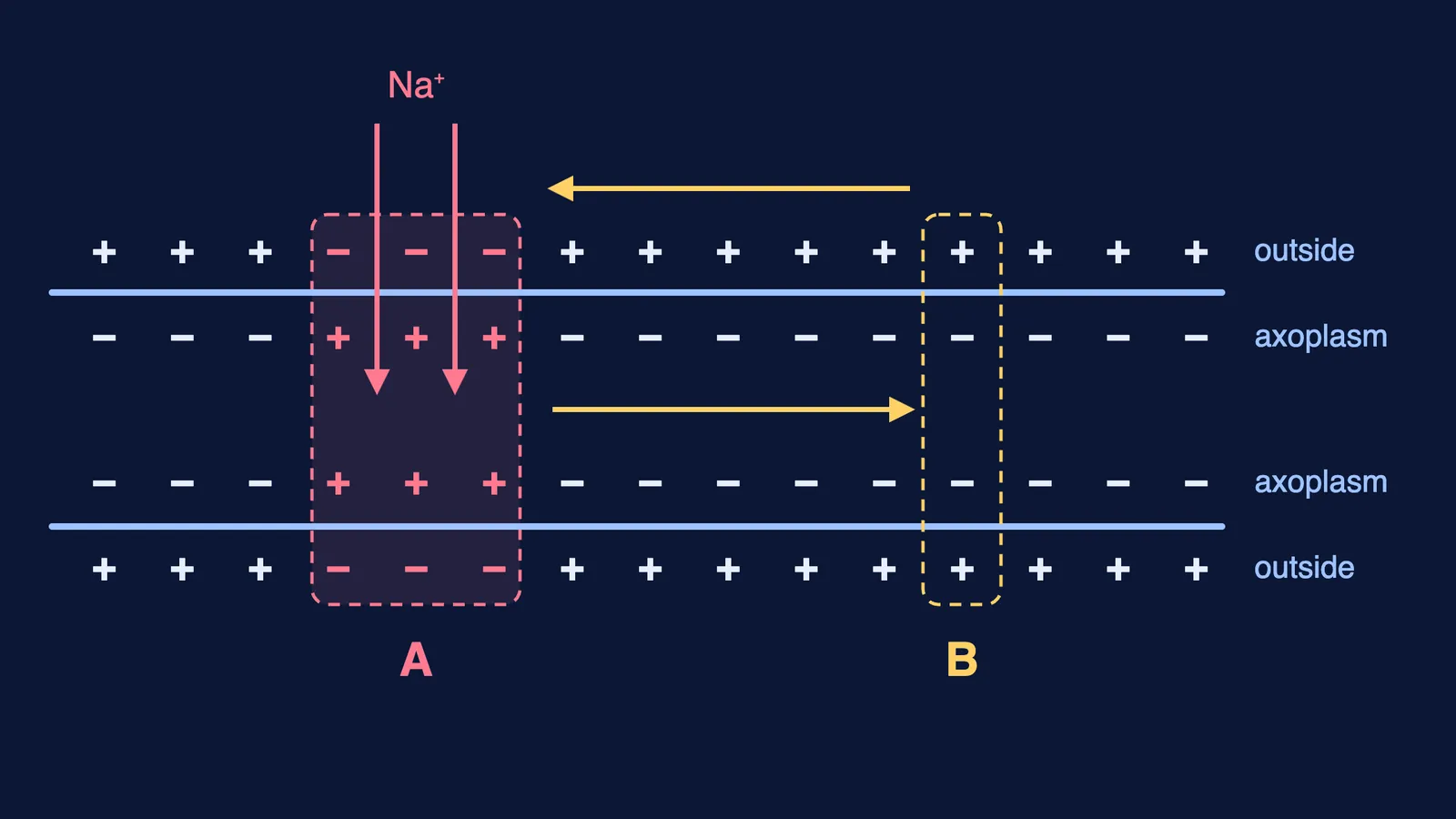
Q6 (hard). Assertion (A): While site A of an axon carries an action potential, the outer surface of the membrane at site B, just ahead of it, is still positively charged. Reason (R): On the outer surface of the membrane, the local current flows from site A to site B.
Answer: (C). A is true: site B is still at resting polarity, positive outside and negative inside. R is false: the current flows from A to B on the inner surface, and from B to A on the outer surface to complete the circuit.
Trap: assuming the current runs the same way on both surfaces.
Statement I and Statement II questions on the neural system
These four also come from sections 18.2 and 18.4 of the NCERT chapter.
Q7 (easy). Statement I: The central neural system includes the brain, the spinal cord and the cranial nerves. Statement II: Afferent nerve fibres carry impulses from tissues and organs to the CNS.
Answer: (D). Statement I is incorrect: the CNS is only the brain and spinal cord, and all nerves associated with them belong to the PNS. Statement II is correct.
Trap: counting cranial nerves as CNS because they start in the brain.
Q8 (medium). Statement I: The somatic neural system relays impulses from the CNS to smooth muscles and involuntary organs. Statement II: Unmyelinated nerve fibres occur only in the autonomic neural system.
Answer: (B). Statement I is incorrect: the somatic system serves skeletal muscles, and the autonomic system serves involuntary organs and smooth muscles. Statement II is incorrect: NCERT says unmyelinated fibres are common in both the autonomic and somatic systems.
Trap: the word "only" in Statement II.
Q9 (medium). Statement I: Respiration, cardiovascular reflexes and gastric secretions are controlled by centres located in the medulla. Statement II: The midbrain, pons and medulla oblongata make up the brain stem.
Answer: (A). Both statements match NCERT.
Trap: adding the cerebellum to the brain stem.
Q10 (hard). Statement I: The heavily folded surface of the cerebellum makes room for many more neurons. Statement II: The corpora quadrigemina are four round swellings on the ventral side of the hindbrain.
Answer: (C). Statement I is correct. Statement II is incorrect twice over: the corpora quadrigemina form the dorsal portion of the midbrain.
Trap: checking "four round swellings" and stopping there.
How should you use this set?
Cover the answers and write a key for all ten in one sitting.
For each miss, note which statement was false, or why R was not the cause.
Retry only the misses after two days, without looking at your notes.
If a miss came from a concept gap rather than a misread word, the Fermi Concept Library has every concept in physics, chemistry, biology, mathematics and computing.
For the whole unit, read our human physiology for NEET guide to chapters, traps and a study plan. For a recap, see neural control and coordination Class 11: neuron, impulse and brain, and for the method, our assertion-reason strategy post.