

On this page
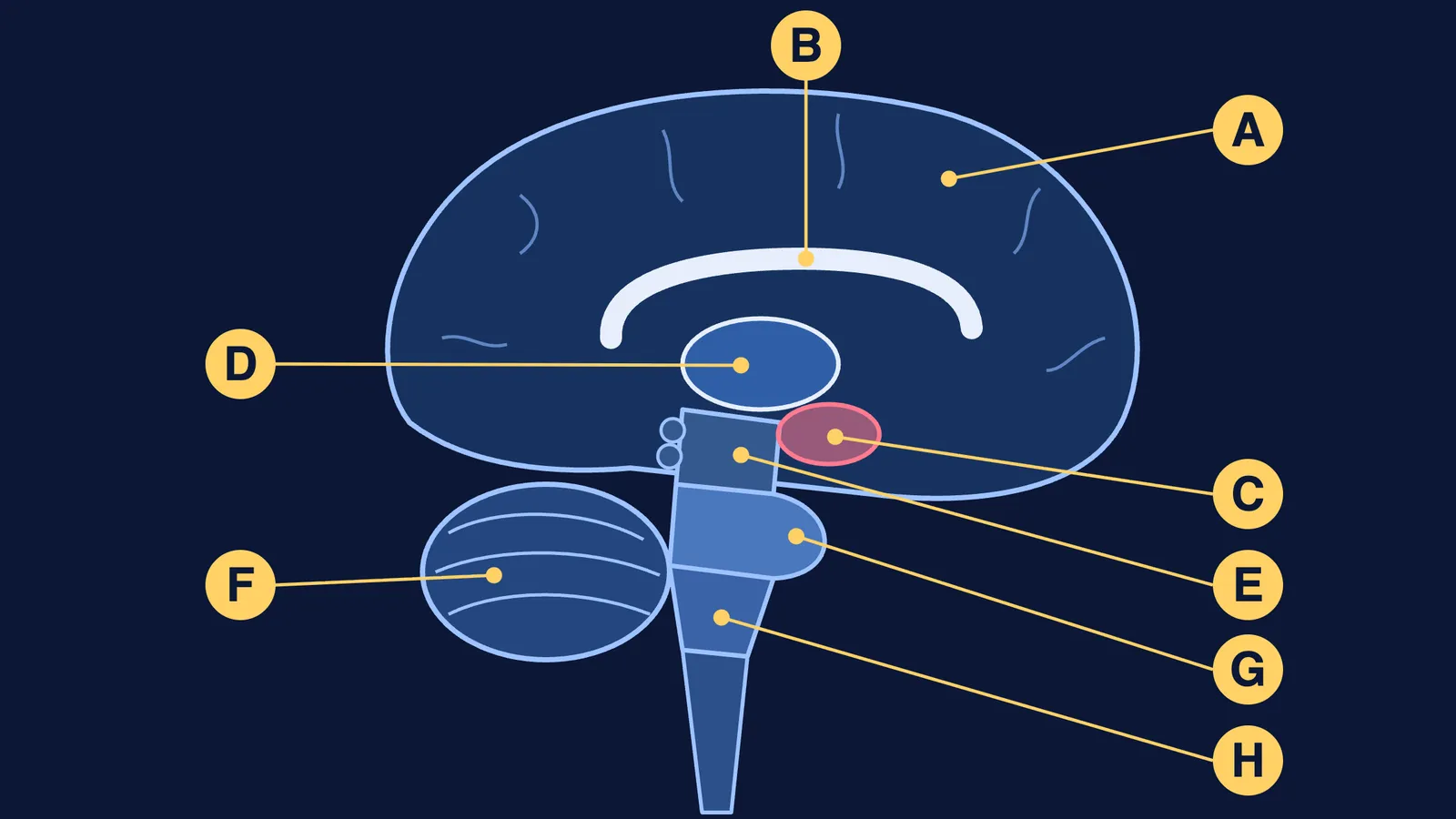
These 13 original questions test the figures of Chapter 18, Neural Control and Coordination, in NCERT Class 11 Biology (Reprint 2026-27). Q1 to Q6 use the lettered brain schematic; Q7 to Q13 describe the other figures in words. Chapter notes are in our Class 11 guide to neural control and coordination.
Which figures does the neural control chapter have?
The current chapter has four figures: a neuron (18.1), impulse conduction along an axon at points A and B (18.2), an axon terminal and synapse (18.3) and a sagittal section of the brain (18.4). It has no section on the eye or ear.
The NMC syllabus for NEET (UG) 2026 places neural control and coordination in Biology Unit 5, Human Physiology. Per the NEET (UG) 2026 Information Bulletin, Biology has 90 of the 180 questions, four options each; a correct answer earns +4 and a wrong one −1.
How do you read a NEET diagram question?
Name the figure before the part: brain section, neuron or synapse.
Anchor on your surest letter, then place its neighbours.
Write a name beside every letter before reading the options.
Questions on the lettered brain schematic
How to attack: judge each statement on its own. Key for two-statement items: (1) both correct, (2) both incorrect, (3) Statement I correct, Statement II incorrect, (4) Statement I incorrect, Statement II correct. For match-the-list, fix your surest pair and cross out options without it.
Q1. Which lettered part holds the centres for body temperature and for eating and drinking urges?
(1) D (2) C (3) H (4) G
Q2. Statement I: The outer layer of A looks grey because neuron cell bodies are packed there. Statement II: B is a tract of nerve fibres that joins the left and right halves of A.
Q3. Match List-I with List-II.
List-I: P. A, Q. D, R. G, S. H
List-II: I. Fibre tracts linking different regions of the brain; II. Joined to the spinal cord, with centres for respiration and gastric secretions; III. Main hub coordinating sensory and motor signals; IV. Holds motor, sensory and association areas
(1) P-IV, Q-III, R-I, S-II (2) P-III, Q-IV, R-I, S-II (3) P-IV, Q-III, R-II, S-I (4) P-I, Q-III, R-IV, S-II
Q4. The cerebral aqueduct runs through which lettered part?
(1) D (2) G (3) E (4) B
Q5. Which option lists only parts of the hindbrain?
(1) E, G, H (2) F, G, H (3) C, D, E (4) D, F, H
Q6. Statement I: E, G and H together make up the brain stem. Statement II: F is part of the brain stem because it lies in the hindbrain.
Answer key for the lettered diagram
A cerebrum, B corpus callosum, C hypothalamus, D thalamus, E midbrain (its back bumps stand for the corpora quadrigemina), F cerebellum, G pons, H medulla oblongata.
Q1: (2). These centres are in the hypothalamus.
Q2: (1). Both follow section 18.4.1.
Q3: (1). Cerebrum, thalamus, pons, medulla, in that order.
Q4: (3). The aqueduct passes through the midbrain.
Q5: (2). The hindbrain is the pons, cerebellum and medulla.
Q6: (3). The brain stem is midbrain, pons and medulla, not cerebellum.
Can you answer figure questions without the figure?
How to attack: sketch the described figure, then test each option against it. The Statement I/II key is as above. For ordering items, fix the first and last steps first.
Q7. A neuron figure shows granular bodies in the cell body and in short, much-branched fibres. Name the bodies and fibres.
(1) Nissl's granules; dendrites (2) Synaptic vesicles; axon branches (3) Nissl's granules; axon (4) Schwann cells; dendrites
Answer: (1). NCERT places Nissl's granules in the cell body and dendrites.
Q8. Statement I: A fibre drawn with a Schwann cell but no myelin sheath is common in the autonomous and somatic neural systems. Statement II: Fibres drawn with myelin sheaths and nodes of Ranvier occur in spinal and cranial nerves.
Answer: (1). Section 18.3 states both.
Q9. In an axon figure, the membrane at site A has just become freely permeable to one ion. Which ion rushes in, and what charge does the inner surface at A now carry?
(1) Na+, positive (2) K+, positive (3) Na+, negative (4) K+, negative
Answer: (1). Na+ influx reverses polarity; the inside turns positive.
Q10. Statement I: At resting site B of the same figure, the axoplasm has a high K+ and a low Na+ concentration. Statement II: The rise in Na+ permeability at site A lasts a long time.
Answer: (3). NCERT calls that rise extremely short-lived.
Q11. For a figure of a chemical synapse, match List-I with List-II.
List-I: P. Synaptic vesicle, Q. Synaptic cleft, R. Receptor, S. New post-synaptic potential
List-II: I. Fluid-filled space between the two membranes; II. Holds neurotransmitter inside the axon terminal; III. Binding site for neurotransmitter on the post-synaptic membrane; IV. May be excitatory or inhibitory
(1) P-II, Q-I, R-III, S-IV (2) P-I, Q-II, R-III, S-IV (3) P-II, Q-III, R-I, S-IV (4) P-II, Q-I, R-IV, S-III
Answer: (1). Vesicles store, the cleft separates, receptors bind.
Q12. Order these events at a chemical synapse. P: vesicles fuse with the plasma membrane. Q: an action potential reaches the axon terminal. R: neurotransmitter binds its receptors. S: neurotransmitter enters the synaptic cleft. T: ion channels open and ions flow in.
(1) Q, P, S, R, T (2) Q, S, P, R, T (3) P, Q, S, T, R (4) Q, P, R, S, T
Answer: (1). Arrival, fusion, release, binding, channels open (section 18.3.2).
Q13. Statement I: In a figure of an electrical synapse, the pre- and post-synaptic membranes sit very close together. Statement II: An impulse crosses an electrical synapse more slowly than a chemical one.
Answer: (3). NCERT says electrical synapses are always faster.
What should you do after checking your answers?
For each miss, cover that NCERT figure's labels and redraw it from memory. Then try our statement and match-the-list set on neural control or the assertion-reason questions on neural control.
Not sure which figure to revise first? Fermi's AI tutor works out what you already know and builds a plan for the session.


