

On this page
Dissolve a non-volatile solute in a liquid and its boiling point goes up. The ebullioscopic constant, Kb, tells you by how much per mole of solute per kilogram of solvent. Here is where it comes from, worked for water.
What is the formula for Kb from enthalpy of vaporisation?
NCERT's Class 12 chapter on solutions gives Kb = (R × M₁ × Tb²) / (1000 × ΔvapH), where R is the gas constant, M₁ is the molar mass of the solvent in g/mol, Tb is the boiling point of the pure solvent in kelvin and ΔvapH is the solvent's enthalpy of vaporisation (NCERT Class 12 Chemistry, Unit 1, equation 1.38). The same chapter defines the elevation as ΔTb = Kb × m, where m is molality, and gives Kb the unit K kg mol⁻¹.
Read the formula as three ideas:
Kb belongs to the solvent. M₁, Tb and ΔvapH all describe the solvent. Nothing about the solute appears.
A higher boiling point means a bigger Kb, and it counts twice, because Tb is squared.
A larger ΔvapH means a smaller Kb, because ΔvapH is in the denominator.
The 1000 turns grams of solvent (from M₁ in g/mol) into kilograms, to match molality. If you put M₁ in kg/mol, drop the 1000.
Where does the formula come from?
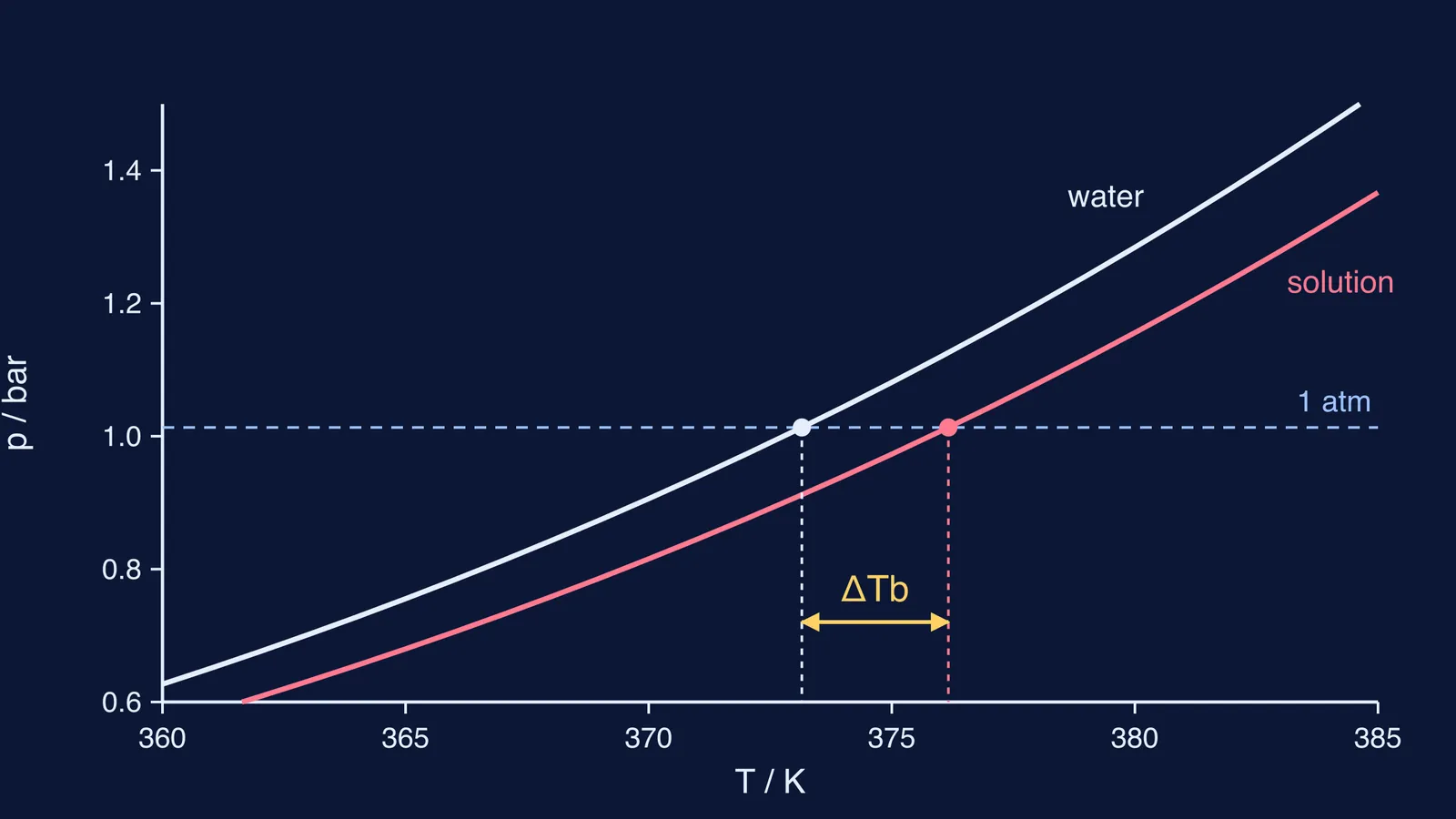
Raoult's law says a non-volatile solute lowers the solvent's vapour pressure in proportion to its mole fraction. The Clausius–Clapeyron equation tells you how much hotter the liquid must get to win that pressure back. Combined for a dilute solution, the rise is ΔTb ≈ (R × Tb² / ΔvapH) × x₂, and for small amounts of solute the mole fraction x₂ is roughly molality × molar mass of the solvent (in kg/mol), which gives the Kb formula (Wikipedia: Boiling-point elevation). The same page notes the main assumptions behind it: the solution is dilute and ideal, and the solute does not evaporate.
The diagram above shows this: the solution's vapour-pressure curve sits below water's, so it reaches 1 atm at a higher temperature.
How do you calculate Kb for water?
You need four numbers. NCERT's Class 11 thermodynamics chapter lists water's boiling point as 373.15 K and its standard enthalpy of vaporisation as 40.79 kJ/mol (Table 5.1, NCERT Class 11 Chemistry, Unit 5). That chapter uses R = 8.314 J K⁻¹ mol⁻¹. Water's molar mass is 18 g/mol.
Convert ΔvapH to joules: 40.79 kJ/mol = 40,790 J/mol.
Square the boiling point: 373.15² = 139,241 K².
Work out the top: 8.314 × 18 × 139,241 ≈ 2.084 × 10⁷.
Work out the bottom: 1000 × 40,790 = 4.079 × 10⁷.
Divide: Kb ≈ 0.511 K kg mol⁻¹.
NCERT's table lists 0.52 K kg mol⁻¹ for water (Table 1.3, NCERT Class 12 Chemistry, Unit 1), and Wikipedia's table gives 0.512. Our 0.511 is within rounding of both; in an exam, use the value given.
What is the matching formula for Kf?
Swap boiling for freezing. NCERT gives Kf = (R × M₁ × Tf²) / (1000 × ΔfusH), where Tf is the freezing point of the pure solvent and ΔfusH is its enthalpy of fusion (equation 1.37, NCERT Class 12 Chemistry, Unit 1). For water, Table 5.1 of the Class 11 chapter gives Tf = 273.15 K and ΔfusH = 6.01 kJ/mol (NCERT Class 11 Chemistry, Unit 5).
Top: 8.314 × 18 × 273.15² = 8.314 × 18 × 74,611 ≈ 1.117 × 10⁷
Bottom: 1000 × 6010 = 6.01 × 10⁶
Kf ≈ 1.86 K kg mol⁻¹, the same as NCERT's table value
Water's Kf is more than three times its Kb mainly because melting ice takes far less energy than boiling water, and ΔH sits in the denominator; the lower Tf only partly offsets that.
Why doesn't my answer match the table?
Five common slips, for water:
ΔvapH left in kJ/mol. You get about 511 instead of 0.511.
Tb in °C. Using 100 instead of 373.15 gives about 0.037.
Tb not squared. The answer drops to about 0.0014.
M₁ in kg/mol with the 1000 still in. The answer comes out 1000 times too small.
The solute's molar mass instead of the solvent's. Kb never depends on the solute.
Published tables don't always agree either. Benzene's values from NCERT Class 11 Table 5.1 (Tb = 353.25 K, ΔvapH = 30.8 kJ/mol) with M₁ = 78 g/mol give about 2.63 K kg mol⁻¹. NCERT's Class 12 table lists 2.53, and the LibreTexts table of ebullioscopic constants lists 2.64. A gap like that comes from the data, not your method.
If a problem stalls at the units, the Fermi Problem Library has worked problems with a step-by-step solver that explains the reasoning rather than printing an answer. If you want to go over Raoult's law or colligative properties first, each has its own lesson in the Fermi Concept Library.
Try it on carbon tetrachloride: Table 5.1 gives Tb = 349.69 K and ΔvapH = 30.0 kJ/mol, and M₁ ≈ 154 g/mol. You should land near 5.2 K kg mol⁻¹, against 5.03 in NCERT's table.


