

On this page
Before 1923, the reigning model for acids and bases belonged to Svante Arrhenius. The Arrhenius theory was simple and important for its time: acids release hydrogen ions (H⁺) when dissolved in water, and bases release hydroxide ions (OH⁻). But as chemistry advanced, the model revealed a major limitation. It only worked for aqueous solutions. If a chemical reaction happened in a gas phase or inside a different liquid solvent, the Arrhenius definitions fell short.
What is the Brønsted-Lowry acid-base theory?
In 1923, two chemists solved this problem independently of one another. Danish physical chemist Johannes Nicolaus Brønsted published his paper, "Einige Bemerkungen über den Begriff der Säuren und Basen," in the *Recueil des Travaux Chimiques des Pays-Bas*. Mere months apart, the English physical chemist Thomas Martin Lowry published his paper, "The uniqueness of hydrogen," in the *Journal of the Society of Chemical Industry*.
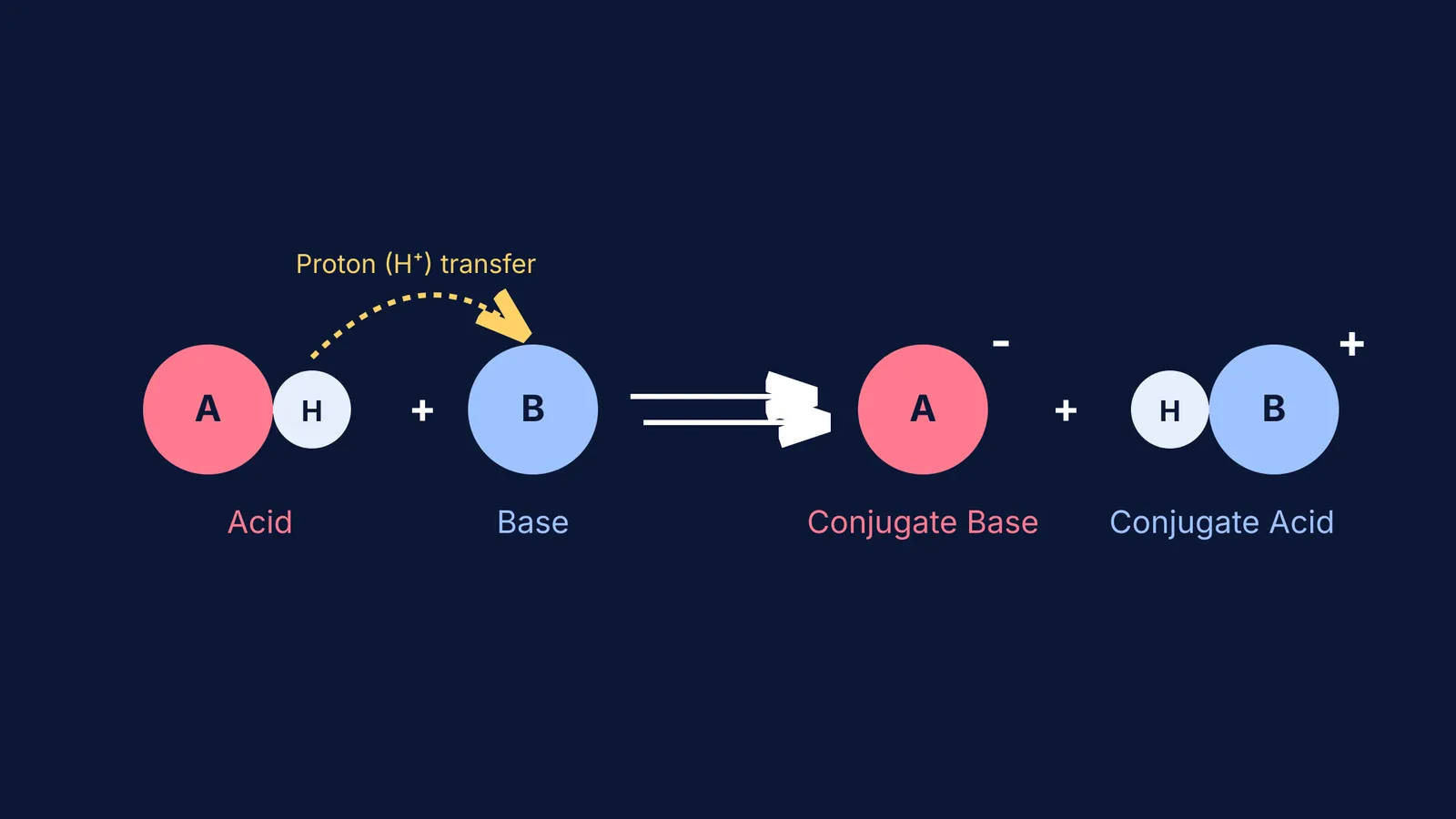
Together, their findings formed what we now call the Brønsted-Lowry acid-base theory. They proposed a broader, more fundamental definition of how these chemicals behave: an acid is a proton donor, and a base is a proton acceptor. Because a hydrogen ion (H⁺) is simply a proton stripped of its electron, any molecule or ion that can transfer a proton acts as an acid, and any chemical species that can accept that proton acts as a base.
This subtle shift in perspective meant a base no longer had to contain a hydroxide group. Ammonia (NH₃), for example, accepts a proton to become the ammonium ion (NH₄⁺). Under the new 1923 definition, ammonia is clearly a Brønsted-Lowry base, even though it has no OH⁻ to give.
How do conjugate acid-base pairs work?
The Brønsted-Lowry theory views acid-base reactions as an ongoing equilibrium of proton transfer. When an acid gives up its proton, the molecule that remains is entirely capable of taking a proton back in the reverse reaction. This leftover species is called a conjugate base. Similarly, when a base accepts a proton, it transforms into a conjugate acid.
Consider what happens when hydrogen chloride (HCl) dissolves in water: HCl + H₂O ⇌ Cl⁻ + H₃O⁺
In this forward reaction, HCl is the acid. It donates a proton to become its conjugate base, the chloride ion (Cl⁻). Water acts as the base, accepting the proton to become its conjugate acid, the hydronium ion (H₃O⁺).
A strong acid always yields a weak conjugate base, while a weak acid yields a strong conjugate base. For any pair in an aqueous solution, their chemical equilibrium constants are inextricably linked. As explored in the mathematical properties of conjugate acid-base pairs, the product of the acid dissociation constant (Ka) and the base dissociation constant (Kb) exactly equals the ion product of water (Kw).
If you find it difficult to spot conjugate pairs or track proton transfers in complex reactions, the Fermi Problem Library has worked problems with a step-by-step solver that explains the reasoning rather than printing an answer.
Why is water an amphiprotic substance?
Because the Brønsted-Lowry model does not strictly rely on a specific liquid solvent, it highlights the unique chemical role of water. Water can act as both an acid and a base depending on what it reacts with, a property known as being amphiprotic.
If you mix water with a strong acid like HCl, water acts as a base and accepts a proton. However, if you mix water with a base like ammonia (NH₃), water flips its role. It acts as an acid, donating a proton to form the hydroxide ion (OH⁻).
Even in completely pure water, molecules constantly transfer protons among themselves (H₂O + H₂O ⇌ H₃O⁺ + OH⁻). This constant background activity is exactly why we must account for water's own H⁺ contribution when calculating the pH of a very dilute acid. It is also the reason why a neutral pH is not always 7; the exact neutral point shifts as the temperature of the water changes the underlying equilibrium.
How do you identify acids and bases?
When tackling exam problems in chemistry, you can consistently identify the roles of each molecule by following a practical, step-by-step framework. Simply compare the reactants (left side) to the products (right side) of the chemical equation:
Spot the change: Look for a species on the reactant side and find its nearly identical structural partner on the product side.
Find the acid: The reactant that has *lost* a hydrogen ion (H⁺) during the reaction is the Brønsted-Lowry acid.
Find the conjugate base: The product that this acid turned into is the conjugate base.
Find the base: The reactant that has *gained* a hydrogen ion is the Brønsted-Lowry base.
Find the conjugate acid: The product that this base turned into is the conjugate acid.
By focusing purely on where the proton moves, the Brønsted-Lowry theory simplifies chemical reactions. It moved chemistry beyond the constraints of water, providing students and scientists with a universal framework for understanding proton exchange.


