

On this page
When you look out over a calm ocean, the surface seems to meet the sky at a sharp, flat line. Because the Earth is a sphere, that line is simply the furthest point on the surface that your line of sight can touch before the planet curves away beneath it. By sketching a simple right-angled triangle, you can predict exactly how far away that point is from any given height.
How far is the horizon from a height formula?
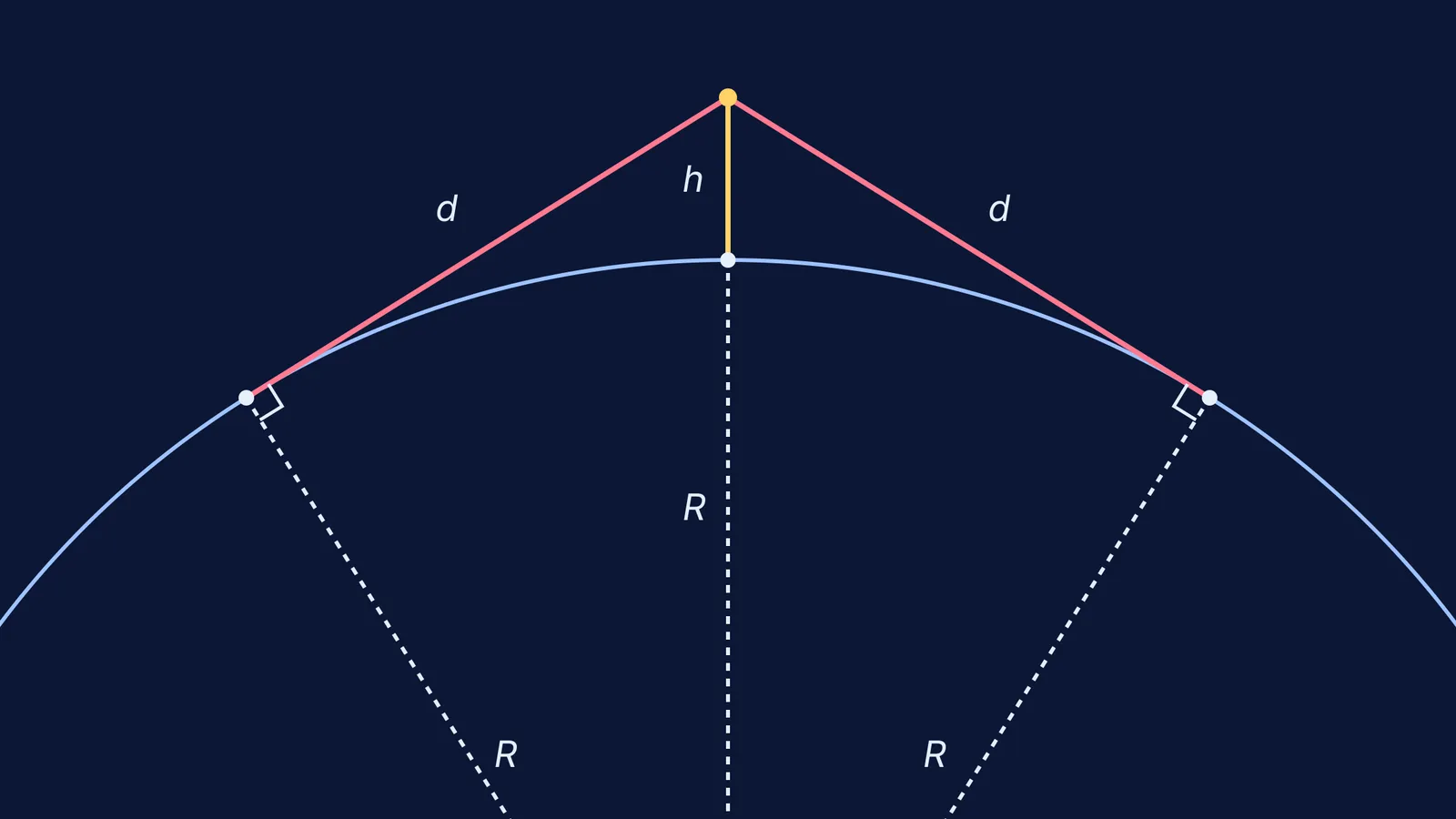
Imagine drawing a line directly from the centre of the Earth up to your eyes. That line has a total length of R + h, where R is the radius of the Earth and h is your height above the ground. Next, draw a second line from your eyes straight to the horizon. Because your line of sight only just grazes the surface of the planet, it forms a tangent to the sphere. In geometry, a tangent always meets the radius of a circle at a perfect right angle.
This gives you a right-angled triangle with three sides: the Earth's radius (R), the distance to the horizon (d), and the hypotenuse from the Earth's centre to your eyes (R + h). According to Pythagoras' theorem, the square of the hypotenuse (R + h)² equals the sum of the squares of the other two sides (R² + d²). Because your height is tiny compared to the sheer size of the Earth, the squared height term drops out, and the formula simplifies neatly. The exact formula for the distance to the true geometric horizon is d ≈ √(2Rh).
To use the formula in practice, you need a precise value for the Earth's radius. According to the NASA Earth Fact Sheet, the volumetric mean radius of the Earth is 6,371 kilometres.
Visualising how tangents and radii behave on a curved planet can be tricky. For ideas that are easier to see than to read, the Fermi Simulation Lab provides interactive simulations where you can change variables to see the geometry shift in real time.
How far is the horizon when standing on the beach?
If you are standing on a beach at sea level, your eyes are roughly 2 metres above the ground. To calculate your horizon, you must ensure all units match, so convert the Earth's radius to 6,371,000 metres. Plugging h = 2 m into the formula gives d = √(2 × 6,371,000 × 2). The result is about 5,048 metres. This means the horizon for a standing adult is only 5.0 kilometres away.
How far is the horizon from a 100-metre cliff?
When you climb to the top of a tall building or a coastal cliff, your line of sight stretches much further over the curve of the Earth. If your observation height is 100 metres, the formula becomes d = √(2 × 6,371,000 × 100). This yields roughly 35,696 metres. By climbing 100 metres up, you push the horizon back to 35.7 kilometres.
For more on how height and gravity affect the paths of objects near cliffs, see our guide on the horizontal projectile from a cliff: time, range and impact speed.
How far is the horizon from an aeroplane?
If you are flying in a commercial aeroplane or standing near the summit of Mount Everest, your height is around 8,000 metres. At this altitude, the formula expands to d = √(2 × 6,371,000 × 8000). The geometric horizon extends to 319,274 metres, or 319.3 kilometres. At this height, the vast distance you can see makes the curvature of the Earth begin to become visible to the naked eye.
How to calculate the horizon distance step by step?
If you want to try testing the root of 2Rh yourself, follow this standard physics sequence:
Convert to metres: Ensure both the Earth's radius and your height are in the same unit. Always use R = 6,371,000 m for standard problems.
Multiply out the core: Multiply 2 × R × h. For a 10-metre hill, this step is 2 × 6,371,000 × 10 = 127,420,000.
Find the square root: Take the square root of that large number to get the total distance in metres. For the 10-metre hill, this is approximately 11,288 m.
Convert to kilometres: Divide your final answer by 1,000 to convert it into a readable kilometre format (11.3 km).
How does atmospheric refraction change the horizon?
The √(2Rh) formula calculates the purely geometric horizon, assuming light travels in perfectly straight lines. However, the Earth's atmosphere is denser near the surface and thinner higher up. This density gradient bends, or refracts, light downwards as it travels through the air. Because the light rays curve slightly along with the shape of the Earth, you can actually see about 8% further than the geometric formula predicts.
Navigators and surveyors account for this atmospheric bending by using an "effective" Earth radius that is roughly one-sixth larger than the real planet. But for testing the core physics of right-angled triangles in a classroom, the geometric formula remains the standard starting point.
If you are curious about tracing lines over the Earth's surface in the real world, you can read how a famous mathematician solved a similar long-distance challenge in our piece on Radhanath Sikdar and the calculation of Everest's height.


