On this page
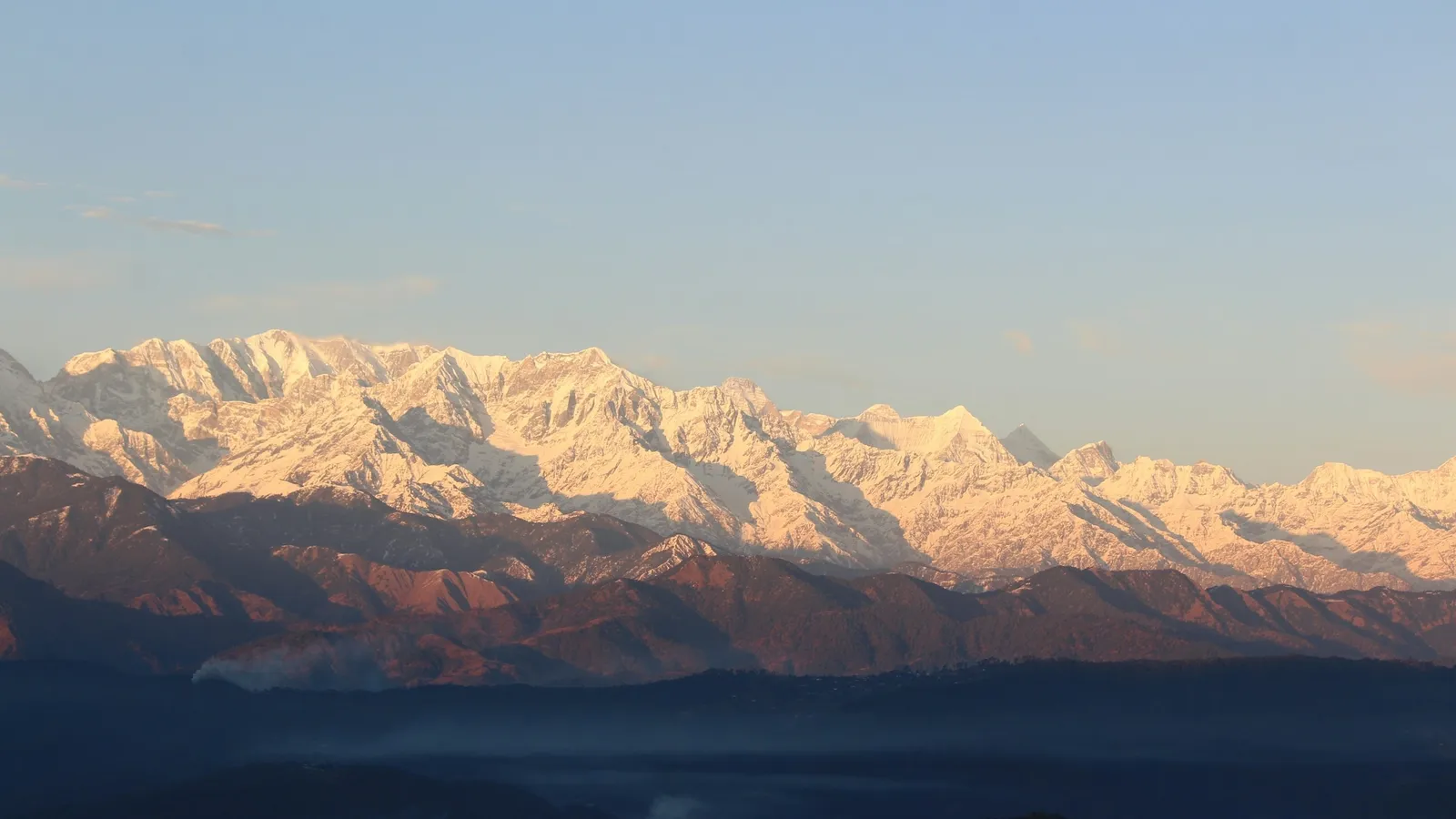
Mount Everest was measured long before anyone climbed it, by surveyors who never went near the summit. One of the people behind that calculation was Radhanath Sikdar, an Indian mathematician in the Survey of India. His story is often told as a single dramatic moment of discovery. The records suggest something slower and more interesting. This post covers what reliable sources say, a worked example on how heights are found with trigonometry, and what students can learn from his work.
Who was Radhanath Sikdar?
A history of the India Meteorological Department by R. R. Kelkar in Mausam (2025) describes Sikdar as "Chief Computor" of the Great Trigonometrical Survey of India. In those days a computer was a person who did calculations. In 1852 he was also given charge of the Calcutta observatory, which stood in the compound of the Surveyor General's office on Park Street. Kelkar writes that he was the first Indian to hold such a position in British India and ran it until he retired in 1862.
At the observatory, Kelkar says, he introduced hourly observations and applied corrections to barometer readings. His observations were published regularly by the Asiatic Society of Bengal, of which he was a member.
What did he do on Peak XV?
The most careful account is a 2016 paper in the Indian Journal of History of Science by Ashish Lahiri, based on internal letters and memos of the Survey of India from 1851 to 1861. Lahiri's summary is:
Sikdar was Chief Computer at the Calcutta office of the Survey from 1849.
He did not take part in the field observations of Peak XV, which were made by others, including Andrew Waugh, Armstrong, Peyton, Hennessey and Nicholson.
From 1849 the field readings were routinely examined by Sikdar in Calcutta and his results sent to Waugh at Dehra Dun.
He was given the task of "bringing order to the hopelessly confused data" from the field, and used the method of least squares to reduce the errors, perhaps showing that the height would come out near 29,000 feet.
Lahiri concludes that Sikdar "was certainly not the 'discoverer' of Mount Everest, nor the only person responsible for the final computations", but that he "was the pivot round whom the computations were conducted". He also notes that George Everest himself had nothing to do with the Peak XV calculation, even though the peak was later named after him, as Kelkar also records.
Not every account agrees. A 2015 paper in the same journal by Shrikant Mishra, drawing mainly on a published biography of George Everest, credits Sikdar as the one who actually discovered Mount Everest.
Why was the height so hard to compute?
Peak XV could only be seen from stations far away on the plains. Over such distances two effects matter a great deal. The Earth curves away, so the mountain's base is far below the line of sight. And air bends light, an effect called refraction, which makes distant objects appear higher than they are. Each observing station gave a slightly different answer, which is exactly the kind of "confused data" that the method of least squares is designed to handle.
Worked example: a height from an angle
The numbers below are sample values for a classroom example, not the Survey's real readings. An observer at a station 70 m above sea level sees a peak 175 km away at an angle of elevation of 2.2°. Use Earth's radius R = 6,371 km.
Flat-Earth height above the observer: d tan θ = 175,000 × tan 2.2° = 175,000 × 0.0384 ≈ 6,723 m.
Curvature correction: the ground drops below a level line by about d²/(2R) = (1.75 × 10⁵)² / (2 × 6.371 × 10⁶) = 3.06 × 10¹⁰ / 1.274 × 10⁷ ≈ 2,404 m.
Refraction correction: refraction cancels part of that drop. Using a typical textbook coefficient k = 0.13, the combined correction is (1 - k) × 2,404 ≈ 2,091 m.
Height = 70 + 6,723 + 2,091 ≈ 8,884 m, or about 29,150 feet (1 m ≈ 3.281 ft).
Look at the sizes. Ignoring curvature would put the peak about 2 km too low. Getting k wrong by just 0.05 shifts the answer by about 120 m. That is why refraction and averaging over many stations decided the final figure.
Common mistakes: using the observer's height as if it were the height of the base, forgetting to square the distance in the curvature term, and mixing kilometres and metres. The basic idea of angles of elevation is in our post on heights and distances for Class 10.
What can a student take from how Sikdar worked?
Careful computing is real science. Turning messy readings into one reliable number was the hard part.
Know your sources of error. Curvature and refraction were bigger than many of the quantities being measured.
Credit is often shared. The measurement of Everest was a team effort spread over years.
When a trigonometry problem has several corrections and you lose track of which comes first, the Fermi Problem Library has worked problems with a step-by-step solver that explains the reasoning rather than printing an answer.
Next step: redo the worked example with k = 0.08 and see how much the height changes.