On this page
In March 1800, Alessandro Volta wrote from Como describing a stack of metal discs and wet card that gave what Nicholson's account calls "a perpetual current of electricity". Within weeks, two men in London had built one and used it to pull water apart.
Who first split water into hydrogen and oxygen by electrolysis?
William Nicholson and Anthony Carlisle first demonstrated sustained electrolysis of water into hydrogen and oxygen in May 1800, using a voltaic pile (Wikipedia: William Nicholson)).
Others had already got gas from water with electricity. In 1789, Jan Rudolph Deiman and Adriaan Paets van Troostwijk used an electrostatic machine to discharge electricity on gold electrodes in a Leyden jar (Wikipedia: Electrolysis of water). What was new in 1800 was the steady current: Volta's pile kept working for hours, so the gases could be collected and measured.
How did Nicholson and Carlisle do the experiment?
Nicholson's report, printed in July 1800 in volume 4 of his *Journal of Natural Philosophy, Chemistry, and the Arts* (original pages via ESTIR), gives a dated record:
20 March 1800: Volta dates his letter at Como; it later appeared in the Royal Society's *Philosophical Transactions* (Crossref record).
Late April: Sir Joseph Banks, President of the Royal Society, lets Carlisle read the first four pages.
30 April: Carlisle builds a pile of 17 silver half crowns, 17 zinc pieces and pasteboard soaked in salt water.
2 May: They push brass wires through corks into a glass tube of New River water, tips about 1¾ inches apart, and connect a pile of 36 half crowns. Bubbles stream from the wire joined to the silver end; the other wire turns orange, then black. After two and a half hours they have two-thirtieths of a cubic inch of gas.
6 May: Carlisle repeats the test with copper wires and litmus. Near the zinc-side wire it turns red, which Nicholson read as either an acid forming or oxygen combining with the litmus.
Why did the result surprise them?
They expected water to break down, but not for the two products to appear at wires almost two inches apart. In Nicholson's words, "it was with no little surprize that we found the hydrogen extricated at the contact with one wire, while the oxigen fixed itself in combination with the other wire" (Nicholson, 1800). He added that the fact "seems to point at some general law of the agency of electricity in chemical operations".
Did they get the 2:1 ratio of hydrogen to oxygen?
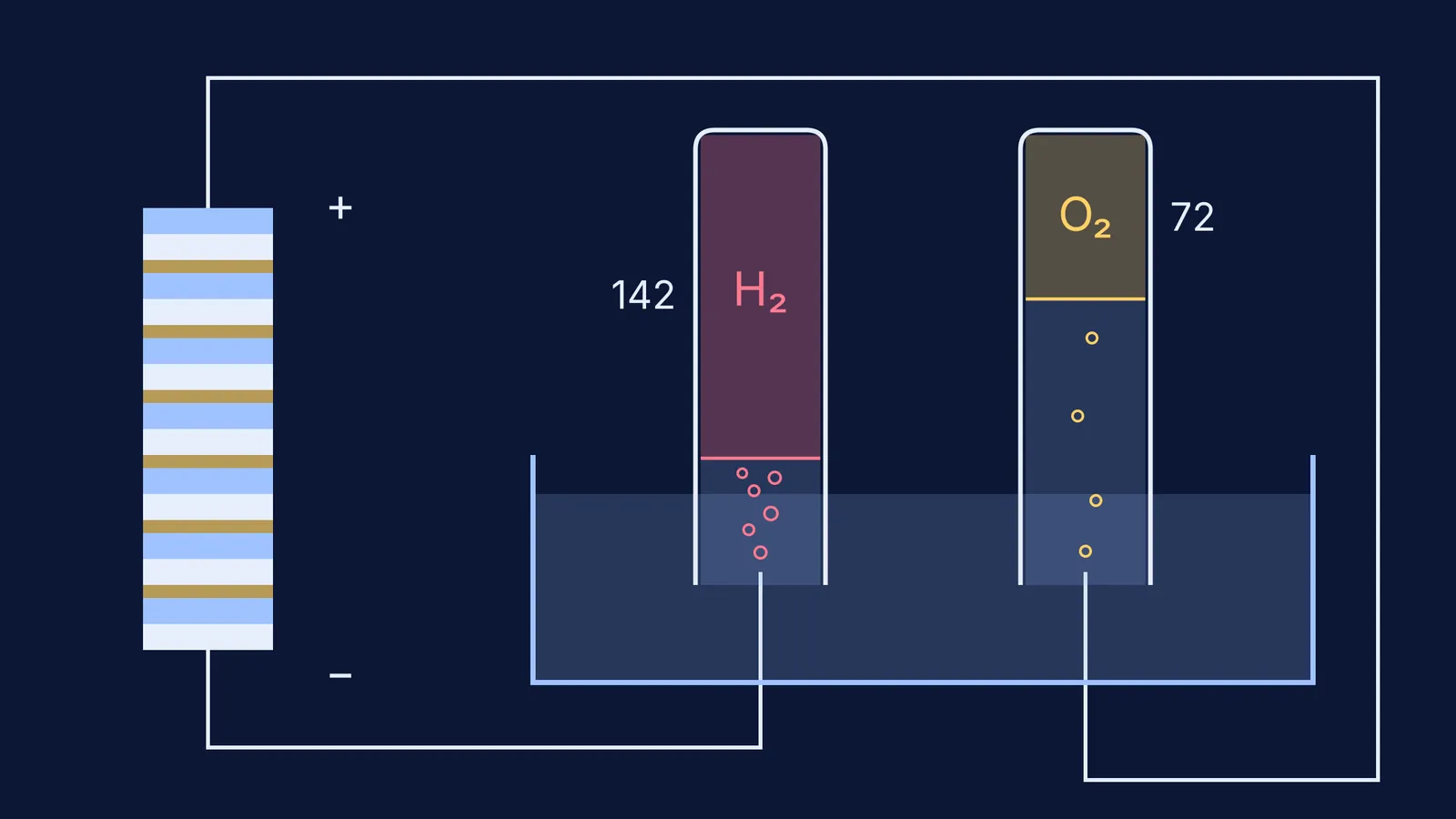
Nearly. Using platinum wires and a combined pile of 68 sets, they ran the current for 13 hours, catching each wire's gas in its own upturned vessel of water. Then they weighed the water each gas displaced: 72 grains on the zinc side, 142 grains on the silver side (Nicholson, 1800).
A worked example:
Displaced water weight tracks gas volume, so the volume ratio is 142 ÷ 72.
142 ÷ 72 = 1.97: the silver side gave about twice as much gas.
Today's answer: splitting water gives twice as much hydrogen as oxygen (Wikipedia: Electrolysis of water), because 2H₂O → 2H₂ + O₂.
Their electrometer showed the silver end was minus, so hydrogen came from the negative electrode (cathode), as your textbook says: 2H⁺ + 2e⁻ → H₂ at the cathode and 2H₂O → O₂ + 4H⁺ + 4e⁻ at the anode.
Nicholson wrote that the volumes were "nearly the proportions in bulk" of the parts of water. He also argued that tiny bubbles had drifted between the vessels, so each one held some of both gases.
How can you use this in your own electrolysis practical?
NCERT Class 10 Science, Chapter 1, Activity 1.7 has you split water with carbon electrodes, a 6 volt battery and a few drops of dilute sulphuric acid, then asks why one test tube collects double the gas (NCERT textbook chapter). Run it the way Nicholson and Carlisle did:
Predict first. Write down which terminal will give more gas, and how much more.
Mark the terminals. Label the battery's minus end first, so you can check that hydrogen comes off at the cathode.
Measure, then divide. Mark the gas levels after a set time and work out the ratio.
Explain the gap. If your ratio falls short of 2, list possible reasons instead of fudging the reading.
To check whether sulphate ions react too, see what forms at the anode when sulphuric acid is electrolysed.
If cathode and anode signs keep swapping in your head, the Fermi Concept Library has a lesson for every concept in chemistry, each with its place in the map. For numericals, the Fermi Problem Library has worked problems with a step-by-step solver that explains the reasoning rather than printing an answer.
What came next?
Humphry Davy used the voltaic pile to decompose chemicals and make new ones (Wikipedia: Voltaic pile), and in 1806 reported extensive experiments electrolysing distilled water (Wikipedia: Electrolysis of water). Michael Faraday later linked charge to the amount of substance split: read about Faraday's first and second laws of electrolysis.