

On this page
You learn that, at the anode, the reaction needing the lowest potential wins. Then the very next example, aqueous sodium chloride, gives chlorine, the one that needs more. Here is why, and how to write it in an exam.
What are the two possible anode reactions in brine?
In aqueous NaCl, the anode has two things it could oxidise: chloride ions and water. The NCERT Class 12 Chemistry chapter on electrochemistry lists both, with their standard potentials:
Cl⁻(aq) → ½Cl₂(g) + e⁻, E° = 1.36 V
2H₂O(l) → O₂(g) + 4H⁺(aq) + 4e⁻, E° = 1.23 V
NCERT states that the reaction with the lower E° is preferred at the anode, so water should be oxidised before chloride. The same chapter then says the opposite happens: chlorine is the product. At the cathode, water is reduced to H₂ and OH⁻, because Na⁺ (E° = −2.71 V) is far harder to reduce. Overall, brine gives NaOH, Cl₂ and H₂.
Why does chlorine form instead of oxygen?
The answer is overpotential. NCERT defines it in the same chapter: some reactions, although feasible, are so slow kinetically that they do not seem to happen at lower voltages, and an extra potential, called overpotential, has to be applied. NCERT then says that, on account of the overpotential of oxygen, chloride oxidation is preferred.
The OpenStax Chemistry: Atoms First section on electrolysis gives a one-line definition you can memorise: the overpotential is the difference between the theoretical cell voltage and the actual voltage needed to cause electrolysis. It adds that the overpotential for oxygen is rather high.
Think of E° as a map showing the shorter road, and overpotential as the traffic on it. Making O₂ means pulling four electrons out of two water molecules, a slow process at the electrode surface. Making Cl₂ needs one electron per chloride ion. The short road is jammed, so the current takes the longer one.
Does the concentration of NaCl matter?
Yes, and this is where exam questions like to catch you. Chemguide's page on the electrolysis of solutions says that reasonably concentrated NaCl gives mainly chlorine, very dilute NaCl gives mainly oxygen, and in-between concentrations give a mixture of both.
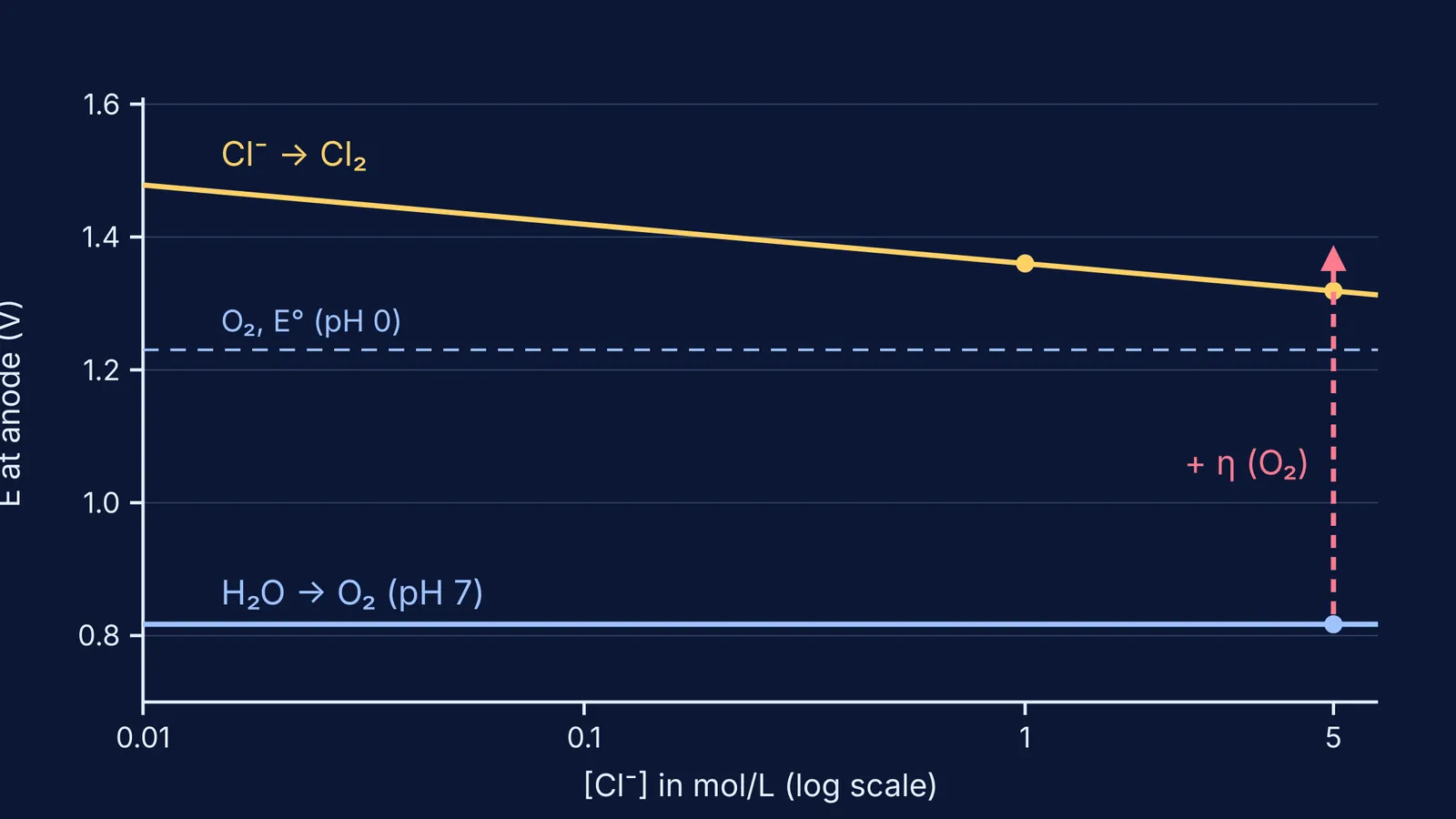
You can see why with the Nernst equation and the E° values from the NCERT chapter. At 25 °C, with each gas at 1 bar:
Chlorine: E = 1.36 − 0.059 log[Cl⁻]. At [Cl⁻] = 5 mol/L, log 5 ≈ 0.70, so E ≈ 1.36 − 0.04 = 1.32 V.
Oxygen: E = 1.23 − 0.059 pH. Taking near-neutral brine at pH 7 gives E ≈ 1.23 − 0.41 = 0.82 V.
So in concentrated brine, oxygen is still favoured on paper, by about 0.5 V. Chlorine is still what forms, so on that anode oxygen's overpotential must exceed chlorine's by more than this gap.
Now dilute the solution to [Cl⁻] = 0.01 mol/L. Chlorine's E rises to 1.36 + 0.12 = 1.48 V. The gap widens by about 0.16 V, which helps explain why oxygen takes over in very dilute solutions.
If the 0.059 looks like magic, our explainer on where the 0.059 in the Nernst equation comes from builds it from RT/F step by step.
Do chlor-alkali plants still make some oxygen?
Yes. A review in Chemical Reviews by Rasmus Karlsson and Ann Cornell (abstract read via Europe PMC) reports that unwanted oxygen production decreases the charge yield of chlor-alkali and chlorate production by up to 5%. The same abstract notes that the dominant anode material is the dimensionally stable anode: titanium coated with a mixed oxide of RuO₂ and TiO₂, on which selectivity for chlorine evolution is high. So the electrode material matters too, not just the ions in solution.
How do you write this answer in a board or JEE exam?
A four-line answer that covers the key points, using the E° values from the NCERT chapter:
Write both anode reactions with E°: Cl⁻ to Cl₂ at 1.36 V, H₂O to O₂ at 1.23 V.
State that, on E° alone, water should be oxidised first.
Say that O₂ evolution has a high overpotential (it is kinetically slow), so Cl⁻ is discharged first in concentrated NaCl.
Add the net reaction: NaCl(aq) + H₂O(l) → Na⁺(aq) + OH⁻(aq) + ½H₂(g) + ½Cl₂(g), and note that very dilute NaCl gives mainly O₂.
Common slips to avoid: saying "chlorine has the lower potential" (it does not), forgetting the cathode gives H₂ and not Na, and quoting the molten-salt result for the aqueous case. Our post on electrode reactions in molten lead bromide shows the simpler case with no water to compete. Once you have Cl₂ and NaOH from the same cell, see what chlorine does with cold and hot NaOH.
If a variant trips you up, such as CuSO₄ with copper electrodes or dilute H₂SO₄, the Fermi Problem Library has worked problems with a step-by-step solver that explains the reasoning rather than printing an answer. If the gap is in the idea itself, overpotential or electrode potential, the Fermi Concept Library gives each concept its own lesson.


