

On this page
To understand how an electric current decomposes a chemical compound, high school chemistry curricula across ICSE and international boards frequently turn to the electrolysis of molten lead(II) bromide (PbBr₂). It offers a striking visual demonstration of electrochemistry: silvery beads of metallic lead forming at one terminal while dense, reddish-brown fumes of bromine gas billow from the other.
Yet before any current can flow, students encounter an essential puzzle: solid lead bromide will not conduct any electric current.
Why does solid lead bromide not conduct electricity?
According to data compiled by PubChem, lead(II) bromide has a molar mass of 367.0 g/mol and a solid density of 6.66 g/cm³. As detailed on Wikipedia_bromide), its solid state adopts an orthorhombic crystal lattice where divalent lead cations (Pb²⁺) and bromide anions (Br⁻) are locked in fixed positions by strong, omnidirectional electrostatic forces.
Electrical conduction requires charge carriers that are free to move. In a metal wire, conduction occurs via a sea of delocalised electrons. In an ionic solid, however, all electrons are tightly bound within completed valence shells, and the ions themselves cannot translate through the rigid lattice. They can only vibrate in place around their lattice points.
When you heat the solid above its melting point of 373 °C, thermal vibrations overcome the lattice energy. The crystal lattice collapses into a molten liquid. In this molten state, the electrostatic bonds loosen, and Pb²⁺ and Br⁻ ions gain translational mobility. Because these charged particles can now drift toward oppositely charged electrodes under an applied potential difference, molten lead bromide functions as an electrolytic conductor.
What happens at the cathode and anode during electrolysis?
As explained by Chemistry LibreTexts/20%3A_Electrochemistry/20.09%3A_Electrolysis), molten salt electrolysis applies an external direct-current voltage to drive nonspontaneous redox reactions in the absence of water. Without solvent water molecules, there are no competing hydrogen ions (H⁺) or hydroxide ions (OH⁻). The only chemical species participating in the redox chemistry are lead cations and bromide anions.
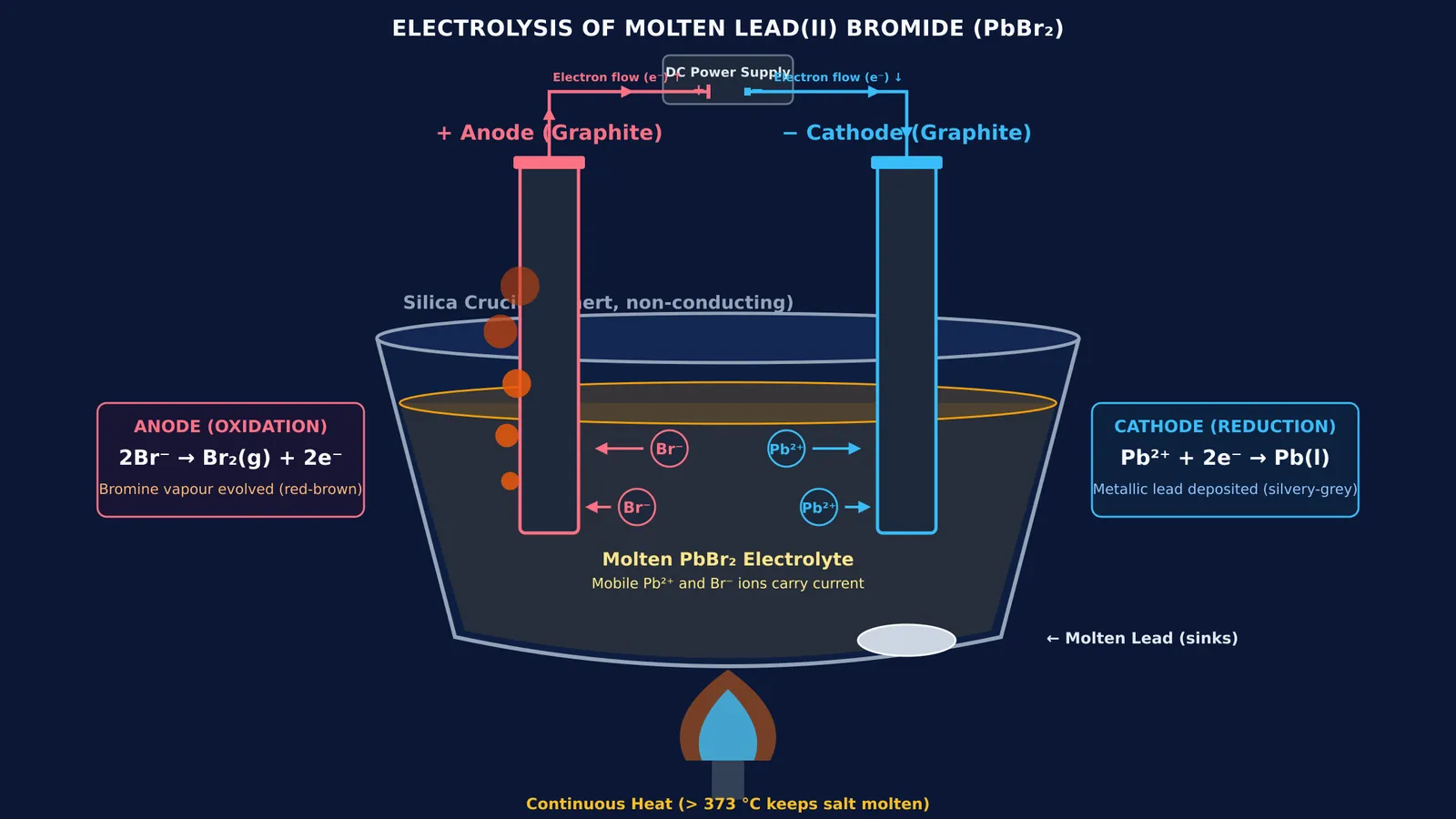
When two inert electrodes connected to a direct-current power supply are immersed into the molten liquid, the ions migrate under the electric field:
At the cathode (negative electrode): Positively charged lead cations (Pb²⁺) are drawn to the electron-rich cathode. Each lead ion gains two electrons in a reduction process:
Pb²⁺(l) + 2e⁻ → Pb(l) The resulting metallic lead forms as a silvery-grey liquid. Because molten lead is substantially denser than molten lead bromide, it sinks to the base of the cell around the cathode.
At the anode (positive electrode): Negatively charged bromide anions (Br⁻) migrate toward the electron-deficient anode. Each bromide ion loses one electron in an oxidation process to form neutral bromine atoms, which quickly pair up into diatomic gas molecules:
2Br⁻(l) → Br₂(g) + 2e⁻ This reaction produces pungent, reddish-brown bromine vapour that bubbles off the anode and escapes into the surrounding atmosphere.
The net cell reaction represents the complete electrolytic decomposition of the binary salt into its constituent elements: PbBr₂(l) → Pb(l) + Br₂(g)
Unlike aqueous cells such as those used in the electrolytic refining of copper, where active metal electrodes dissolve into solution, the inert electrodes in molten lead bromide electrolysis serve purely as electron donors and acceptors.
Why must the cell use graphite electrodes and a silica crucible?
The choice of cell apparatus is critical because molten lead bromide and hot bromine vapour are both chemically aggressive.
A silica crucible is chosen for several specific reasons:
Chemical inertness: Silica (silicon dioxide, SiO₂) does not react with molten lead bromide, metallic lead, or hot halogen vapour.
Thermal resistance: Silica withstands sustained high temperatures above the melting point of lead bromide without cracking from thermal stress.
Electrical insulation: Silica does not conduct electricity, ensuring that the applied current passes entirely through the molten electrolyte rather than leaking through the vessel walls.
Similarly, the electrodes are made of inert graphite (carbon). Graphite conducts electricity through its delocalised pi-electron system while remaining unaffected by corrosive bromine vapour, which would destroy metallic electrodes such as copper or iron. Because bromine vapour is toxic and irritates the respiratory tract, the demonstration must always be performed inside a functioning fume cupboard.
If you are mapping out electrode potentials and cell mechanisms across different compounds, the Fermi Concept Library covers every concept in physics, chemistry, biology, mathematics and computing, each with its own lesson and its place in the map.
How do you calculate electrolysis products from current and time?
To connect the qualitative observations with quantitative calculations, standard electrochemistry problems apply Faraday's laws of electrolysis, as formulated on Chemistry LibreTexts/20%3A_Electrochemistry/20.09%3A_Electrolysis).
Consider a practical example: a constant direct current of 2.50 A is passed through molten lead(II) bromide for 1930 s. Calculate the mass of lead metal deposited at the cathode and the volume of bromine gas evolved at standard temperature and pressure (STP, taking molar gas volume as 22.4 L/mol).
Calculate the total electric charge passed:
Q = I × t = 2.50 A × 1930 s = 4825 C
Determine the moles of electrons transferred:
Using Faraday's constant (F ≈ 96500 C/mol): Moles of electrons = 4825 C / 96500 C/mol = 0.0500 mol e⁻
Calculate the mass of lead deposited at the cathode:
From the cathode half-equation, Pb²⁺ + 2e⁻ → Pb, 1 mol of lead requires 2 mol of electrons: Moles of Pb = 0.0500 mol / 2 = 0.0250 mol Mass of Pb = 0.0250 mol × 207.2 g/mol = 5.18 g of lead metal
Calculate the volume of bromine gas evolved at the anode:
From the anode half-equation, 2Br⁻ → Br₂ + 2e⁻, 1 mol of Br₂ produces 2 mol of electrons: Moles of Br₂ = 0.0500 mol / 2 = 0.0250 mol Volume of Br₂ at STP = 0.0250 mol × 22.4 L/mol = 0.560 L (or 560 cm³)
For additional practice with stoichiometry and Faraday's laws, review our complete guide to electrolysis and Faraday's laws. When you encounter multi-step electrochemistry numericals, the Fermi Problem Library provides worked problems with a step-by-step solver that explains the reasoning rather than printing an answer.


