

On this page
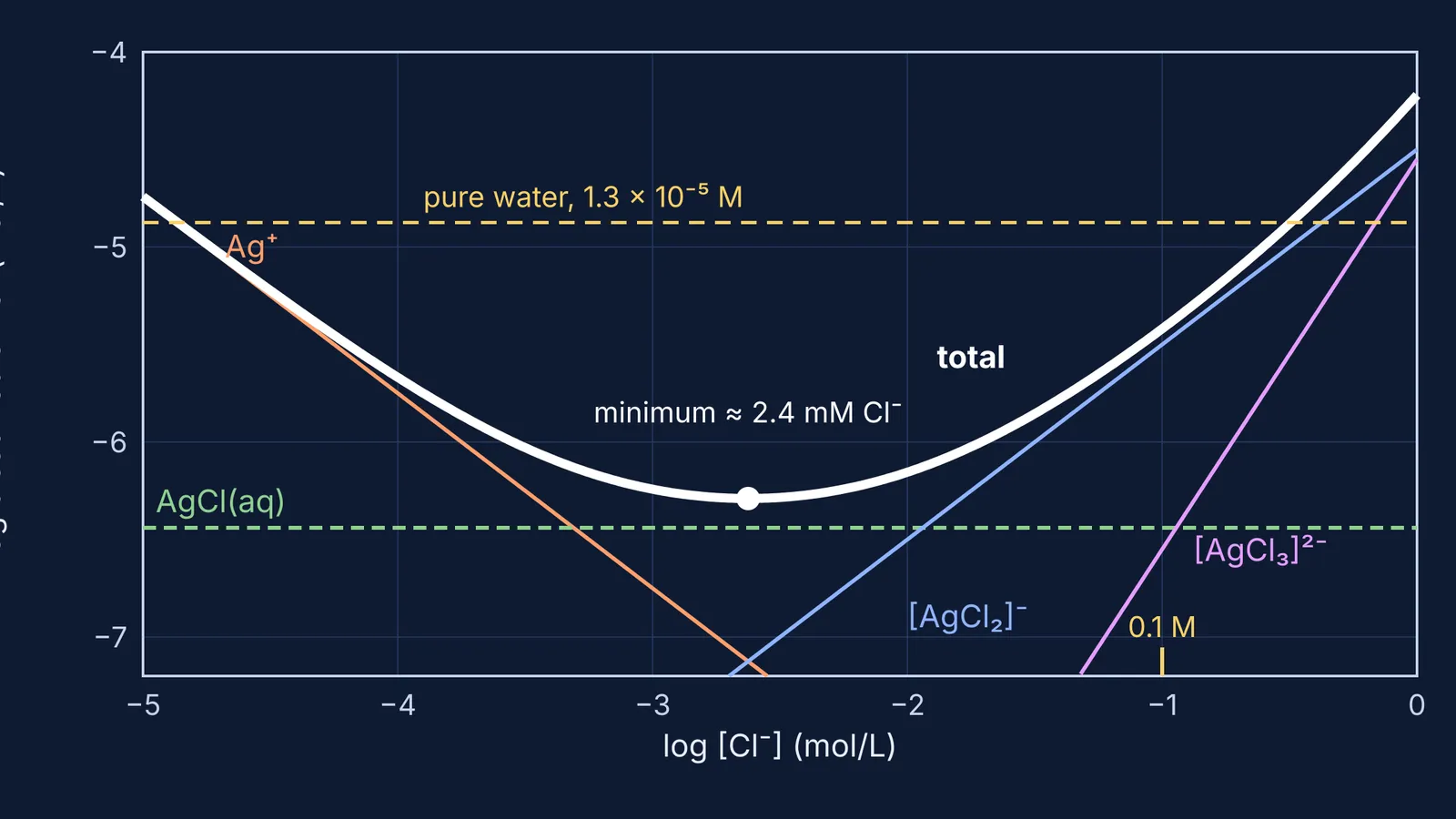
Your Class 11 textbook says that adding a common ion pushes a sparingly soluble salt out of solution. For silver chloride that is true, but only up to a point. Add chloride beyond a few millimoles per litre and AgCl starts to dissolve again. By 1 M chloride it is several times more soluble than in pure water. The reason is that chloride does two jobs: it is the common ion, and it is also a ligand that binds Ag⁺ into soluble complexes.
What does NCERT say about the common ion effect and AgCl?
The NCERT Class 11 chapter Equilibrium uses the common ion effect to explain why an excess of a common ion makes precipitation almost complete in gravimetric analysis, and silver as AgCl is the standard example. The working rule is the solubility product:
AgCl(s) ⇌ Ag⁺(aq) + Cl⁻(aq), Ksp = [Ag⁺][Cl⁻] ≈ 1.8 × 10⁻¹⁰ at 25 °C
With extra chloride, [Ag⁺] = Ksp/[Cl⁻]. Read literally, this says the more chloride you add, the less silver stays in solution, without limit. At 1 M chloride it predicts 1.8 × 10⁻¹⁰ M dissolved silver. The NCERT advice is sound for the small excess used in real gravimetric work. The formula just leaves out a second set of equilibria that take over at high chloride.
Why does excess chloride dissolve silver chloride?
Ag⁺ is a soft metal ion that forms complexes with Cl⁻, exactly as it does with NH₃ (the ammonia case is explained in why AgCl dissolves in ammonia solution). With chloride, the complexes form step by step:
Ag⁺ + Cl⁻ ⇌ AgCl(aq), log β₁ = 3.31
Ag⁺ + 2Cl⁻ ⇌ [AgCl₂]⁻, log β₂ = 5.25
Ag⁺ + 3Cl⁻ ⇌ [AgCl₃]²⁻, log β₃ = 5.2
These cumulative formation constants are for 25 °C and zero ionic strength, from the NIST critically selected stability constants database (NIST SRD 46), as recorded in the MINTEQ v4 thermodynamic database distributed with USGS PHREEQC, which also gives log Ksp = −9.75 (Ksp = 1.78 × 10⁻¹⁰). Other tables give slightly different values, because the constants depend on ionic strength. A fourth complex, [AgCl₄]³⁻, also appears in very concentrated chloride; we leave it out here, so the high-chloride numbers below are, if anything, too low.
AgCl(aq) is a neutral, dissolved species, not the solid. It counts as dissolved silver just as Ag⁺ does.
How do you calculate AgCl solubility in excess chloride?
Worked example. Find the total dissolved silver, S, in a solution saturated with AgCl, as a function of free [Cl⁻].
Write S as the sum of every silver species. S = [Ag⁺] + [AgCl(aq)] + [AgCl₂⁻] + [AgCl₃²⁻].
Put each in terms of [Ag⁺]. From the β expressions, [AgClₙ] = βₙ[Ag⁺][Cl⁻]ⁿ.
Use Ksp for [Ag⁺]. Since the solid is present, [Ag⁺] = Ksp/[Cl⁻]. Substituting:
S = Ksp/[Cl⁻] + Ksp·β₁ + Ksp·β₂[Cl⁻] + Ksp·β₃[Cl⁻]²
Evaluate the terms (Ksp = 1.78 × 10⁻¹⁰):
Ksp·β₁ = 1.78 × 10⁻¹⁰ × 2.04 × 10³ = 3.6 × 10⁻⁷ M
Ksp·β₂ = 1.78 × 10⁻¹⁰ × 1.78 × 10⁵ = 3.2 × 10⁻⁵ (multiply by [Cl⁻])
Ksp·β₃ = 1.78 × 10⁻¹⁰ × 1.58 × 10⁵ = 2.8 × 10⁻⁵ (multiply by [Cl⁻]²)
Tabulate. Pure water, for comparison: S = √Ksp = 1.3 × 10⁻⁵ M.
[Cl⁻] = 10⁻⁴ M: S = 1.8 × 10⁻⁶ + 3.6 × 10⁻⁷ + small = 2.1 × 10⁻⁶ M
[Cl⁻] = 2.4 × 10⁻³ M: S = 5.1 × 10⁻⁷ M (the minimum)
[Cl⁻] = 0.1 M: S = 3.8 × 10⁻⁶ M, mostly [AgCl₂]⁻
[Cl⁻] = 1 M: S = 6.0 × 10⁻⁵ M, about 4.5 times the pure-water value
Locate the minimum. The falling term Ksp/[Cl⁻] and the rising term Ksp·β₂[Cl⁻] are equal when [Cl⁻]² = 1/β₂, so [Cl⁻] = 1/√β₂ = 2.4 × 10⁻³ M. Setting dS/d[Cl⁻] = 0 gives the same answer, because the β₃ term is still tiny there.
At 1 M chloride the simple common ion formula says 1.8 × 10⁻¹⁰ M. The complexes make it about 6 × 10⁻⁵ M, more than 300,000 times higher. One caution: at 0.1 to 1 M chloride the activity coefficients of ions are well below 1, and the constants above are for zero ionic strength. Treat the high-chloride numbers as an illustration of the trend, not as exact measured values.
Can chloride ever precipitate silver completely?
No, and the middle term shows why. Ksp·β₁ = 3.6 × 10⁻⁷ M does not depend on [Cl⁻] at all. Any solution in contact with solid AgCl holds this much neutral AgCl(aq), whatever the chloride level. That is about 0.04 mg of silver per litre. The minimum solubility, 5.1 × 10⁻⁷ M, is only a little above this floor.
That is still tiny for gravimetric work. Suppose 2.50 mmol of Ag⁺ is precipitated and the final volume is 100 mL:
at the minimum (2.4 × 10⁻³ M free Cl⁻), 5.1 × 10⁻⁸ mol stays dissolved, a loss of 0.002%
at 0.1 M free Cl⁻, the loss is 0.015%
at 1 M free Cl⁻, the loss rises to about 0.24%, enough to matter in careful analysis
So NCERT's advice is right for what analysts actually do: add a slight excess of chloride, which lands close to the minimum. A large excess works against you. The solubility product and common ion effect guide has the standard Ksp problems that this builds on.
Why is dilute HCl used for group I in salt analysis?
Group I cations (Ag⁺, Pb²⁺, Hg₂²⁺) are precipitated with dilute HCl. Dilute acid gives enough chloride to pass Ksp, but not so much that chloro complexes pull the precipitate back into solution. Lead is the sensitive case: PbCl₂ is fairly soluble already, and in concentrated HCl it dissolves further as chloro complexes such as [PbCl₄]²⁻. Why some lead escapes into group II even with dilute acid is covered in why lead appears in Group 1 and Group 2.
If combining several equilibria in one expression is where you get stuck, the Fermi Problem Library has a step-by-step solver that explains the reasoning at each stage.
What should you write in exams?
For a numerical with Ksp and a common ion, use S = Ksp/[common ion], as NCERT does. Do not bring in complexes unless the question gives formation constants.
If a question gives Kf or β values, add every dissolved species, as in the worked example.
For "why dilute HCl in group I?", write: enough Cl⁻ to precipitate the chlorides, while excess Cl⁻ would redissolve them as soluble chloro complexes, for example [AgCl₂]⁻ and [PbCl₄]²⁻.
For "why only a slight excess of precipitant in gravimetric analysis?", give the same reason.
Quick checklist
The common ion effect lowers AgCl solubility only up to about 2 × 10⁻³ M chloride.
Beyond that, [AgCl₂]⁻ and [AgCl₃]²⁻ form and solubility rises again.
Total silver: S = Ksp/[Cl⁻] + Ksp·β₁ + Ksp·β₂[Cl⁻] + Ksp·β₃[Cl⁻]².
Minimum at [Cl⁻] = 1/√β₂ ≈ 2.4 × 10⁻³ M, S ≈ 5 × 10⁻⁷ M.
AgCl(aq) sets a floor of about 3.6 × 10⁻⁷ M that no amount of chloride can remove.
In exams, use Ksp/[Cl⁻] unless formation constants are given.


