

On this page
Why is silver chloride insoluble in pure water?
Silver chloride (AgCl) is a classic sparingly soluble ionic salt. Placed in pure water at 25 °C, solid silver chloride establishes a dynamic heterogeneous equilibrium of solids with its constituent ions:
AgCl(s) ⇌ Ag⁺(aq) + Cl⁻(aq)
Because pure solid AgCl maintains a constant thermodynamic activity, its concentration does not appear in the equilibrium expression. The extent of dissolution is governed strictly by the solubility product constant, Ksp:
Ksp = [Ag⁺][Cl⁻]
From NIST Critically Selected Stability Constants data, the solubility product of AgCl at 25 °C is 1.77 × 10⁻¹⁰. Because each dissolved formula unit yields equal silver and chloride ions ([Ag⁺] = [Cl⁻] = s), the molar solubility s is:
s = √(Ksp) = √(1.77 × 10⁻¹⁰) ≈ 1.33 × 10⁻⁵ mol/L
Multiplying by silver chloride's molar mass (143.32 g/mol) shows only 0.0019 g dissolves per litre of water. Strong crystal lattice forces exceed the hydration enthalpy supplied by water dipoles, leaving the salt undissolved as a white precipitate.
How does ammonia pull the dissolution equilibrium forward?
Adding aqueous ammonia (NH3) changes the medium completely. Ammonia molecules donate their lone electron pair as neutral Lewis bases (ligands), coordinating silver cations (Ag⁺), which act as Lewis acids:
Ag⁺(aq) + 2 NH3(aq) ⇌ [Ag(NH3)2]⁺(aq)
This coordination reaction forms the soluble diamminesilver(I) complex cation, [Ag(NH3)2]⁺. The NIST Standard Reference Database 46 records an overall formation constant of log β2 = 7.22 at 25 °C, giving:
Kf = 1.7 × 10⁷
Because Kf is so large, aqueous ammonia rapidly sequesters dissolved silver ions into coordination complexes. This binding drives free uncomplexed Ag⁺ down to roughly 3.6 × 10⁻⁹ mol/L. Under Le Chatelier's principle, removing dissolved silver ions forces the solid to dissolve continuously to replenish them.
By comparing reaction quotient Q with equilibrium constant K, the ion product Q = [Ag⁺][Cl⁻] falls far below Ksp. Solid AgCl dissolves until the precipitate completely clears.
How do you calculate AgCl solubility in 1.0 M ammonia?
To find how much AgCl dissolves, we combine both equilibria into a single net equation, as detailed in OpenStax Chemistry 2e Section 15.3:
AgCl(s) + 2 NH3(aq) ⇌ [Ag(NH3)2]⁺(aq) + Cl⁻(aq)
Because this reaction sums dissolution and complexation, its equilibrium constant (Knet) is the product of both values:
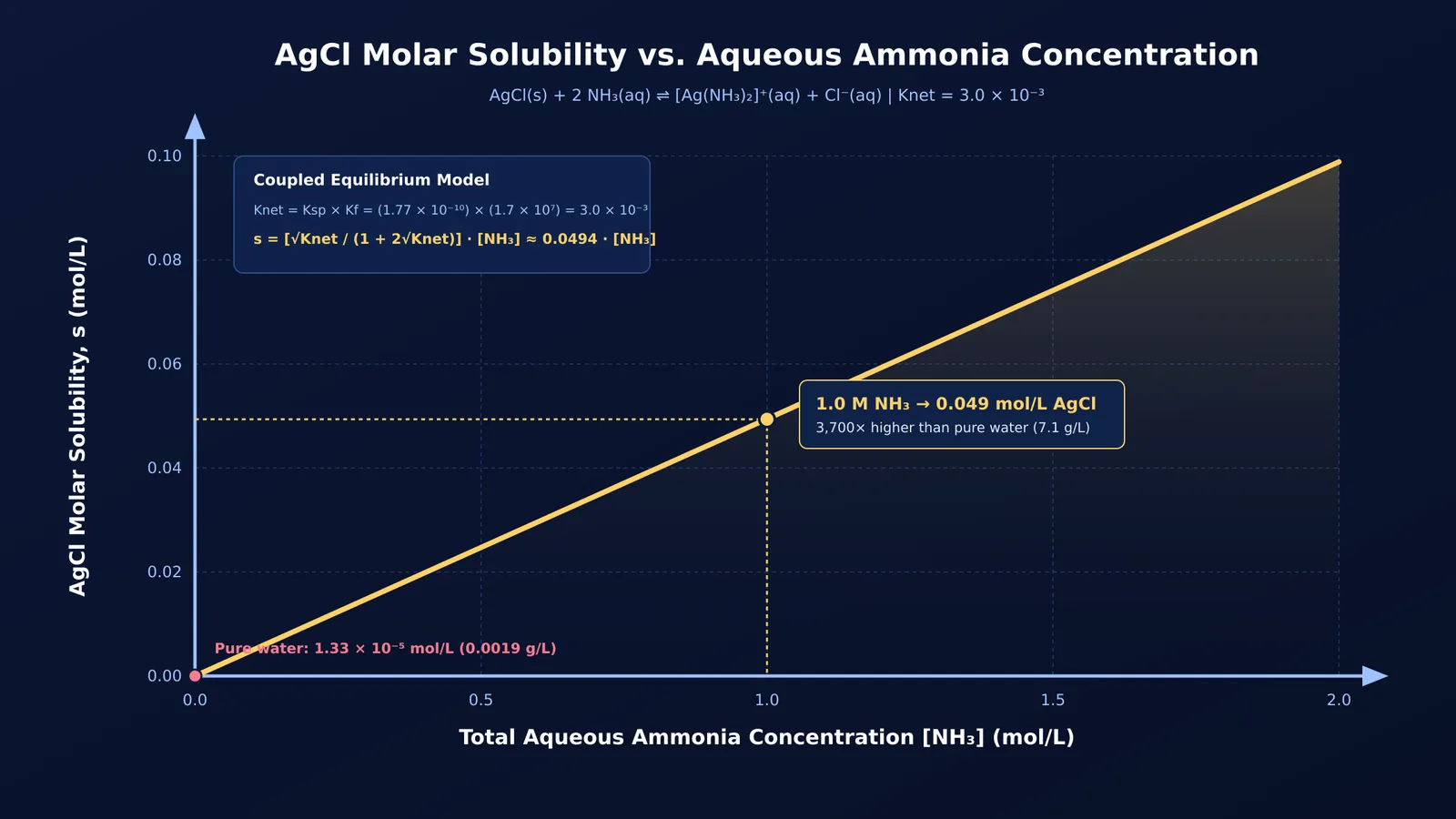
Knet = Ksp × Kf = (1.77 × 10⁻¹⁰) × (1.7 × 10⁷) ≈ 3.0 × 10⁻³
As analytical chemist Clyde R. Johnson demonstrated in the Journal of Chemical Education, we can set up an equilibrium table for an initial ammonia concentration C = 1.0 mol/L:
Let s be the moles of AgCl dissolved per litre.
At equilibrium, [Cl⁻] = s, and [[Ag(NH3)2]⁺] = s.
Because each complex ion consumes two ammonia molecules, uncomplexed ammonia is [NH3] = 1.0 − 2s.
Substituting these quantities into the equilibrium expression gives:
Knet = ([[Ag(NH3)2]⁺][Cl⁻]) / [NH3]² = s² / (1.0 − 2s)² = 3.0 × 10⁻³
Taking the square root gives s / (1.0 − 2s) = √(3.0 × 10⁻³) ≈ 0.0548. Solving for s yields:
s = 0.0548 × (1.0 − 2s) = 0.0548 − 0.1096 s 1.1096 s = 0.0548 s ≈ 0.0494 mol/L
In 1.0 M ammonia, AgCl solubility reaches approximately 0.049 mol/L (about 7.1 g/L). Comparing 0.0494 mol/L with 1.33 × 10⁻⁵ mol/L in pure water shows that complex formation raises AgCl solubility by roughly 3,700 times.
When working through coupled multi-equilibrium numericals, setting up simultaneous equilibrium expressions without dropping secondary species is where algebraic errors occur. The Fermi Problem Library provides worked problems with a step-by-step solver that explains the reasoning rather than printing an answer.
Why does AgCl dissolve in dilute ammonia while AgBr and AgI do not?
In qualitative inorganic analysis, the selective solubility of silver halides in aqueous ammonia distinguishes chloride, bromide, and iodide anions, based on their NIST stability constants:
AgCl dissolves readily in dilute aqueous ammonia (around 2 M).
AgBr dissolves only in concentrated ammonia (around 15 M) because its lower Ksp (5.35 × 10⁻¹³) yields an overall Knet of 9.1 × 10⁻⁶, requiring much higher ligand levels.
AgI is insoluble even in concentrated ammonia because its tiny Ksp (8.52 × 10⁻¹⁷) yields a Knet of only 1.4 × 10⁻⁹.
This test also demonstrates reversibility. Adding dilute nitric acid (HNO3) protonates ammonia to ammonium (NH4⁺), destroying the ligand. Free Ag⁺ ions are released, driving the ion product Q above Ksp and reprecipitating white AgCl.
For students exploring how ligand field theory, coordination numbers, and ionisable chloride precipitation with silver nitrate interlink across coordination chemistry, the Fermi Concept Library covers every concept in physics, chemistry, biology, mathematics and computing, each with its own lesson and its place in the map.


