

On this page
Every gas problem in Class 11 treats molecules as tiny hard balls that fly in straight lines and bounce. Every metal problem in Class 12 eventually says that free electrons need quantum mechanics. Why should one swarm of particles be classical and the other not? NCERT's Dual Nature chapter has two exercises that answer this with one number each: the de Broglie wavelength of a particle at room temperature, compared with the distance between neighbouring particles. If the wavelength is much smaller than the spacing, the particles behave like balls. If it is larger, their waves overlap and classical physics fails.
What is the thermal de Broglie wavelength?
A particle in a gas at temperature T has an average kinetic energy of (3/2)kT. NCERT uses the rms speed, so
½mv²(rms) = (3/2)kT, which gives p = mv(rms) = √(3mkT)
and the de Broglie wavelength is
λ = h/p = h/√(3mkT)
This is the "thermal" wavelength: a typical λ for a particle of mass m at temperature T. Two things follow at once. Heavier particles have shorter waves, and colder particles have longer waves, with λ ∝ 1/√(mT).
Statistical mechanics books often define the thermal wavelength as h/√(2πmkT) instead. That version is about 0.69 times the NCERT value. Both are order-of-magnitude estimates, so state which one you use and never mix them in one answer. This post uses NCERT's √(3mkT) throughout. The same formula applied to neutrons is worked in the de Broglie wavelength of a thermal neutron; here the point is the comparison with spacing.
How far apart are the molecules in air?
From the ideal gas law, P = nkT, the number of molecules per cubic metre is n = P/kT. At 300 K and 1 atm (1.013 × 10⁵ Pa):
n = 1.013 × 10⁵ / (1.381 × 10⁻²³ × 300) = 2.45 × 10²⁵ m⁻³
Each molecule then has a cube of volume 1/n to itself. The side of that cube is the mean spacing:
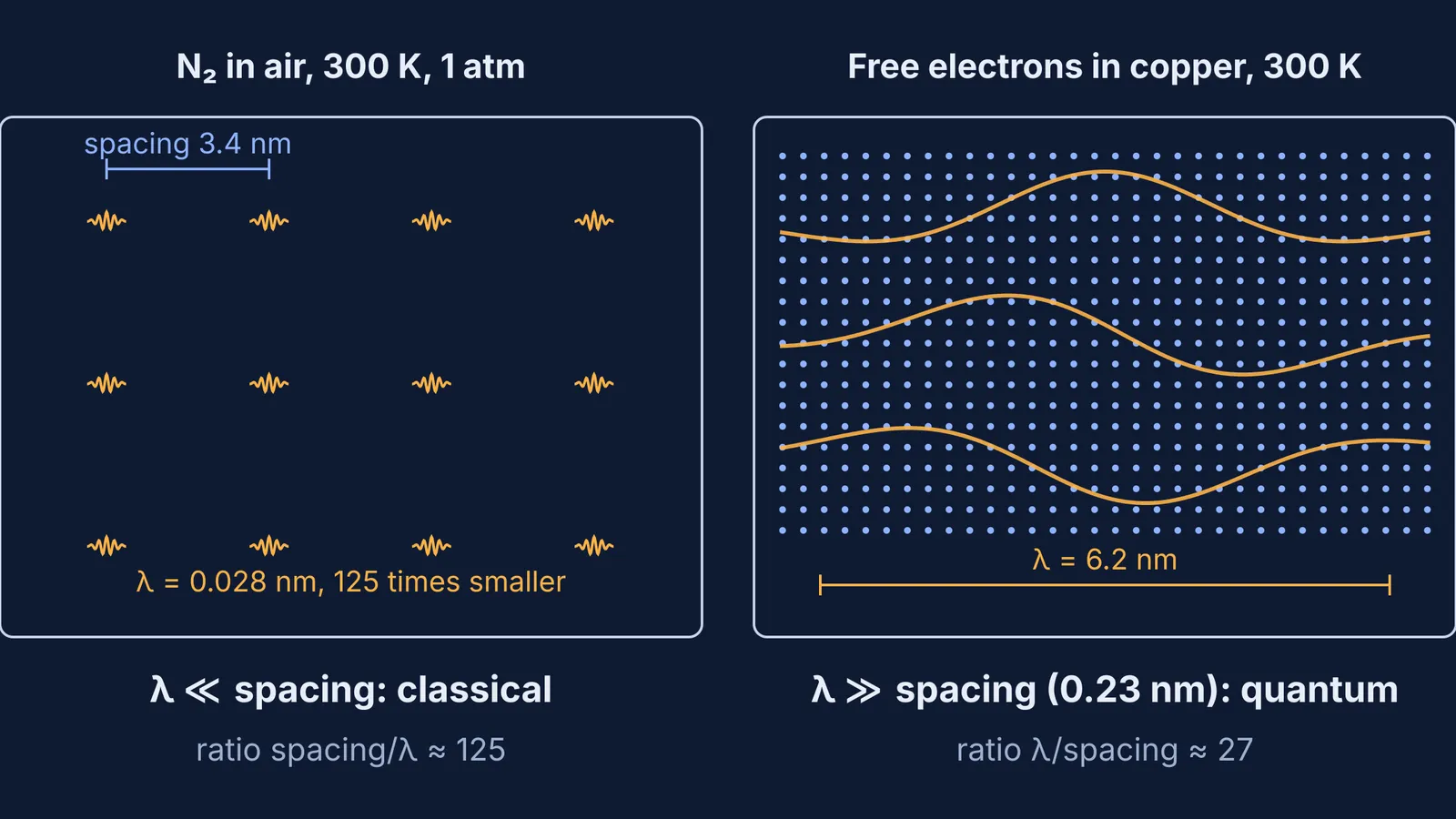
d = (1/n)^(1/3) = (kT/P)^(1/3) = 3.4 × 10⁻⁹ m = 3.4 nm
This is not the size of a molecule. An N₂ molecule is roughly 0.3 nm across, ten times smaller than the gap. How much of the volume the molecules themselves fill is a separate question, covered in what fraction of a gas's volume is occupied by molecules.
Worked example: is nitrogen in air classical at 300 K?
Take h = 6.626 × 10⁻³⁴ J s, k = 1.381 × 10⁻²³ J/K and 1 u = 1.66 × 10⁻²⁷ kg.
Mass of one molecule. N₂ has molecular mass 28 u, so m = 28 × 1.66 × 10⁻²⁷ = 4.65 × 10⁻²⁶ kg.
Momentum. p = √(3mkT) = √(3 × 4.65 × 10⁻²⁶ × 1.381 × 10⁻²³ × 300) = 2.40 × 10⁻²³ kg m/s. Units: kg × J = kg² m²/s², and its square root is kg m/s, a momentum.
Wavelength. λ = h/p = 6.626 × 10⁻³⁴ / 2.40 × 10⁻²³ = 2.76 × 10⁻¹¹ m, about 0.028 nm.
Compare. d/λ = 3.4 nm / 0.028 nm ≈ 125.
Conclusion. Each molecule's wave is about 125 times smaller than the gap to its neighbour. The waves never overlap, so you can treat each molecule as a separate ball with a definite position. Kinetic theory works.
Helium is lighter, so its wave is longer: with m = 4.00 u, λ = 0.073 nm. That is still about 47 times smaller than the 3.4 nm spacing (the spacing depends only on T and P, not on the gas). Helium at room temperature is classical too.
When would a gas stop being classical?
At fixed pressure, λ grows as 1/√T while the spacing (kT/P)^(1/3) shrinks as T^(1/3). Set them equal for N₂ at 1 atm and solve: the crossover is near 0.9 K. Nitrogen liquefies at 77 K, long before that, so nitrogen gas never reaches the quantum regime. To see overlapping waves in a gas, physicists use very dilute gases of light atoms cooled far below a kelvin. Under everyday conditions, every gas is safely classical.
Worked example: are free electrons in copper classical?
Copper has about one free electron per atom, n = 8.5 × 10²⁸ m⁻³ (the value NCERT uses for drift speed problems).
Spacing. d = n^(−1/3) = (8.5 × 10²⁸)^(−1/3) = 2.3 × 10⁻¹⁰ m, about 0.23 nm.
Momentum at 300 K. m = 9.11 × 10⁻³¹ kg, so p = √(3 × 9.11 × 10⁻³¹ × 1.381 × 10⁻²³ × 300) = 1.06 × 10⁻²⁵ kg m/s.
Wavelength. λ = 6.626 × 10⁻³⁴ / 1.06 × 10⁻²⁵ = 6.2 × 10⁻⁹ m = 6.2 nm.
Compare. λ/d = 6.2 / 0.23 ≈ 27.
Conclusion. Each electron's wave spreads over about 27 spacings, so it overlaps the waves of thousands of neighbours (27³ is about 20,000). You cannot follow electrons as separate balls. Classical kinetic theory does not apply.
The two results differ for two reasons. The electron is about 51,000 times lighter than N₂, which makes its λ √51,000 ≈ 226 times longer. And electrons in a metal are packed about 15 times closer than molecules in air.
Is 6.2 nm the real wavelength of an electron in copper?
No, and this is where NCERT's exercise stops short. Electrons obey the Pauli exclusion principle: no two can occupy the same state. So they cannot all sit at the low thermal energy of (3/2)kT, which is only 0.039 eV at 300 K. They fill the energy levels from the bottom up, and the fastest ones reach the Fermi energy, about 7 eV for copper. Those electrons move at about 1.6 × 10⁶ m/s, not the 1.2 × 10⁵ m/s the thermal estimate gives, and their wavelength is about 0.46 nm.
That does not rescue the classical picture. 0.46 nm is still about twice the spacing, so the waves still overlap. The 300 K estimate does its job: it shows that classical physics fails, and once it fails, you cannot trust the classical average energy that went into the estimate. This is why electrons in metals need quantum statistics, and why the classical free-electron model gets the heat capacity of metals wrong.
To see how λ = h/p changes with speed for a single electron, the comparison in de Broglie wavelength visualised: electron vs cricket ball helps. For the reasoning behind each step of problems like these, the Fermi Problem Library has a step-by-step solver that explains the reasoning.
Quick checklist
Thermal wavelength (NCERT): λ = h/√(3mkT).
Mean spacing in a gas: d = (kT/P)^(1/3) = 3.4 nm at 300 K and 1 atm.
N₂ at 300 K: λ = 0.028 nm, 125 times smaller than d, so classical.
Helium at 300 K: λ = 0.073 nm, still classical.
Electrons in copper: λ = 6.2 nm against d = 0.23 nm, so quantum.
The Pauli principle makes real metal electrons faster than thermal, but their waves still overlap.
Use 28 u for N₂ and do not mix √(3mkT) with √(2πmkT).


