

On this page
When a neutron is emitted from a nuclear fission reaction, it travels extremely fast, possessing a kinetic energy of around 1 million electron-volts (1 MeV) (Wikipedia). These "fast neutrons" have wavelengths far too small to be useful for studying materials. To harness them, physicists must slow them down by passing them through a moderator, such as heavy water or graphite. By colliding with light atoms, the neutrons lose energy until they reach thermal equilibrium with their surroundings. At this point, they are called thermal neutrons. Their kinetic energy is entirely dictated by the ambient temperature, and they begin to behave as matter waves of a highly useful size.
What is the de Broglie wavelength of a thermal neutron at temperature T?
The matter-wave relationship states that any particle with momentum p has a wavelength of λ = h/p, an insight detailed in Louis de Broglie: the PhD idea that electrons behave like waves. To find the wavelength of a neutron in thermal equilibrium at an absolute temperature T, we first need to determine its kinetic energy E.
In kinetic theory, the average translational kinetic energy of a gas particle at temperature T is given as E = (3/2)kT. We can relate this kinetic energy back to momentum using the formula E = p²/(2m), which is a central technique taught in Kinetic energy and momentum: using p squared over 2m in problems. This formula easily rearranges to p = √(2mE).
Substituting the average kinetic energy into the momentum equation gives: p = √(2m((3/2)kT)) = √(3mkT)
Finally, placing this momentum expression into the de Broglie equation yields the standard formula used in physics problems: λ = h/√(3mkT)
To find a practical numerical value, we simply plug in the exact values of the fundamental constants:
Planck's constant (h) is 6.626 × 10⁻³⁴ J s (NIST).
The mass of a neutron (m) is 1.675 × 10⁻²⁷ kg (NIST).
The Boltzmann constant (k) is 1.381 × 10⁻²³ J/K (NIST).
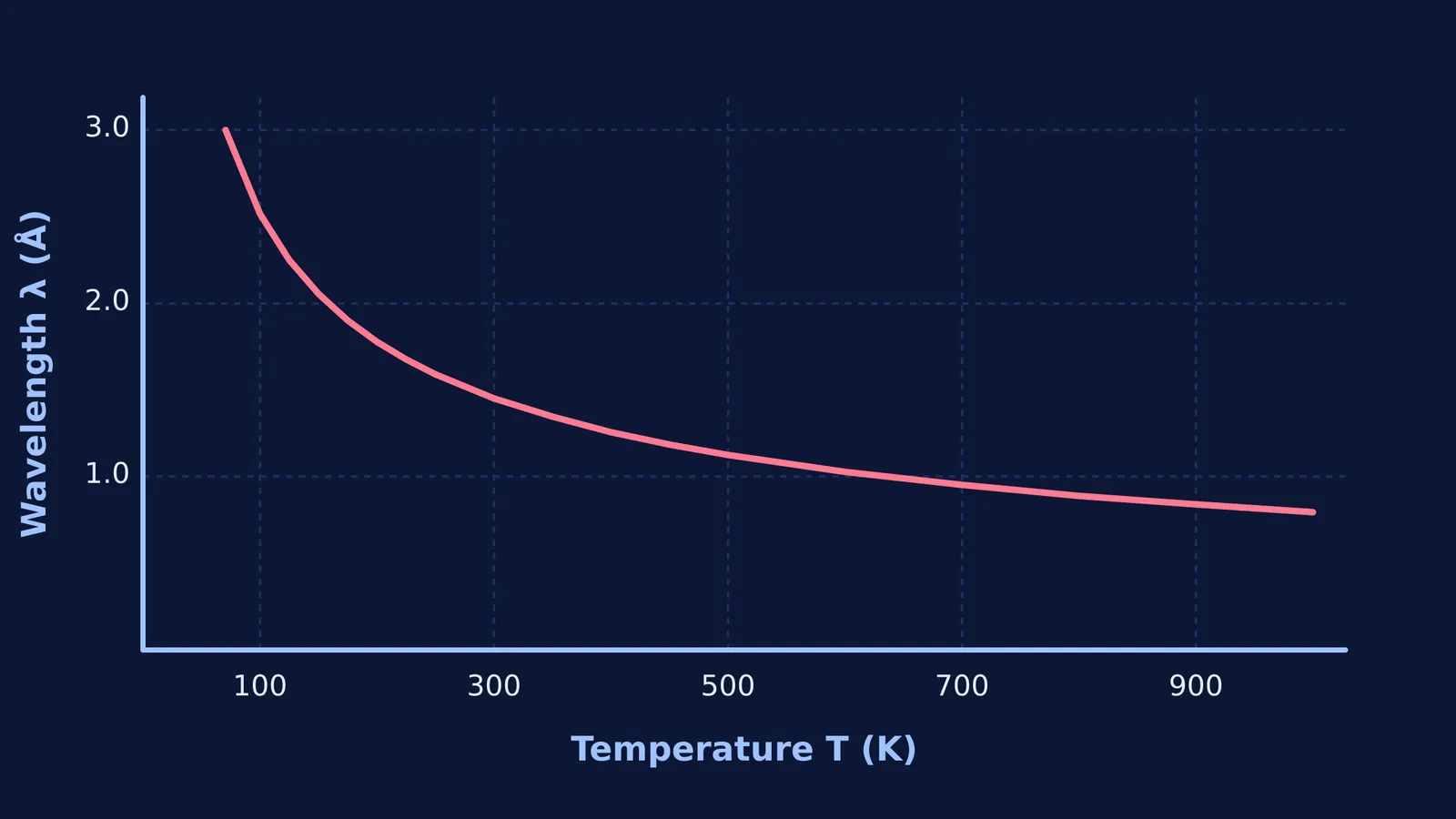
Calculating h / √(3mk) yields roughly 2.516 × 10⁻⁹ metres multiplied by the square root of Kelvin. Converting metres to Ångströms (where 1 Å = 10⁻¹⁰ m) provides a useful shortcut formula: λ = 25.16 / √T Å
At a typical room temperature of 300 K, this formula predicts an average wavelength of 1.45 Å. You will sometimes see a slightly different shortcut, λ = 30.8 / √T Å, which predicts 1.78 Å at 300 K. This discrepancy happens because physicists often define "thermal energy" using the most probable kinetic energy E = kT rather than the average kinetic energy E = (3/2)kT, yielding a wavelength of roughly 1.8 Å at 0.025 eV (Wikipedia).
If you are working through these derivations and get stuck or lose track of the algebra, the Fermi Concept Library has lessons for every concept in physics, chemistry, biology, mathematics and computing, each with its place in the map.
Why do thermal neutrons diffract from crystals?
For any wave to diffract clearly off a structure, its wavelength must be roughly the same size as the gaps in that structure. The typical separation between atoms in solid materials is around 1 Å, or 0.1 nm (Wikipedia).
Because a thermal neutron's wavelength of 1.45 to 1.8 Å closely matches this atomic spacing, thermal neutrons undergo Bragg diffraction when they pass through a crystal lattice. This produces a diffraction pattern that scientists can use to map the internal structure of the material.
While X-rays also have wavelengths in this exact range, they scatter off the electron clouds surrounding atoms. Neutrons, however, interact directly with the atomic nuclei via the strong nuclear force. This fundamental difference gives thermal neutrons two unique advantages over X-rays. First, they can clearly "see" light elements like hydrogen, which are practically invisible to X-rays because they have only one electron. Second, because neutrons possess a tiny magnetic moment, they scatter off the magnetic fields of unpaired electrons, making them an excellent tool for studying magnetic materials (Wikipedia).
How do you calculate thermal neutron wavelength?
If an exam question asks for the de Broglie wavelength of a thermal neutron at 27 °C, you can follow this structured checklist to avoid unit errors and lost marks.
Convert to Kelvin: Temperature must always be absolute.
T = 27 + 273 = 300 K
Choose your formula: Unless the question specifically dictates using the most probable speed, use the average kinetic energy derivation:
λ = h/√(3mkT)
Use the shortcut if permitted: In multiple-choice scenarios, you can bypass the heavy arithmetic entirely.
λ = 25.16 / √300 Å
Calculate the final value:
λ = 25.16 / 17.32 = 1.45 Å
The step-by-step logic above is a reliable way to tackle De Broglie wavelength problems: electrons, protons and voltage. For more practice, the Fermi Problem Library has worked problems with a step-by-step solver that explains the reasoning rather than printing an answer.


