

On this page
When you inflate a bicycle tyre, it feels perfectly solid and full to the touch. But if you could zoom in to the atomic level, you would find that the "full" space is almost entirely a void.
The Kinetic Molecular Theory (KMT) is built on the assumption that gas molecules are negligibly small compared to the vast distances between them 1. But just how negligible is "negligible" in reality? When we compare the actual space the molecules take up to the space they roam freely in, the numbers are striking.
How much space do gas molecules actually take up?
Let us look at a single mole of nitrogen gas (N₂) at Standard Temperature and Pressure (STP, defined as 0 °C and 1 atm). We know from the ideal gas law that one mole of this gas occupies a total macroscopic volume of 22.4 litres, or 22,400 mL.
To find the actual microscopic volume of the nitrogen molecules themselves, we can turn to the van der Waals equation. This physical chemistry equation introduces a constant, b, which corrects for the physical volume that gas molecules exclude from one another. For nitrogen, the experimentally derived value of b is 0.0391 L/mol (39.1 mL) 2.
Physical chemistry dictates that the constant b is roughly four times the true physical volume of the molecules. Dividing 39.1 mL by 4 gives us an actual molecular volume of about 9.8 mL per mole.
When we compare the two volumes, the difference is vast:
Actual volume of the nitrogen molecules = 9.8 mL
Total macroscopic volume of the gas = 22,400 mL
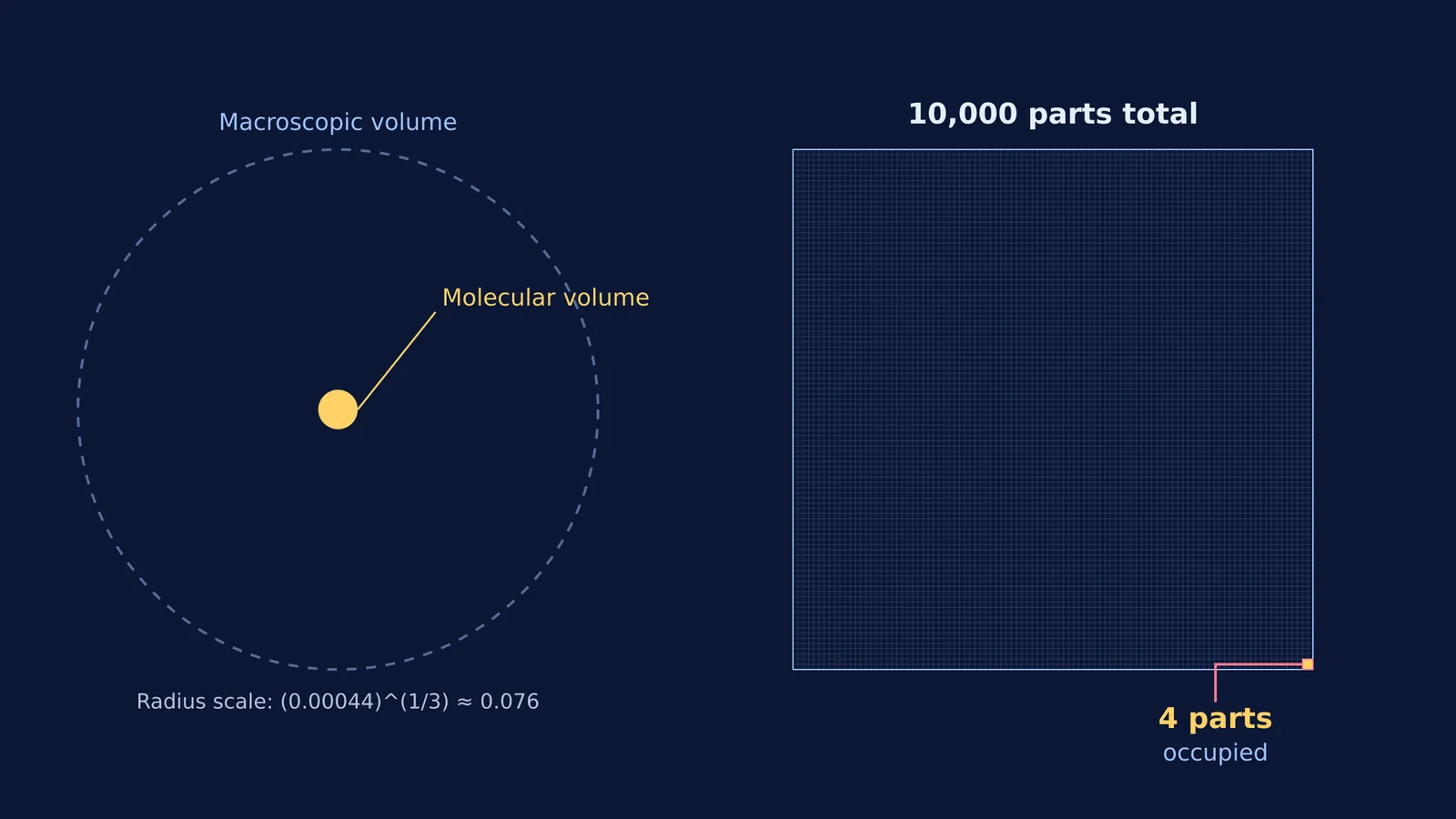
Fraction = 9.8 / 22,400 ≈ 0.00044
This means the molecules themselves take up just over 4 parts in 10,000 (or about 0.04%) of the total available space. If you were sitting in a 10,000-seat sports stadium, the molecules would be crowded into just four of the seats. The other 9,996 seats represent entirely empty space.
Why are gases so easy to compress?
This overwhelming amount of empty space explains the macroscopic properties that we use every day. Gases are highly compressible because pushing on them simply reduces the empty space between the molecules. When you push down on the piston of a bicycle pump, you are not squeezing the physical nitrogen and oxygen molecules themselves; you are just crowding them much closer together.
It is also why we can rely on concepts like the free expansion of an ideal gas. Because the molecules are so far apart, their attractive forces are very weak under normal conditions, allowing them to expand without doing any work against each other.
What happens at high pressures?
When we squeeze a gas to a very high pressure, the total volume shrinks dramatically, but the actual volume of the molecules stays exactly the same 2.
If we compress that mole of nitrogen from 1 atm to 500 atm, the total volume drops from 22,400 mL to roughly 45 mL. Now, the 9.8 mL of actual molecular volume makes up more than 20% of the total space. At this point, the ideal gas law fails because the molecules are no longer "negligibly small" compared to the container.
This is why converting PV, PT and VT graphs must be done very carefully for real gases at high pressures, as they no longer form the straight, predictable lines of an ideal gas.
When you are revising for physical chemistry and need to picture exactly when gases stop behaving ideally, you can use the Concept Library. Fermi's AI tutor works out what you already know and teaches through the van der Waals equation, drawing the figure and checking understanding as it goes.
When should you use real or ideal behaviour?
When solving advanced gas problems, use this quick framework to decide if you can ignore the volume of the molecules 2:
Check the pressure: Near standard atmospheric pressure, the molecular volume is negligible (parts per 10,000). You can safely use PV = nRT.
Check the temperature: At high temperatures, molecules move fast and easily overcome weak attractions, staying far apart. Ideal behaviour holds perfectly well.
Look out for condensation: If the gas is close to its boiling point (like water vapour on a cold winter window), the molecules are spending too much time close together. You must immediately account for real-gas behaviour.
The next time you take a deep breath, remember that the air filling your lungs is overwhelmingly made of nothing at all.


