

On this page
Anything that moves has a wavelength. Louis de Broglie put this idea forward in 1923 in a short Nature letter, Waves and Quanta, and four years later electrons were seen to diffract off a crystal. So why does a cricket ball not spread out like a ripple? Here are the numbers for both, plus how voltage sets an electron's wavelength.
What is the de Broglie wavelength?
The de Broglie wavelength of a particle is λ = h/p, where h is Planck's constant and p is the particle's momentum (OpenStax University Physics, Volume 3).
Planck's constant is exactly 6.626 070 15 × 10⁻³⁴ J s (NIST CODATA 2022).
Because h is so small, λ is only noticeable when momentum is tiny too. A wave diffracts when it meets a gap or a row of atoms about the size of its wavelength. If λ is many powers of ten smaller than every gap, the object goes in a straight line.
Why do electrons diffract and cricket balls do not?
Start with the electron. If an electron starts from rest and is accelerated through a voltage V, its kinetic energy is eV, so p = √(2meV). Using the electron mass of 9.109 × 10⁻³¹ kg (NIST) and the elementary charge of 1.602 × 10⁻¹⁹ C (NIST), the formula becomes λ ≈ 1.226/√V nanometres, with V in volts.
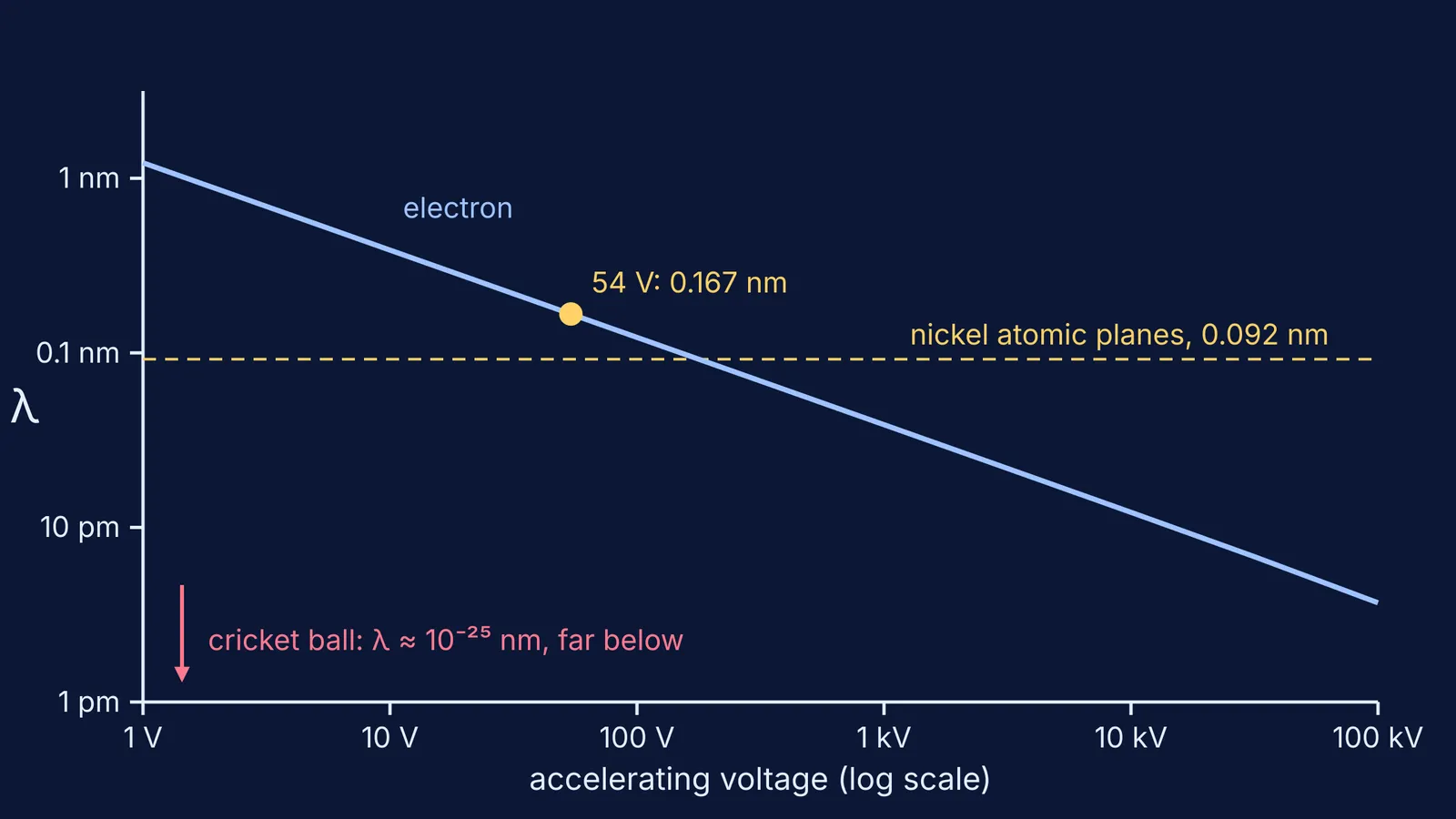
In the Davisson–Germer experiment, electrons accelerated through 54 V gave a definite peak at a scattering angle of 50° off a nickel crystal whose atomic planes are 0.092 nm apart (HyperPhysics). Put 54 V into the formula: λ = 1.226/√54 ≈ 0.167 nm. That is the same scale as the spacing between atoms, so diffraction shows up. The Bragg check agrees: 2 × 0.092 nm × sin 65° ≈ 0.167 nm. Using a 2.15 Å spacing between nickel atoms, OpenStax gives the measured wavelength as 1.64 Å against a predicted 1.67 Å (OpenStax). The full result was published as Diffraction of Electrons by a Crystal of Nickel in Physical Review in 1927. Our profile of Clinton Davisson and the experiment that showed electrons are waves tells the story behind it.
Now the cricket ball. Under MCC Law 4.1, a new Size 1 ball weighs between 156 g and 163 g (MCC Laws of Cricket). Take 160 g bowled at 40 m/s (144 km/h). Its momentum is 0.16 × 40 = 6.4 kg m/s, so λ = 6.63 × 10⁻³⁴ / 6.4 ≈ 1.0 × 10⁻³⁴ m.
A proton's charge radius is about 8.4 × 10⁻¹⁶ m (NIST), so the ball's wavelength is roughly 10¹⁹ times smaller than a proton. No gap anywhere comes close, so the ball never diffracts.
How does accelerating voltage change the electron's wavelength?
From λ ≈ 1.226/√V nm, the wavelength falls as one over the square root of the voltage. Four times the voltage halves λ; a hundred times the voltage cuts it by ten. Using the NIST CODATA constants above:
1 V: 1.23 nm
10 V: 0.388 nm
54 V: 0.167 nm
150 V: 0.100 nm
1 kV: 0.0388 nm
10 kV: 12.3 pm
100 kV: 3.88 pm from the simple formula, 3.70 pm with relativity
The last line matters. The electron's rest energy, mc², works out to about 511 keV from the NIST electron mass and the speed of light. Once eV is no longer tiny next to that, use p = √(2meV(1 + eV/2mc²)). At 10 kV the simple formula is off by about 0.5%; at 100 kV, by about 5%.
How can you predict λ before you calculate?
Use this three-step pocket method on any matter-wave question:
Find the momentum: p = mv for a ball or a car; p = √(2mK) if you are given kinetic energy K; p = √(2mqV) for a charge q accelerated through V.
Divide: λ = h/p. For electrons, jump straight to 1.226/√V nm.
Compare λ with the gap or atomic spacing. Similar size: expect diffraction. Many powers of ten smaller: straight-line motion.
Try these before reading the answers:
Double the voltage from 54 V to 108 V. Prediction: λ falls by √2, to 0.118 nm.
Slow the cricket ball to 1 m/s. λ = 6.63 × 10⁻³⁴ / 0.16 ≈ 4.1 × 10⁻³³ m. Still nothing to see.
Which voltage gives exactly 0.1 nm? Square 1.226/0.1 to get about 150 V.
Common traps: mixing up eV (energy) with V (voltage), leaving kinetic energy in eV instead of joules, and mixing nm with Å (1 nm = 10 Å). For a full set of exam-style questions, see de Broglie wavelength problems: electrons, protons and voltage.
How do you actually see it?
The Fermi Simulation Lab has interactive simulations for ideas that are easier to see than to read; predict first, then check. Our post on when simulations beat static diagrams explains why that order matters.
If you keep picking the wrong formula for p, the Fermi Problem Library has worked problems with a step-by-step solver that explains the reasoning rather than printing an answer.


