On this page
In June 1887 two chemists in Stockholm heated a few hundredths of a gram of aluminium chloride inside a platinum cylinder, up to 1260 °C, and weighed its vapour. One was Lars Fredrik Nilson, who had found scandium eight years earlier (his story is in Lars Nilson and the discovery of scandium). The other was his co-worker Otto Pettersson. Their vapour was lighter than Al₂Cl₆ even at 440 °C, and above 835 °C it weighed exactly what AlCl₃ should. That settled a question about aluminium's valency. Their paper is in the Zeitschrift für physikalische Chemie, volume 1, pages 459–464. Translations from the German are ours.
Why did chemists think aluminium chloride was Al₂Cl₆?
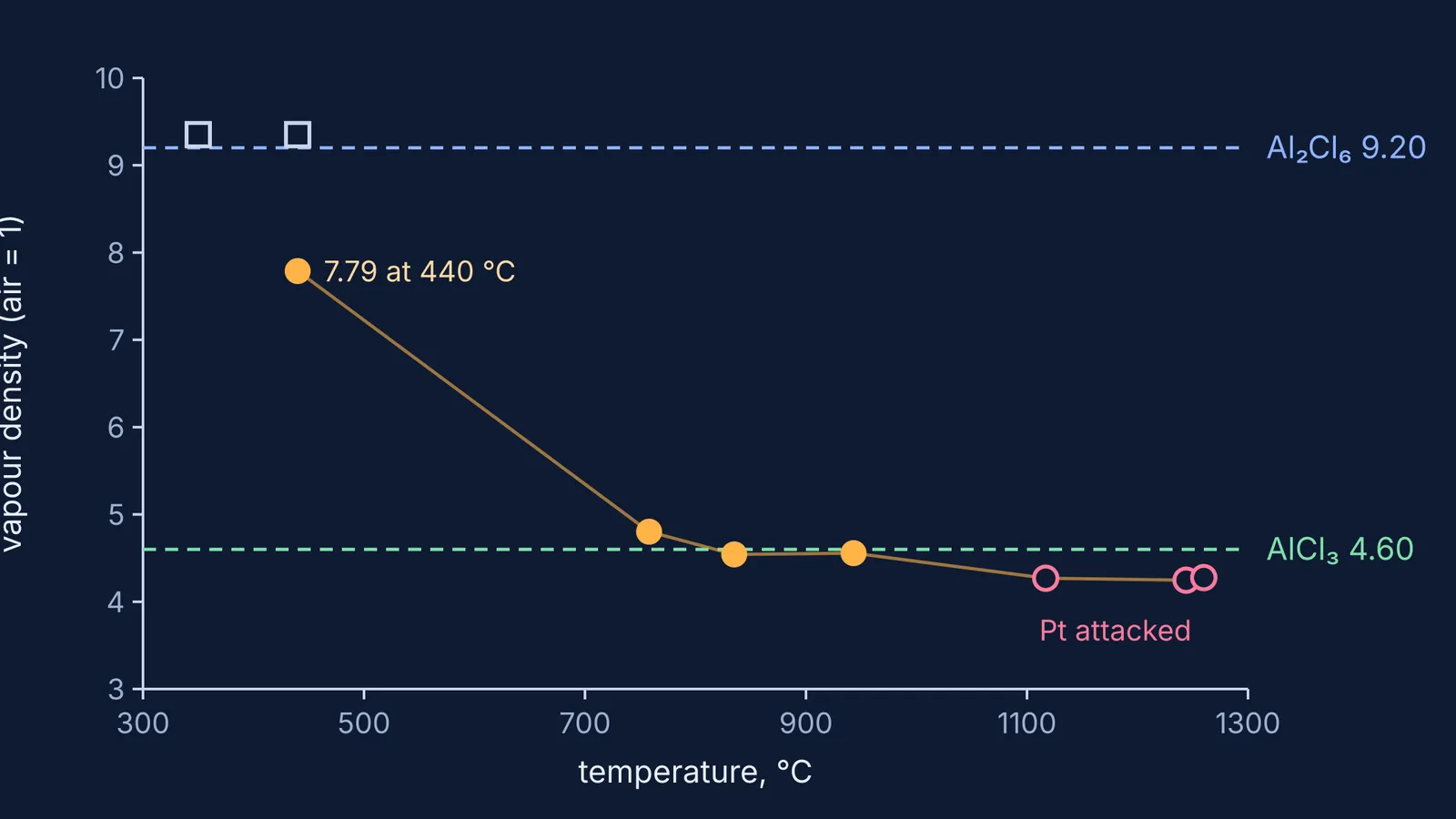
Thirty years earlier, Deville and Troost had measured the vapour densities of the aluminium halides by Dumas' method. All densities here are relative to air, not hydrogen. They found:
aluminium chloride 9.35 at 350 °C and 440 °C;
aluminium bromide 18.62 at 440 °C;
aluminium iodide 27.00 at 440 °C.
Nilson and Pettersson give the values expected for Al₂X₆ as 9.20, 18.40 and 28.10. With modern atomic masses and air at 28.96 g mol⁻¹ we get 9.21, 18.42 and 28.16. The match looked perfect.
Iron seemed to agree. Iron(III) chloride vapour gave 11.39 (Deville and Troost) and 11.14 and 11.01 (Victor Meyer), against 11.19 calculated for Fe₂Cl₆. Iron(III) and aluminium compounds were also known to crystallise in the same forms. So, the authors write, "aluminium was accordingly to be regarded as tetravalent, but appeared in its compounds as hexavalent only with two combined atoms". In that picture each Al used three bonds on chlorine and one on the other Al.
What made Nilson and Pettersson doubt it?
The periodic table. Aluminium heads the group Al, Ga, In, and the formula of indium chloride as InCl₃ "can no longer be doubted" after Victor Meyer's vapour density. If aluminium really formed Al₂Cl₆, indium would be the odd one out.
There was a second clue. Victor Meyer had reported that aluminium chloride heated to 697 °C in nitrogen was "totally decomposed", with plenty of chlorine gas in the vessel. Nilson and Pettersson had seen something similar with beryllium chloride, but the free chlorine disappeared when they vaporised it in dry, air-free carbon dioxide instead of nitrogen. They suspected the hot-chloride results were artefacts.
How did they make and weigh the vapour?
They made the chloride from aluminium wire and dry, air-free hydrogen chloride gas:
2Al + 6HCl → 2AlCl₃ + 3H₂
Check: 2 Al, 6 H and 6 Cl on each side. The white product gave only "a tinge of red" with potassium thiocyanate, so iron was a trace. As a purity test, 0.0766 g of their aluminium gave 0.00841 g of hydrogen against 0.008498 g expected, which ruled out any oxychloride.
The vapour density was measured by their own gas-displacement method in a platinum vessel; the temperature was found in separate runs from the volume of gas the vessel displaced. The 440 °C run was done in boiling sulphur vapour. Their results:
440 °C: 7.789
758 °C: 4.802
835 °C: 4.542
943 °C: 4.557
1117 °C: 4.269
1244 °C: 4.247
1260 °C: 4.277
"For the chloride AlCl₃ the vapour density is calculated as 4.600."
Worked example: how much Al₂Cl₆ splits at each temperature?
The equilibrium is Al₂Cl₆ ⇌ 2AlCl₃. Check: 2 Al and 6 Cl on each side.
Count moles. Start with 1 mol Al₂Cl₆. If a fraction α splits, you have (1 − α) mol of dimer and 2α mol of monomer, 1 + α mol in all.
Link to density. The mass does not change, so vapour density is inversely proportional to the number of moles. D₀/D = 1 + α, so α = D₀/D − 1, with D₀ = 9.20 for pure Al₂Cl₆.
At 440 °C. α = 9.20 ÷ 7.789 − 1 = 0.18. About 18% of the dimers have split, and AlCl₃ makes up 2α/(1 + α) = 31% of the molecules. The average molar mass is 7.789 × 28.96 = 225.6 g mol⁻¹, between 133.3 and 266.7.
At 835 °C and 943 °C. 9.20 ÷ 4.542 − 1 = 1.03 and 9.20 ÷ 4.557 − 1 = 1.02. α cannot exceed 1, so read these as α ≈ 1. The measured densities are within about 1% of 4.60: the vapour is all AlCl₃.
Exercise. At 758 °C the formula gives α = 0.92, but the authors say the chloride was "not yet completely vaporised at 758°", so treat that as practice only. What density would a 50% split show? 9.20 ÷ 1.5 = 6.13.
In NCERT problems vapour density is relative to hydrogen, so M = 2 × VD. Here M = 28.96 × D instead. Both give AlCl₃ = 133.3 g mol⁻¹. The same method for PCl₅ is in degree of dissociation of PCl₅ from vapour density.
What went wrong above 943 °C?
The last three densities, about 4.25–4.28, fall about 7% below 4.60. In the runs up to 943 °C the contents of the platinum vessel dissolved completely in water. After the 1117–1260 °C runs there was a black, insoluble residue in which they found platinum and aluminium, and the platinum casing was coated with it. The chloride vapour had attacked the platinum, releasing some free chlorine and lowering the density. They state that they cannot interpret this, "with V. Meyer, as a spontaneous dissociation of the chloride".
Why does the AlCl₃ vapour make aluminium trivalent?
A density of 4.6 means a molar mass of about 133 g mol⁻¹, so the molecule holds one Al and three Cl. One aluminium atom combines with three chlorine atoms, and that is valency 3. As the authors put it, the density 4.60 "corresponds fully to a trivalent element".
They then drew the group-wide conclusion: since aluminium, like indium, forms a trichloride, "it is still more probable that gallium and all the elements of the third group, in keeping with their position in the periodic system, are really trivalent". They did not measure gallium or iron chloride themselves, and left those for others.
Modern chemistry also corrects the old reading of the dimer. Al₂Cl₆ has no Al–Al bond. Two chlorine atoms bridge the aluminium atoms, each giving a lone pair to the other Al, so each Al is four-coordinate but still +3. The structure is drawn in why aluminium chloride exists as the dimer Al₂Cl₆.
Where does this come up in JEE and NEET?
Class 11 p-block, group 13: AlCl₃ is electron deficient, dimerises in the vapour and splits on strong heating; +3 is aluminium's state.
Class 11 Equilibrium and mole concept: degree of dissociation from vapour density.
For timed practice on α and vapour density questions, Fermi's AI tutor for JEE prep is part of Fermi Test Prep for JEE Main and Advanced.
Quick checklist
Deville and Troost: 9.35 near 440 °C, read as Al₂Cl₆, so aluminium looked "tetravalent".
Nilson and Pettersson, 1887: 7.79 at 440 °C, 4.54–4.56 at 835–943 °C, against 4.60 for AlCl₃.
α = D₀/D − 1 for a dimer; 0.18 at 440 °C, about 1 at 835 °C.
AlCl₃ monomer means one Al holds three Cl: trivalent, like In.
Low values above 943 °C came from attack on platinum, not further splitting.
In Al₂Cl₆, Al is bridged by Cl, not bonded to Al, and stays +3.