

On this page
When Dmitri Mendeleev published his periodic table, its greatest strength was what it left out. In the mid-19th century, chemists were struggling to organise the known elements into a logical system. By arranging the elements by their atomic weights and chemical properties, Mendeleev noticed places where the pattern abruptly broke. Rather than forcing the known elements to fit or assuming the pattern was flawed, he made a radical assumption: the elements that belonged in those spots simply had not been discovered yet.
He left empty spaces in his table and gave the missing elements placeholder names using the Sanskrit prefix *eka-*, meaning "one" or "the first element below". This set the stage for one of the most exciting periods in chemical history, as chemists across Europe began hunting for these mysterious substances to see if Mendeleev's system was real. For more on how he developed this system, read our article on Mendeleev's periodic table and the gaps he left.
What was Mendeleev's eka-boron?
In 1871, Mendeleev published a detailed version of his periodic table. In it, he described a missing element that he placed immediately below boron, which he named eka-boron. He did not just leave an empty box; he was remarkably specific about what this unknown element would look like and how it would behave when found.
He predicted it would have an atomic mass of approximately 44 and would form an oxide with the chemical formula Eb₂O₃. He even predicted that this oxide would have a density of 3.5 g/cm³ and would be completely insoluble in water (RSC).
Mendeleev published these predictions boldly. For the periodic table to be accepted as a fundamental law of nature rather than just a neat filing system, these missing elements had to be found, and they had to behave exactly as he said they would.
How did Lars Nilson discover scandium?
The breakthrough came eight years later in Sweden. In 1879, the Swedish chemist Lars Fredrik Nilson was analysing rare earth minerals found in Scandinavia. He was working with gadolinite and euxenite, complex minerals that contain a mixture of heavy elements. Nilson was originally attempting to isolate known rare earth elements, particularly ytterbium, when he noticed unexpected lines in the emission spectrum of his sample.
An emission spectrum acts like a chemical fingerprint, and these new lines meant only one thing: there was an unknown element hiding in the ore. Through painstaking chemical separation and purification, Nilson managed to extract just 2 grams of a highly pure oxide of this completely new element (Wikipedia). Honouring the region where the euxenite and gadolinite minerals were found, he named the element scandium, derived from *Scandia*, the Latin word for Scandinavia.
Why was scandium the perfect match?
Nilson had found a new element, but because he was focused on rare earth elements, he was initially unaware that he had just solved one of Mendeleev's puzzles. It was his colleague, the chemist Per Teodor Cleve, who connected the dots and saw the bigger picture (RSC).
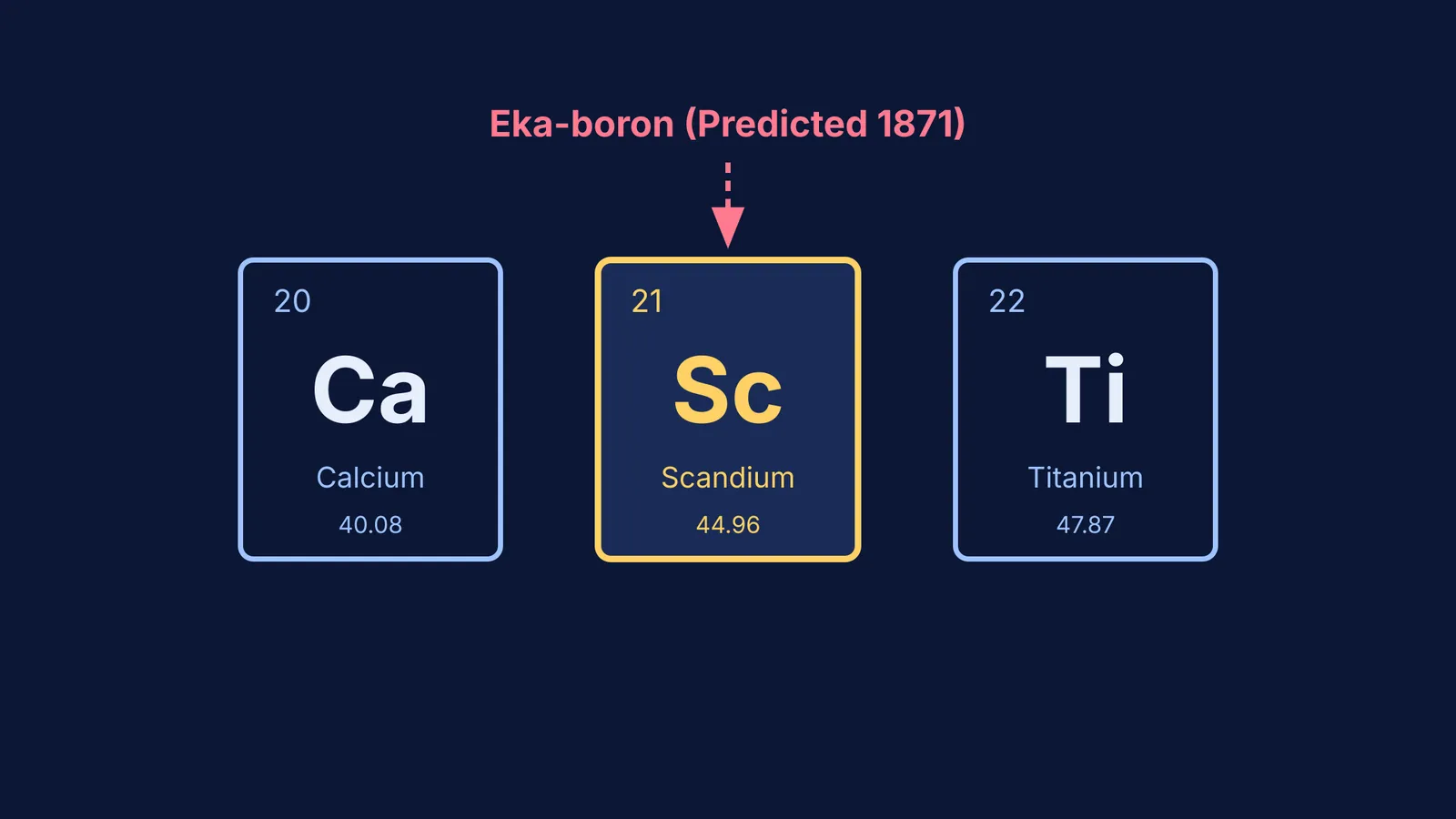
Cleve realised that scandium's physical and chemical properties were an uncanny match for the eka-boron predicted in 1871. Scandium's atomic mass is 44.96, which is very close to the predicted mass of 44. It formed an oxide with the formula Sc₂O₃, perfectly matching the predicted Eb₂O₃, and this oxide was indeed insoluble in water, just as Mendeleev had foreseen.
When Cleve wrote to Mendeleev to tell him that eka-boron had been found in Sweden, it marked a massive triumph for the periodic table. Along with the discovery of gallium (eka-aluminium) and later germanium (eka-silicon), scandium provided the empirical proof that Mendeleev's system was a true reflection of atomic structure, much like how Clemens Winkler found germanium in 1886.
If you are learning these historical developments for your chemistry exams, the sheer volume of facts can feel overwhelming. The Fermi Concept Library has a lesson for every concept in chemistry and shows its place in the map. When you need to practise exam questions on atomic structure, the Fermi Problem Library provides a step-by-step solver that explains the reasoning rather than printing an answer.
How can you study periodic trends effectively?
The discovery of elements like scandium shows that the periodic table is built on predictable, logical patterns. If you are preparing for exams like the JEE or board exams, you should use these patterns to your advantage rather than trying to memorise properties in isolation.
Here is a simple framework for tackling periodic table questions:
Locate the element: Always start by picturing where the element sits. Is it in the s-block, p-block, or d-block? Scandium, being element 21, is the first of the 3d transition metals.
Determine the nuclear charge: Ask yourself how the effective nuclear charge changes as you move left to right across a period. A higher charge pulls the electron cloud in tighter.
Consider the shielding effect: As you move down a group, new electron shells are added. These inner shells shield the outermost electrons from the pull of the nucleus.
Apply the trend: Use nuclear charge and shielding to deduce the property. For example, atomic radius generally decreases across a period because the increasing nuclear charge pulls the same shell of electrons closer, while it increases down a group due to the added shells.
By understanding the rules that govern the table, you can predict chemical behaviour just as Mendeleev did, turning a massive grid of data into a tool you can actually use.


