On this page
Each order here is taken from Principles of Inheritance and Variation, Chapter 4 of NCERT Class 12 Biology (Reprint 2026-27). The NEET (UG) 2026 syllabus files the chapter under Unit 7 (Genetics and Evolution). All 11 questions are original, not past-paper items.
Study summary, not medical advice: the phenylketonuria steps only restate NCERT.
Which sequences in this chapter does NCERT give in order?
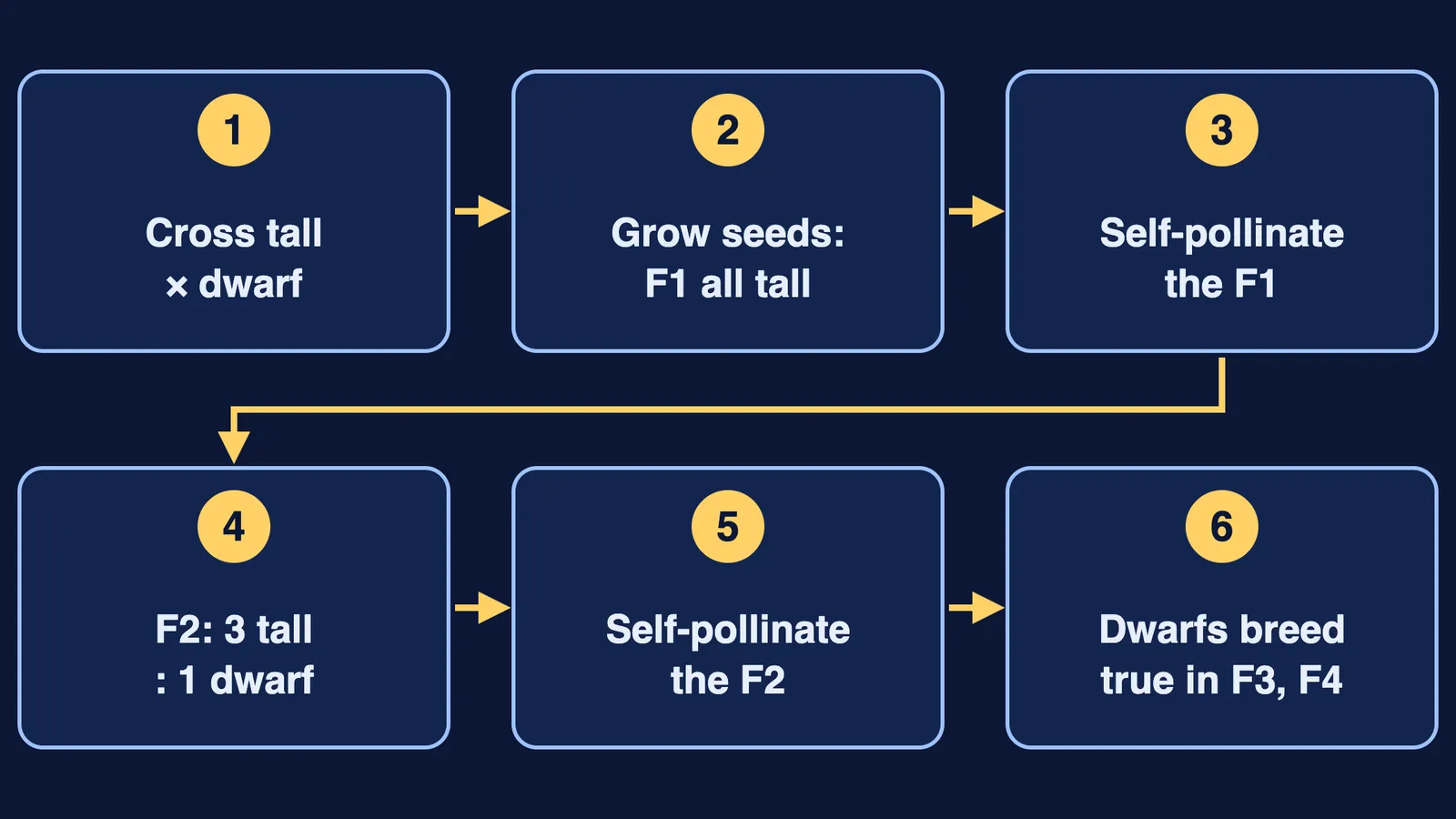
Monohybrid cross (4.2): tall × dwarf, seeds grown into an all-tall F1, F1 self-pollinated, F2 of 3 tall : 1 dwarf, F2 selfed, dwarfs breed true in F3 and F4.
Dihybrid cross (4.3, 4.3.1): RRYY and rryy form RY and ry gametes, these unite into F1 RrYy, the F1 makes RY, Ry, rY and ry gametes equally, the F2 shows 9:3:3:1.
Chromosomal theory (4.3.2): better microscopy, cell division watched, dividing nuclear structures named chromosomes, their meiotic movement worked out by 1902, Sutton and Boveri match it to genes, Sutton names the theory, Morgan's group tests it.
Linkage to maps (4.3.3): yellow-bodied, white-eyed females × brown-bodied, red-eyed males, F1 intercrossed, F2 far from 9:3:3:1, Morgan coins "linkage" and "recombination", Sturtevant maps genes by recombination frequency.
X body to sex chromosome (4.6): Henking (1891) traces a structure through insect spermatogenesis, calls it the X body without explaining it, others show it is a chromosome, it is named the X-chromosome, then designated the sex chromosome.
Human sex determination (4.6.1): half the sperm carry X and half Y, one fertilises the X-bearing ovum, the zygote is XX or XY, it develops as female or male.
Phenylketonuria (4.5, 4.8.2): enzyme gene mutated, so phenylalanine is not made into tyrosine and builds up, then becomes phenylpyruvic acid and other derivatives, these collect in the brain, mental retardation follows.
Dates NCERT prints: experiments from 1856 (4.1), publication 1865 and rediscovery 1900 (4.3.2), Langdon Down 1866 (4.8.3), Henking 1891 (4.6).
How do you attack arrange-in-order questions?
Pin the first and last steps; strike options that disagree. Where survivors differ, ask which step needs the other first: a ratio cannot be counted before its generation exists.
Can you put these NCERT steps in order?
Q1. A. The F2 shows 9:3:3:1 B. RRYY and rryy form RY and ry gametes C. The F1 makes RY, Ry, rY and ry gametes equally D. RY and ry unite to give F1 RrYy. (1) B-C-D-A (2) D-B-C-A (3) B-D-C-A (4) B-D-A-C
Q2. A. Sutton and Boveri link chromosome behaviour to genes B. Better microscopes reveal cell division C. Chromosome movement in meiosis is worked out D. Dividing nuclear structures are found and called chromosomes E. Sutton names the chromosomal theory. (1) B-D-A-C-E (2) B-D-C-A-E (3) D-B-C-A-E (4) B-D-C-E-A
Q3. A. Sturtevant maps genes using recombination frequency B. F1 flies are intercrossed C. Yellow-bodied, white-eyed females × brown-bodied, red-eyed males D. Morgan coins the term linkage E. The F2 departs far from 9:3:3:1. (1) C-B-E-D-A (2) C-E-B-D-A (3) C-B-D-E-A (4) B-C-E-D-A
Q4. A. Other scientists conclude the X body is a chromosome B. Henking traces a structure through insect spermatogenesis C. The structure is named the X-chromosome D. Henking calls it the X body E. It is designated the sex chromosome. (1) B-A-D-C-E (2) B-D-C-A-E (3) D-B-A-C-E (4) B-D-A-C-E
Q5. A. The zygote is XX or XY B. Spermatogenesis gives X-bearing and Y-bearing sperm C. The zygote develops as female or male D. A sperm fertilises an X-bearing ovum. (1) B-D-A-C (2) D-B-A-C (3) B-A-D-C (4) B-D-C-A
Q6. By year: A. Henking traces the X body B. Mendel publishes C. Langdon Down describes Down's syndrome D. Mendel's results are rediscovered E. Mendel's pea experiments begin. (1) E-C-B-A-D (2) E-B-A-C-D (3) E-B-C-A-D (4) B-E-C-A-D
Answers. 1: (3). The F1 exists only once RY meets ry (4.3). 2: (2). Sutton and Boveri used the worked-out meiotic movement (4.3.2). 3: (1). The deviation came before Morgan named linkage (4.3.3). 4: (4). Henking named the X body but could not explain it (4.6). 5: (1). Fertilisation fixes XX or XY (4.6.1). 6: (3). 1856, 1865, 1866, 1891, 1900 (4.1, 4.3.2, 4.8.3, 4.6).
Which step comes before, after or out of place?
Q7. What came immediately after Mendel selfed the tall F1 plants? (1) All offspring were tall (2) The F1 seeds were grown (3) Dwarf plants reappeared as about 1/4 of the F2 (4) F2 dwarfs gave only dwarfs in F3 and F4
Q8. In phenylketonuria, what comes immediately after phenylalanine builds up? (1) The enzyme that makes tyrosine is missing (2) Phenylalanine is changed into phenylpyruvic acid and other derivatives (3) Mental retardation (4) Derivatives collect in the brain
Q9. One step is misplaced: self-pollinate F1; cross tall with dwarf; grow the seeds into an all-tall F1; count the F2, 3 tall : 1 dwarf; F2 dwarfs breed true in F3 and F4. Which single step must move? (1) Cross tall with dwarf (2) Self-pollinate F1 (3) Grow the seeds into F1 (4) Count the F2
For Q10 and Q11: (1) Both I and II are correct (2) Both I and II are incorrect (3) I is correct, II is incorrect (4) I is incorrect, II is correct.
Q10. I: In the dihybrid cross, the F1 RrYy forms its four gamete types before the 9:3:3:1 F2 appears. II: Mendel's test cross used a tall plant taken from the F2, so it could only follow the F2 generation.
Q11. I: In humans, sex is fixed at fertilisation, and the zygote then develops as female or male. II: Morgan's group verified the chromosomal theory before Sutton and Boveri linked chromosomes to genes.
Answers. 7: (3). The recessive trait returned in the F2, unblended (4.2). 8: (2). Conversion to phenylpyruvic acid precedes its build-up in the brain (4.8.2). 9: (2). Selfing needs the F1, so it moves to third (4.2). 10: (1). Both follow NCERT's order (4.3.1, 4.2). 11: (3). Morgan's verification followed Sutton and Boveri's synthesis (4.6.1, 4.3.2).
Where should you practise next?
To drill the same chapter in other formats, use the statement and match-the-list set, the diagram-based questions and the NCERT exceptions and odd-one-out set.
Which of these orders do you keep scrambling? Fermi's AI tutor works out what you already know and builds a plan for the session.