On this page
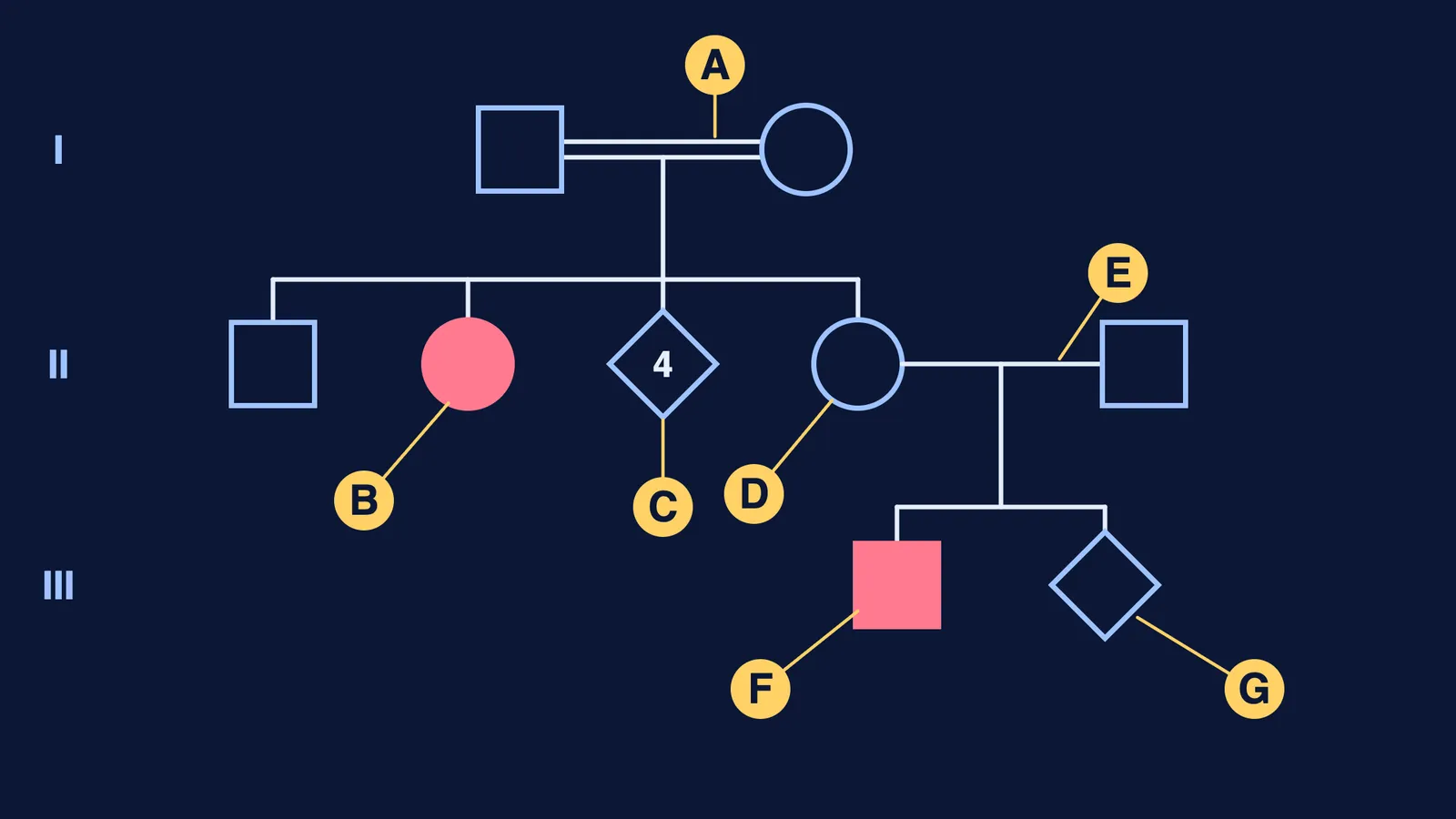
Our hero is an original three-generation pedigree drawn with the standard symbols of NCERT Class 12 Biology Chapter 4, Principles of Inheritance and Variation and seven parts tagged A to G. The NEET (UG) 2026 syllabus places this chapter in Unit 7, Genetics and Evolution.
Q1 to Q6 use the letters; Q7 to Q14 describe other figures in words. All 14 items are new, with reasons from the NCERT text (Reprint 2026-27).
Study summary, not medical advice. The disorder items repeat NCERT and say nothing about any real family.
How should you read a family tree drawn with letters?
Name each symbol's sex and status, generation by generation.
An unaffected couple with an affected child signals a recessive allele.
Before choosing X-linked recessive, check each affected daughter's father.
Can you decode symbols A to G in the pedigree?
In match items, lock in the pair you trust most. Two-statement codes: (1) I and II hold (2) I and II fail (3) I holds, II fails (4) II holds, I fails.
Line A shows: (1) an unrelated couple (2) a mating between relatives (3) parents above, children below (4) an affected couple
Which two letters mark individuals who show the trait? (1) B and D (2) C and G (3) D and F (4) B and F
I: Symbol C records four unaffected offspring whose sex is not given. II: The children in generation II are drawn in order of birth, left to right.
Which pattern best fits this pedigree? (1) Autosomal dominant (2) X-linked recessive (3) Autosomal recessive (4) Co-dominant
Match List-I (A, C, E, G) with List-II: I. Mating II. Sex unspecified III. Mating between relatives IV. Four unaffected offspring. Codes: (1) A-I, C-IV, E-III, G-II (2) A-III, C-IV, E-I, G-II (3) A-III, C-II, E-I, G-IV (4) A-IV, C-III, E-II, G-I
If the trait is sickle-cell anaemia (autosomal recessive in NCERT), D must be: (1) HbAHbS (2) HbAHbA (3) HbSHbS (4) free of the HbS allele
Answer key for the lettered diagram
A: mating between relatives (consanguineous mating). B: affected female. C: four unaffected offspring, sex unspecified. D: unaffected female. E: mating. F: affected male. G: individual of unspecified sex, unaffected. Symbols: Figure 4.13 (pedigree symbols) of the chapter.
1: (2). A double line marks a consanguineous mating.
2: (4). Filled symbols are affected individuals.
3: (1). A diamond's number counts unaffected offspring; siblings run in birth order from the left.
4: (3). Unaffected parents have an affected daughter, B, so the trait is recessive, not dominant; it is not X-linked, since an affected daughter needs an affected father.
5: (2). Double line, numbered diamond, single line, plain diamond.
6: (1). D is unaffected but has an affected son, so she carries HbS; only HbSHbS individuals show the disease.
Can you answer the cross and chromosome figures from a description?
Two-statement items use the codes above.
NCERT writes the F2 of Tt × Tt as the square of which binomial? (1) (T + t)/2 (2) (1/4 T + 3/4 t)² (3) 1/2 (TT + tt) (4) (1/2 T + 1/2 t)²
A test-cross figure uses violet (V) over white (v) flowers. I: The dominant-looking plant is crossed with the recessive parent, not selfed. II: A VV violet parent would give half white offspring.
A figure follows meiosis in a cell with four chromosomes. Each germ cell receives: (1) four (2) two, one per pair (3) both members of one pair (4) one
In the dihybrid cross figure, which is NOT a gamete of the F1 plant RrYy? (1) Ry (2) rY (3) Rr (4) ry
Match figure with idea. List-I: A. Snapdragon red × white B. Possibilities I and II at the metaphase plate C. Morgan's Crosses A and B D. Honey bee. List-II: I. Incomplete dominance II. Independent alignment of chromosome pairs III. Unequal linkage strength IV. Sex set by chromosome sets. Codes: (1) A-I, B-II, C-III, D-IV (2) A-I, B-III, C-II, D-IV (3) A-IV, B-II, C-III, D-I (4) A-II, B-I, C-IV, D-III
Morgan's figure compares Cross A (y and w) with Cross B (w and m). Which is correct? (1) Cross A gives more recombinants (2) Both fit 9:3:3:1 (3) w and m are more tightly linked (4) y and w are more tightly linked
I: In the panels for humans and Drosophila, the female is homogametic, XX. II: In the panel for many birds, the male carries the dissimilar pair ZW.
A figure compares red blood cells and part of the β-chain in a normal person and in sickle-cell anaemia. Which is correct? (1) Mutant haemoglobin polymerises at low oxygen tension, sickling the biconcave cell (2) Glutamic acid replaces valine (3) The alpha globin gene is altered (4) GUG becomes GAG
Answers, all from the NCERT chapter:
7: (4). Gametes carry T or t with a frequency of 1/2 each, giving 1/4 TT + 1/2 Tt + 1/4 tt.
8: (3). A VV parent passes only V, so no white offspring would appear.
9: (2). Each germ cell gets one member of each pair.
10: (3). A gamete carries one allele of each gene: RY, Ry, rY and ry, a quarter each.
11: (1). The pink F1 is incomplete dominance; the bee is haplodiploid.
12: (4). NCERT notes y–w linkage is stronger than w–m.
13: (3). Females are XX; in birds the female is ZW and the male ZZ.
14: (1). GAG becomes GUG, and the sixth amino acid of the beta chain switches from Glu to Val.
What should you redraw if you missed one?
Missed Q1 to Q6: draw the symbol chart from memory, then tag a tree of your own. Missed Q7, Q8 or Q10: write gametes first. Missed Q11 to Q13: redraw and caption each figure.
For text-only items, try the statements and match-the-list set on principles of inheritance; for worked crosses, the principles of inheritance practice questions with solutions. Next chapter: molecular basis of inheritance diagram set.
Which figure do you still have to look up? Fermi's AI tutor works out what you already know and builds a plan for the session.