On this page
The third law tells you that entropy has a true zero, at 0 K for a perfect crystal, and that every substance at 298 K has a positive standard entropy. Then you open a data table for a JEE numerical and find Mg²⁺(aq) at −137 J K⁻¹ mol⁻¹ and Al³⁺(aq) at −325. Both statements are correct. They are about different kinds of number. The S° of an element or compound is absolute. The S° of an aqueous ion is measured against a chosen zero, and that zero is H⁺(aq).
Why can the standard entropy of an ion be negative?
You can never put one kind of ion in a beaker on its own. A solution must stay electrically neutral, so every experiment on Mg²⁺(aq) also contains an equal charge of anions. Measurements give the entropy of the whole salt in solution, and there is no experiment that splits that total between the cation and the anion.
So tables fix one ion by agreement. The open University of Wisconsin general chemistry text puts it this way: for aqueous ions, "the standard entropy values are reported at 1 M concentrations relative to that of H⁺(aq), which is set to S° = 0 by convention." The CODATA Key Values for Thermodynamics, the internationally agreed reference set, list H⁺(aq) with ΔfH° = 0 and S° = 0.
So S°(Mg²⁺, aq) = −137 J K⁻¹ mol⁻¹ means "137 less than H⁺(aq)", not "less than nothing". It is the same idea as setting ΔfH° of H⁺(aq) to zero, explained in why the standard enthalpy of formation of elements is zero. The difference is that for neutral substances S° really is absolute, as shown in the third law and absolute entropy. For ions it is not.
What are the standard entropies of common aqueous ions?
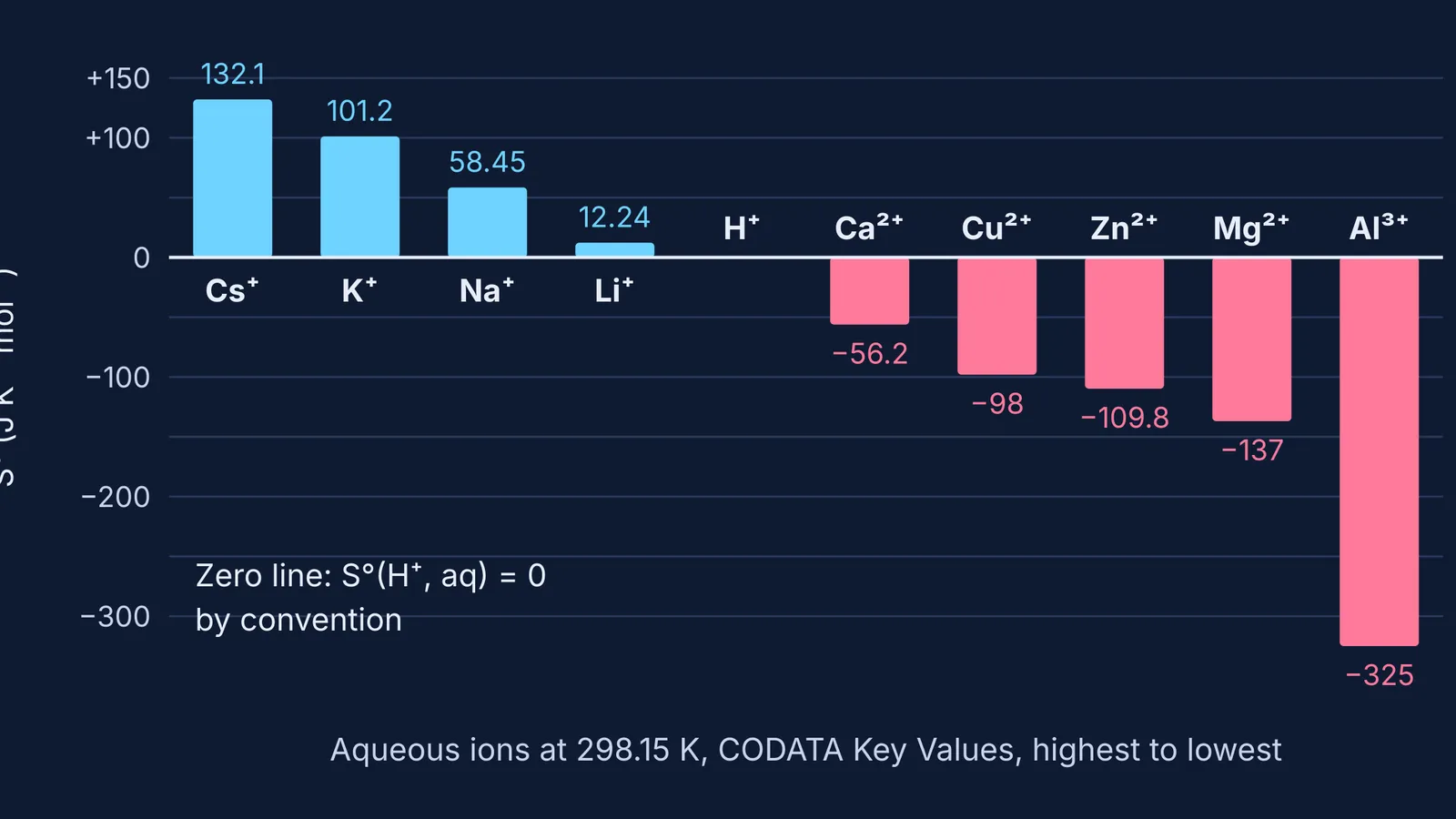
CODATA values at 298.15 K, in J K⁻¹ mol⁻¹:
Cs⁺ 132.1, K⁺ 101.20, Na⁺ 58.45, Li⁺ 12.24
H⁺ 0 (by convention)
Ca²⁺ −56.2, Cu²⁺ about −98, Zn²⁺ −109.8, Mg²⁺ about −137
Al³⁺ about −325 (CODATA gives ±10, so treat it as approximate)
I⁻ 106.45, Br⁻ 82.55, Cl⁻ 56.60, F⁻ −13.8, OH⁻ −10.90, CO₃²⁻ −50.0
The pattern is clean. Down Group 1, the bigger the ion, the higher its S°. Going from +1 to +2 to +3 charge, S° drops sharply. Among the halides, F⁻ is the only one below zero.
Why are small, highly charged ions the most negative?
An ion in water pulls the nearby water molecules into an ordered shell. The smaller the ion and the higher its charge, the stronger the pull and the more water is held in place. That lost freedom of the water shows up as lower entropy. Al³⁺ and Mg²⁺ are small and highly charged, so they sit at the bottom. Cs⁺ is large with a single charge, so it orders water the least.
The same strong hydration explains other facts you already know, such as why Li⁺ has the lowest ionic mobility in water.
One caution. Because the numbers are relative, a positive value does not prove an ion disorders water, and a negative value does not prove the ion has less than zero entropy. Only the order and the differences mean something. No experiment gives the absolute entropy of H⁺(aq) on its own, and you do not need it for any exam.
Does the H⁺ convention break ΔrS° calculations?
No. Suppose the "true" value of S°(H⁺, aq) were some unknown number c. Shifting the zero would raise every cation's S° by c times its charge and lower every anion's by c times its charge. In any balanced ionic equation, total charge is the same on both sides, so all the c terms cancel. ΔrS° comes out the same whichever zero you choose.
That is why you can use table values directly in ΔrS° = ΣS°(products) − ΣS°(reactants), negative signs included.
Worked example: magnesium in acid
Find ΔrS°, ΔrG° and E° for Mg(s) + 2H⁺(aq) → Mg²⁺(aq) + H₂(g) at 298.15 K. CODATA data: S°/J K⁻¹ mol⁻¹: Mg(s) 32.67, H⁺ 0, Mg²⁺ −137, H₂(g) 130.680. ΔfH°(Mg²⁺, aq) = −467.0 kJ mol⁻¹.
Check the equation. One Mg and two H on each side. Charge +2 on each side.
ΔrS°. Products: −137 + 130.68 = −6.32. Reactants: 32.67 + 2(0) = 32.67. ΔrS° = −6.32 − 32.67 = −39.0 J K⁻¹ mol⁻¹.
ΔrH°. Only Mg²⁺ has a non-zero ΔfH°, so ΔrH° = −467.0 kJ mol⁻¹.
ΔrG°. ΔrG° = ΔrH° − TΔrS° = −467.0 − 298.15 × (−0.0390) = −467.0 + 11.6 = −455.4 kJ mol⁻¹.
E°. For the half-reaction Mg²⁺ + 2e⁻ → Mg, ΔG° = +455.4 kJ, so E° = −ΔG°/(nF) = −455,400/(2 × 96,485) = −2.36 V.
That is the standard electrode potential of magnesium you meet in E° tables. Now see what happens if you drop the minus sign and use +137. ΔrS° becomes +235.0 J K⁻¹ mol⁻¹, ΔrG° becomes −537.1 kJ mol⁻¹ and E° comes out −2.78 V, which is wrong by more than 0.4 V.
The same data pass a second test. For H₂O(l) → H⁺(aq) + OH⁻(aq), CODATA gives ΔrS° = −10.90 − 69.95 = −80.85 J K⁻¹ mol⁻¹ and ΔrH° = +55.815 kJ mol⁻¹. Then ΔrG° = 79.92 kJ mol⁻¹ and pKw = 79,920/(2.303 × 8.314 × 298.15) = 14.00. The negative entropy of OH⁻ is exactly what gives Kw = 1.0 × 10⁻¹⁴. How Kw then shifts with temperature is covered in why neutral pH is not always 7.
For more practice with ΔrS°, ΔrG° and E° from tables, the Fermi Problem Library has a step-by-step solver that explains the reasoning at each line.
What mistakes should you avoid?
Calling a negative ion S° a third-law violation. The third law is about absolute entropy; ion values are relative.
Dropping the minus sign on ion entropies. It can change E° by tenths of a volt.
Assuming S°(H⁺, aq) = 0 means H⁺ has no entropy. It is a chosen zero, like sea level.
Treating aqueous S° values as exact. Multivalent ions carry larger uncertainties: Mg²⁺ ±4, Al³⁺ ±10.
Mixing an element's S° (never zero at 298 K) with its ΔfH° (zero in its reference state).
If thermodynamics data questions keep slowing you down, Fermi's AI tutor for JEE prep can work out where you are stuck and build a plan for the session.
Quick checklist
S° of elements and compounds is absolute and always positive at 298 K.
S° of aqueous ions is relative to S°(H⁺, aq) = 0.
Small, highly charged ions have the most negative values: Al³⁺ about −325, Mg²⁺ about −137.
The convention cancels in any charge-balanced equation, so ΔrS° is unaffected.
Keep every sign from the table.
Check: CODATA data give E°(Mg²⁺/Mg) = −2.36 V and pKw = 14.00.