

On this page
Enthalpy has no zero point you can measure. You only ever get ΔH, which is why tables list ΔfH° with elements set to zero by agreement. Entropy is different. The third law of thermodynamics gives entropy a real zero, so a data book can list absolute values like S°(N₂) = 191.6 J K⁻¹ mol⁻¹.
What does the third law of thermodynamics say?
The entropy of a perfectly crystalline substance is zero at absolute zero (0 K).
Each word matters:
Perfectly crystalline means every particle sits in its lattice site in one fixed orientation. There is no disorder of position or of direction.
At 0 K all thermal motion has dropped to the lowest possible energy state.
Zero follows from Boltzmann's relation S = k ln W. A perfect crystal at 0 K can be arranged in only one way, so W = 1 and ln 1 = 0.
Why can we tabulate absolute entropy but not absolute enthalpy?
For enthalpy there is no state where you know H = 0. Every measurement gives a change. Chemists then choose a convention: ΔfH° of every element in its standard state is zero.
For entropy, the third law hands you a physical zero. Once you know S = 0 at 0 K, you can add up the entropy gained while warming the substance to 298 K. The total is the absolute (third-law) entropy, S°. That is why tables say S°, not ΔfS°.
How is the standard entropy S° measured?
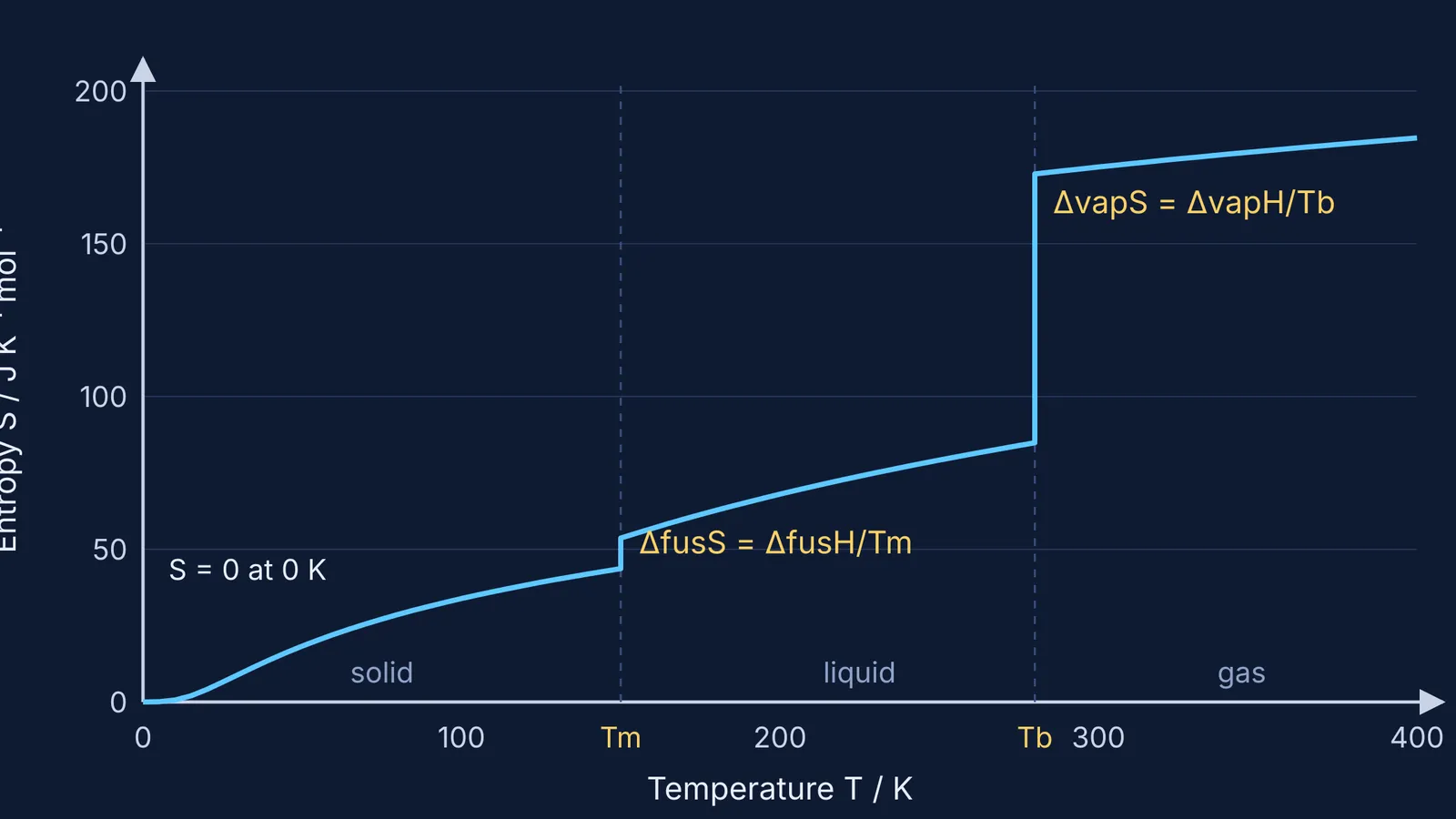
You heat one mole of the substance from close to 0 K up to 298 K at 1 bar and add up every step. For warming within one phase, each small step adds dS = Cp dT / T. For each phase change at its transition temperature, the entropy jumps by ΔH/T. In words:
Solid from 0 K to its melting point Tm: integrate Cp/T dT using measured heat capacities. Very close to 0 K, where measurement is hard, Cp is extrapolated with the Debye law (Cp proportional to T³).
Melting at Tm: add ΔfusS = ΔfusH / Tm.
Liquid from Tm to the boiling point Tb: integrate Cp/T dT again.
Boiling at Tb: add ΔvapS = ΔvapH / Tb.
Gas up to 298 K (if it gets there): integrate Cp/T dT once more.
The graph at the top shows this: a smooth rise inside each phase and two jumps. The jump at boiling is much bigger than the jump at melting. For water, ΔfusS = 6.01 kJ mol⁻¹ / 273 K ≈ 22 J K⁻¹ mol⁻¹, while ΔvapS = 40.7 kJ mol⁻¹ / 373 K ≈ 109 J K⁻¹ mol⁻¹. We work through these jumps in more detail in entropy change during melting or boiling (ΔS = ΔH/T).
Why is S° of a gas greater than that of a liquid or solid?
Entropy counts how many ways the energy and particles of a system can be arranged. In a solid, particles only vibrate about fixed sites. In a liquid, they can also move past one another. In a gas, they spread through the whole volume and translate and rotate freely. More freedom means many more microstates, so S°(gas) > S°(liquid) > S°(solid) for the same substance.
Water shows it clearly: S°(H₂O, l) = 69.9 J K⁻¹ mol⁻¹ but S°(H₂O, g) = 188.8 J K⁻¹ mol⁻¹. Among solids, harder and more ordered lattices have lower entropy: diamond is 2.4 J K⁻¹ mol⁻¹ and graphite is 5.7 J K⁻¹ mol⁻¹.
Why is S° of an element not zero when ΔfH° is?
This is a favourite trap. ΔfH° of an element in its standard state is zero by convention. S° is not a formation quantity at all; it is an absolute value measured from 0 K. Any element at 298 K has absorbed heat on the way up from 0 K, so its entropy is positive. H₂(g) has S° = 130.7 J K⁻¹ mol⁻¹ and O₂(g) has 205.1 J K⁻¹ mol⁻¹.
Which substances do not have zero entropy at 0 K?
Some crystals freeze in disorder before they reach 0 K, so they keep a residual entropy.
CO: the molecule is nearly symmetric, so in the crystal each CO can point either way (CO or OC) with almost no energy difference. If both orientations were fully random, the residual entropy would be R ln 2 ≈ 5.76 J K⁻¹ mol⁻¹. The measured value is a little lower, because the disorder is not complete.
N₂O: a linear NNO molecule that can sit as NNO or ONN, for the same reason as CO.
Ice: the oxygen atoms form an ordered lattice, but the hydrogen atoms can be arranged in many ways along the hydrogen bonds. Linus Pauling estimated the residual entropy as R ln (3/2) ≈ 3.4 J K⁻¹ mol⁻¹, close to the measured value.
These are not violations of the third law. These crystals are simply not perfect, which is the condition the law asks for.
How do you calculate ΔrS° from standard entropies?
Use products minus reactants, each multiplied by its stoichiometric coefficient:
ΔrS° = Σ ν S°(products) − Σ ν S°(reactants)
Worked example: find ΔrS° for N₂(g) + 3H₂(g) → 2NH₃(g) at 298 K. Data: S°(N₂) = 191.6, S°(H₂) = 130.7, S°(NH₃) = 192.5, all in J K⁻¹ mol⁻¹.
Products: 2 × 192.5 = 385.0 J K⁻¹ mol⁻¹.
Reactants: 191.6 + 3 × 130.7 = 191.6 + 392.1 = 583.7 J K⁻¹ mol⁻¹.
ΔrS° = 385.0 − 583.7 = −198.7 J K⁻¹ mol⁻¹.
Check the sign. Four moles of gas become two moles of gas, so the system becomes more ordered and ΔrS° should be negative. It is. For more practice on predicting the sign of ΔS before you calculate, see entropy in chemistry: predicting the sign of ΔS and calculating it.
This negative ΔrS° is why the Haber process favours lower temperatures for equilibrium yield: in ΔG = ΔH − TΔS, the −TΔS term grows more unfavourable as T rises. You can find the crossover temperature using the method in temperature at which a reaction becomes spontaneous: T = ΔH/ΔS.
If the idea of microstates still feels abstract, the Fermi Concept Library covers every concept in chemistry, including entropy and the laws of thermodynamics, so you can revise the background before attempting numericals.
Quick checklist
The third law: a perfectly crystalline substance has S = 0 at 0 K.
That gives entropy a true zero, so tables list absolute S°, not ΔfS°.
S° comes from adding ∫Cp/T dT within each phase plus ΔH/T at each phase change.
S°(gas) > S°(liquid) > S°(solid); the boiling jump is far larger than the melting jump.
Elements have positive S° even though their ΔfH° is zero.
CO, N₂O and ice keep residual entropy because their crystals are not perfectly ordered.
ΔrS° = Σ ν S°(products) − Σ ν S°(reactants); check the sign against the change in moles of gas.


