On this page
In April 1888 Hugo de Vries, professor of botany in Amsterdam, settled an argument that chemists had been having about a sugar. Chemists agreed what raffinose was made of, but three camps gave it molar masses of 396, 594 and 1188. De Vries found the sugar strength that just made purple leaf cells shrink from their walls, compared it with cane sugar, and got 595.7. This post follows his paper, "Osmotische Versuche mit lebenden Membranen" (Osmotic experiments with living membranes), in the Zeitschrift für physikalische Chemie, volume 2, pages 431–432. Translations from the German are ours.
Why couldn't chemists agree on the formula of raffinose?
Raffinose is a crystalline sugar. De Vries describes it as the sugar "identical with gossypose and melitose", and lists the three opinions:
396: C₁₂H₂₂O₁₁ + 3H₂O, from Berthelot and Ritthausen.
594: C₁₈H₃₂O₁₆ + 5H₂O, from Loiseau and Scheibler.
1188: C₃₆H₆₄O₃₂ + 10H₂O, from Tollens and Rischbiet.
Then he points out the catch: "These three formulas correspond to the same elemental composition of the crystalline substance, but to different contents of water of crystallisation."
C₁₂H₂₂O₁₁·3H₂O adds up to C₁₂H₂₈O₁₄. Multiply by 1.5 and you get C₁₈H₄₂O₂₁, which is exactly C₁₈H₃₂O₁₆·5H₂O. Double that and you get the third formula. All three contain 36.37% carbon and 7.12% hydrogen. Burning the sugar and weighing the CO₂ and water could never tell them apart.
The water figures fit. De Vries says the first formula assumed 13.64% water from older work, and the other two used 15.15% from "very exact experiments of Scheibler". We get 54.05 ÷ 396.34 = 13.64% and 90.08 ÷ 594.51 = 15.15%. Tollens and Rischbiet doubled the formula to fit a sodium derivative, C₁₂H₂₁NaO₁₁, and a 22–23% yield of mucic acid.
What was needed was a property that counts molecules.
How can a leaf cell count molecules?
De Vries used the purple lower skin of the leaf of Tradescantia discolor, cut from beside the midrib. A thin slice holds a few hundred living cells. Each has a rigid wall and, pressed against it, a living membrane full of coloured sap. He describes the sap as a weak solution, mostly 2–3%, containing glucose, potassium and calcium malate and some salts, with an osmotic pressure of about 4–6 atmospheres.
In a solution stronger than the sap, water leaves the cell. The wall keeps its shape but the coloured contents pull away from it: plasmolysis. In a weaker or equal solution nothing visible happens.
De Vries looked for the boundary: the weakest solution that just starts plasmolysis. That solution has the same osmotic pressure as the sap. He called such solutions isotonic, a word he built from the Greek for "equal" and "tension". The boundary is sharp: cells from one leaf were untouched in 0.20 mol of cane sugar per litre but slightly plasmolysed after two hours in 0.22.
The key step is in one sentence. If a sugar of unknown molar mass and one of known molar mass are both isotonic with the same cells, "both solutions will evidently contain approximately the same number of dissolved molecules per unit volume". That is van 't Hoff's law, π = CRT, applied to non-electrolytes: equal π at the same T means equal C. For how van 't Hoff got there from Pfeffer's pots, see van 't Hoff's osmotic pressure equation and why π = CRT works.
Is his plant the Rhoeo leaf from your practical?
Yes. Tradescantia discolor and Rhoeo discolor are both older names for Tradescantia spathacea, the oyster plant, whose leaves are purple underneath. That is the Rhoeo peel in the Class 11 Biology plasmolysis experiment, and de Vries used the same purple layer.
In school you use strong salt solution to see plasmolysis happen and reverse it. De Vries used a series of sugar solutions to find the exact concentration at which it begins (incipient plasmolysis). If the three words still blur, read isotonic, hypotonic and hypertonic: what happens to cells.
Worked example: from four leaves to a molar mass of about 596
Each experiment used peels cut close together from one leaf. Cane sugar (sucrose, M = 342.3) was made up in mol per litre. Raffinose was weighed as crystals, water of crystallisation included, and given as a percentage, meaning grams per 100 mL of solution. His four isotonic pairs:
Leaf I: 0.19 mol L⁻¹ sucrose and 10.5% raffinose.
Leaf II: 0.17 mol L⁻¹ and 10.5%.
Leaf III: 0.17 mol L⁻¹ and 10.0%.
Leaf IV: 0.20 mol L⁻¹ and 12.5%.
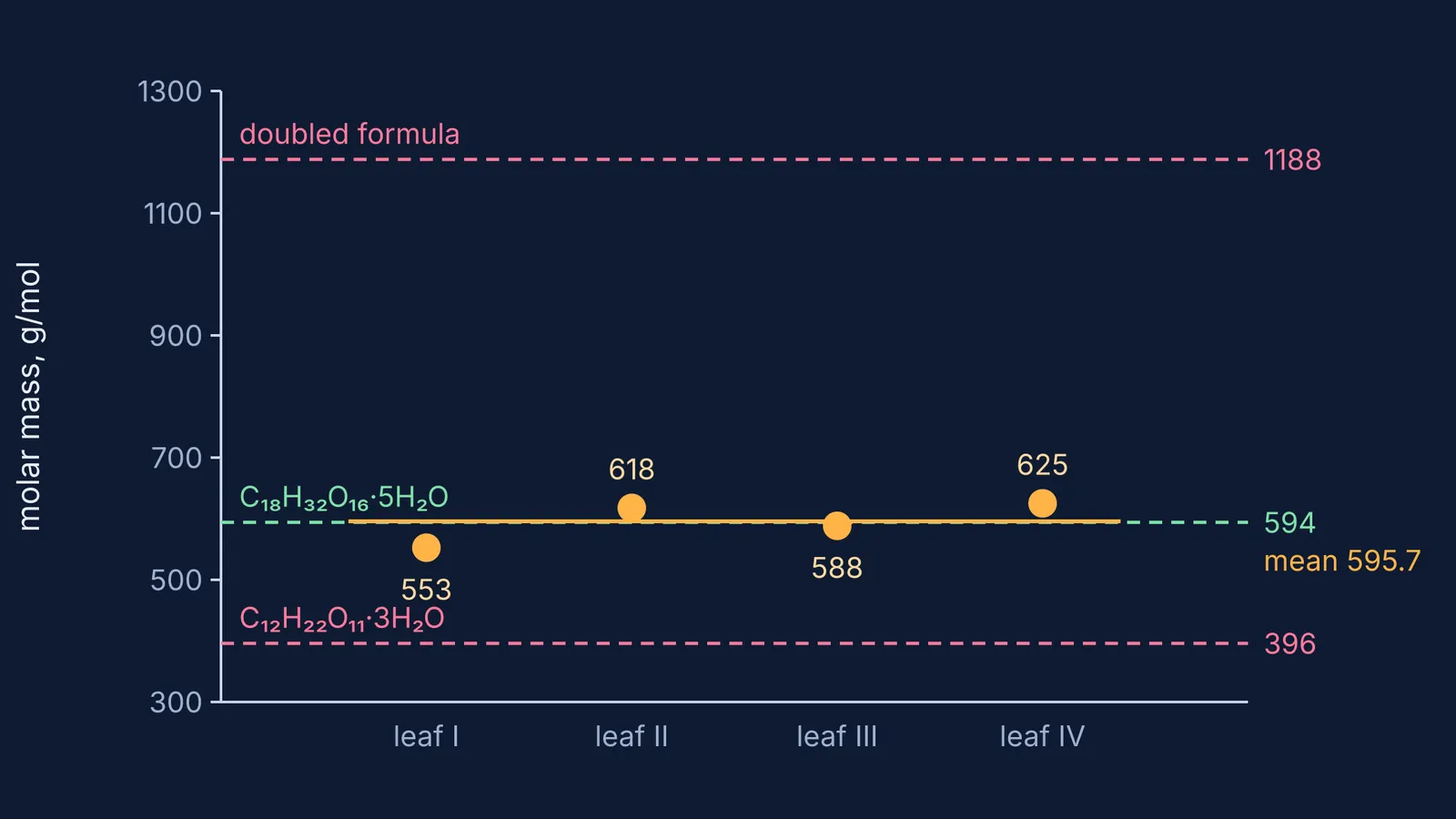
Scale each pair to 0.1 mol L⁻¹ sucrose. Leaves differ, but within a pair the ratio holds. Leaf I: 10.5 × 0.1 ÷ 0.19 = 5.526%. The others give 6.176%, 5.882% and 6.250%. These are his numbers.
Average. (5.526 + 6.176 + 5.882 + 6.250) ÷ 4 = 5.959%. He printed 5.957%; the small difference does not change anything.
Convert to a molar mass. 5.957% means 59.57 g per litre. It is isotonic with 0.1 mol L⁻¹ sucrose, so it also holds about 0.1 mol L⁻¹ of raffinose. M = 59.57 ÷ 0.1 = 595.7 g mol⁻¹.
Compare the candidates. A 396 sugar would have needed only 3.96%, and an 1188 sugar 11.88%. Even single leaves give 553 to 625. Only 594 fits.
Check against the cell. Sucrose at 0.17–0.20 mol L⁻¹ and an assumed 20 °C (293 K) gives π = CRT = 0.17 × 0.0821 × 293 = 4.1 atm up to 4.8 atm. That sits inside his 4–6 atm for the sap. This check is ours; he gives no temperature.
His verdict: the osmotic measurement "decides for the opinion put forward by Loiseau and defended by Scheibler." Today C₁₈H₃₂O₁₆·5H₂O works out at 594.51, so he was within 0.2%.
Why did the water of crystallisation matter?
He weighed crystals, so 595.7 is the molar mass of the hydrate. Anhydrous C₁₈H₃₂O₁₆ is 504.44; compare 595.7 with 504 and you would wrongly reject the right formula.
Today raffinose is known as a trisaccharide of galactose, glucose and fructose. Three hexoses joined by two glycosidic bonds lose two water molecules: 3C₆H₁₂O₆ − 2H₂O = C₁₈H₃₂O₁₆. Check: 18 C, 36 − 4 = 32 H and 18 − 2 = 16 O. The 1888 answer still stands.
Where is this in the JEE and NEET syllabus?
Class 12 Solutions: osmotic pressure, π = CRT, isotonic solutions, and molar mass from a colligative property. The usual numerical with a measured π is in finding molar mass from osmotic pressure.
Class 11 Biology: plasmolysis in Rhoeo peels.
Class 12 Biomolecules: oligosaccharides, and why an empirical formula is not a molecular formula.
To connect osmosis, colligative properties and cell biology as one idea, the Fermi Concept Library has a lesson for each concept in chemistry and biology. For more isotonic and π = CRT numericals, the Fermi Problem Library has a step-by-step solver that explains the reasoning.
Quick checklist
1888: three formulas for raffinose, molar masses 396, 594 and 1188, all with the same percentage composition.
De Vries found the weakest raffinose and sucrose solutions that just plasmolysed the same leaf cells.
Isotonic non-electrolyte solutions hold equal moles per litre (π = CRT).
5.957 g per 100 mL raffinose matched 0.1 mol L⁻¹ sucrose, so M ≈ 596 (hydrate 594.51).
Compare a measured molar mass with the form actually weighed: hydrate or anhydrous.