

On this page
These three words turn up in both biology and chemistry. Biology asks what the cell does, and chemistry asks for the number.
What is the difference between isotonic, hypotonic and hypertonic solutions?
All three words compare a solution with the fluid inside a cell. NCERT's Class 12 chemistry chapter on solutions defines them like this:
Isotonic: two solutions with the same osmotic pressure at a given temperature. No osmosis happens between them.
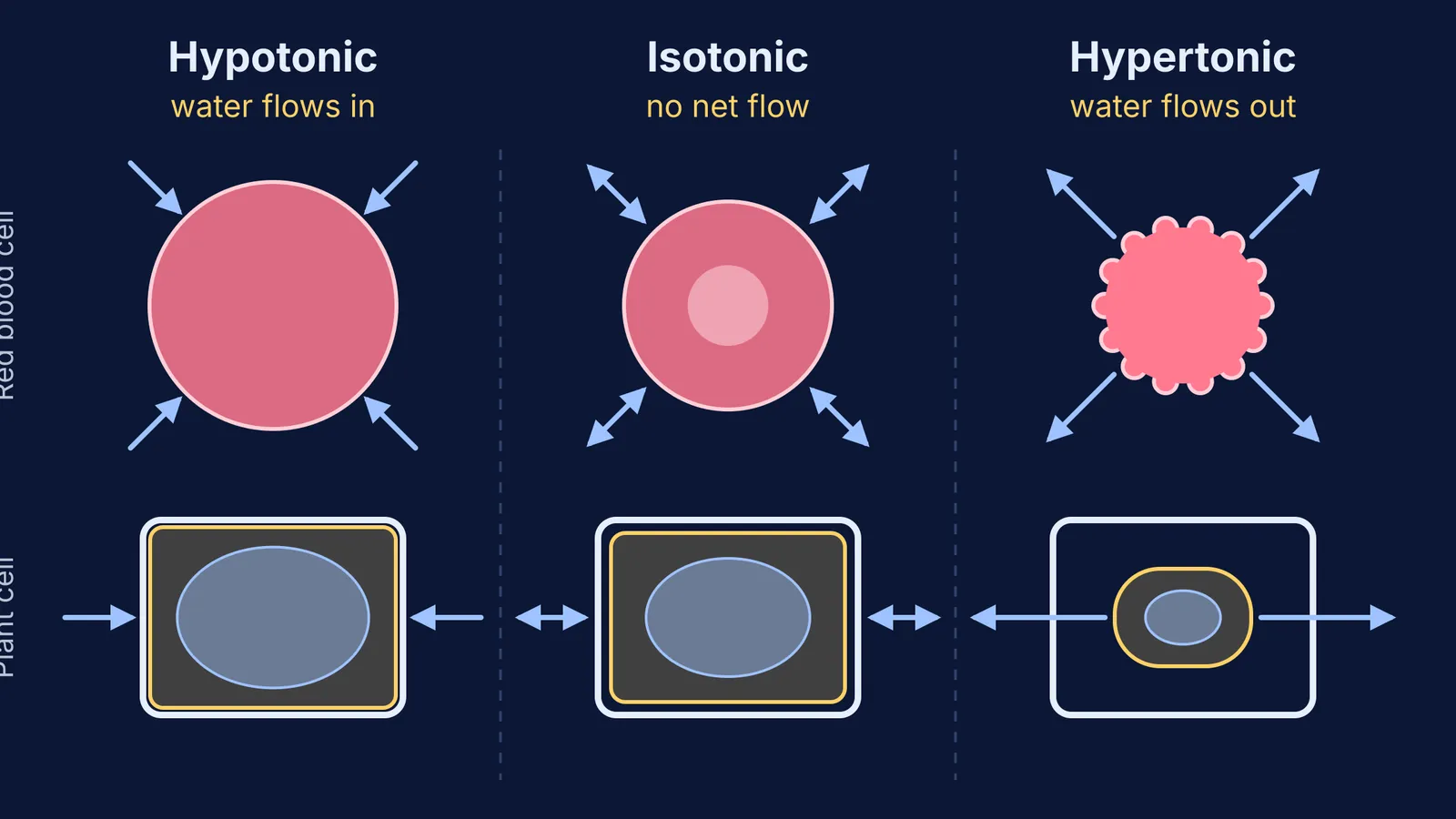
Hypertonic: the outside solution is more concentrated, so water flows out of the cell.
Hypotonic: the outside solution is less concentrated, so water flows into the cell.
Osmotic pressure is the extra pressure you must apply to a solution to stop solvent flowing into it through a semipermeable membrane, according to the same NCERT chapter. Left alone, the solvent flows from the more dilute side to the more concentrated side.
What happens to red blood cells in each solution?
A red blood cell has a membrane but no wall, so its volume follows the water. OpenStax Biology 2e describes all three cases:
Hypotonic: water enters and the cell swells. Past what the membrane can stretch to, it bursts (lysis).
Isotonic: there is no net movement of water, so the cell's size does not change.
Hypertonic: water leaves and the cell shrinks. In a red blood cell this shrinking is called crenation.
What happens to plant cells in each solution?
A plant cell has a rigid cell wall outside its membrane, and that changes the hypotonic result. OpenStax explains that cell walls prevent lysis in a hypotonic solution. Instead, the water that flows in creates turgor pressure, which stiffens the cell walls.
In a hypertonic solution, the membrane pulls away from the wall and the cytoplasm shrinks. This is called plasmolysis, and the plant wilts. NCERT gives kitchen examples. A raw mango in concentrated salt solution loses water and shrivels into pickle, and a limp carrot goes firm again in water.
Our post on why pickles last for months follows this into food safety.
Why is a saline drip 0.9% sodium chloride?
A drip goes straight into the blood, so it must not swell or shrink red blood cells. The NCERT chapter says that 0.9% (mass/volume) sodium chloride, called normal saline, has the same osmotic pressure as the fluid inside blood cells, and that it is safe to inject into a vein.
The numbers on the bag agree. Baxter's product listing gives an osmolarity of 308 mOsmol/L for its 0.9% sodium chloride injection. MedlinePlus gives the normal blood osmolality range as 275 to 295 mOsm/kg. The units differ slightly (per litre of solution against per kilogram of water), but the two values are close.
Which fluid a patient gets is a doctor's decision. This is chemistry, not treatment advice.
How do you calculate the osmotic pressure of normal saline?
NCERT gives the formula for dilute solutions as π = iCRT, where i is the van 't Hoff factor, C is the molarity, R = 0.083 L bar mol⁻¹ K⁻¹ and T is the temperature in kelvin (NCERT, Solutions).
Find the concentration. 0.9% (mass/volume) means 0.9 g in 100 mL, which is 9 g per litre.
Convert to moles. 9 g ÷ 58.5 g/mol = 0.154 mol/L.
Choose i. NaCl splits into Na⁺ and Cl⁻, so the ideal value is 2. NCERT's table gives a measured i of 1.87 at 0.1 m.
Take body temperature as 37 °C, which is 310 K. RT = 0.083 × 310 = 25.7 L bar/mol.
Ideal answer: π = 2 × 0.154 × 25.7 = 7.9 bar. With i = 1.87, it comes to about 7.4 bar.
Now check it against blood. Treating a kilogram of water as roughly a litre, the MedlinePlus range of 0.275 to 0.295 osmol/kg times RT gives about 7.1 to 7.6 bar. The more realistic 7.4 bar for saline falls inside that range, which is what "isotonic" means in numbers.
Two exam traps come from the same numbers:
Is 0.9% glucose isotonic? No. Glucose (180 g/mol) does not dissociate, so i = 1. That gives 9 ÷ 180 = 0.05 mol/L and π ≈ 1.3 bar, which is strongly hypotonic.
What glucose solution matches 0.9% saline? Set iC equal: glucose needs 2 × 0.154 = 0.308 mol/L, which is 0.308 × 180 ≈ 55 g/L, or about 5.5%.
For more practice ranking solutions by particle count, see ranking colligative properties using i × m. For osmosis pushed backwards, see how an RO water purifier works against osmotic pressure.
A three-question check for any tonicity problem
Which cell, and what is inside it? Tonicity always compares two sides.
Count particles, not grams: multiply molarity by i.
Does the cell have a wall? Without one it can burst. With one it becomes turgid or plasmolyses.
If a step here felt shaky, the Fermi Concept Library has a lesson on each idea, from osmosis to the van 't Hoff factor. For more numericals, the Fermi Problem Library has a step-by-step solver that explains the reasoning rather than printing an answer.