

On this page
In Class 12 CBSE, JEE Main, and NEET-UG chemistry, ranking problems frequently ask which solution has the highest boiling point, freezing point, or osmotic pressure. The classic comparison tests 0.1 m sodium chloride against 0.1 m glucose. The answer is 0.1 m sodium chloride, and the solution lies in counting total dissolved particles in colligative properties.
Which solution has the highest boiling point: 0.1 m NaCl or 0.1 m glucose?
Boiling point elevation depends strictly on the total concentration of solute particles, as detailed in Boiling-point elevation. Glucose is a covalent non-electrolyte. In water, each molecule stays intact, giving a van 't Hoff factor of i = 1 and an effective molality of 0.1 mol/kg.
Sodium chloride is a strong electrolyte that dissociates into Na⁺ and Cl⁻ ions, giving i ≈ 2 and an effective molality of i × m = 2 × 0.1 = 0.2 mol/kg—twice that of glucose.
For water, the molal boiling point elevation constant is Kb = 0.512 K kg/mol (Boiling-point elevation). Using ΔTb = i × Kb × m:
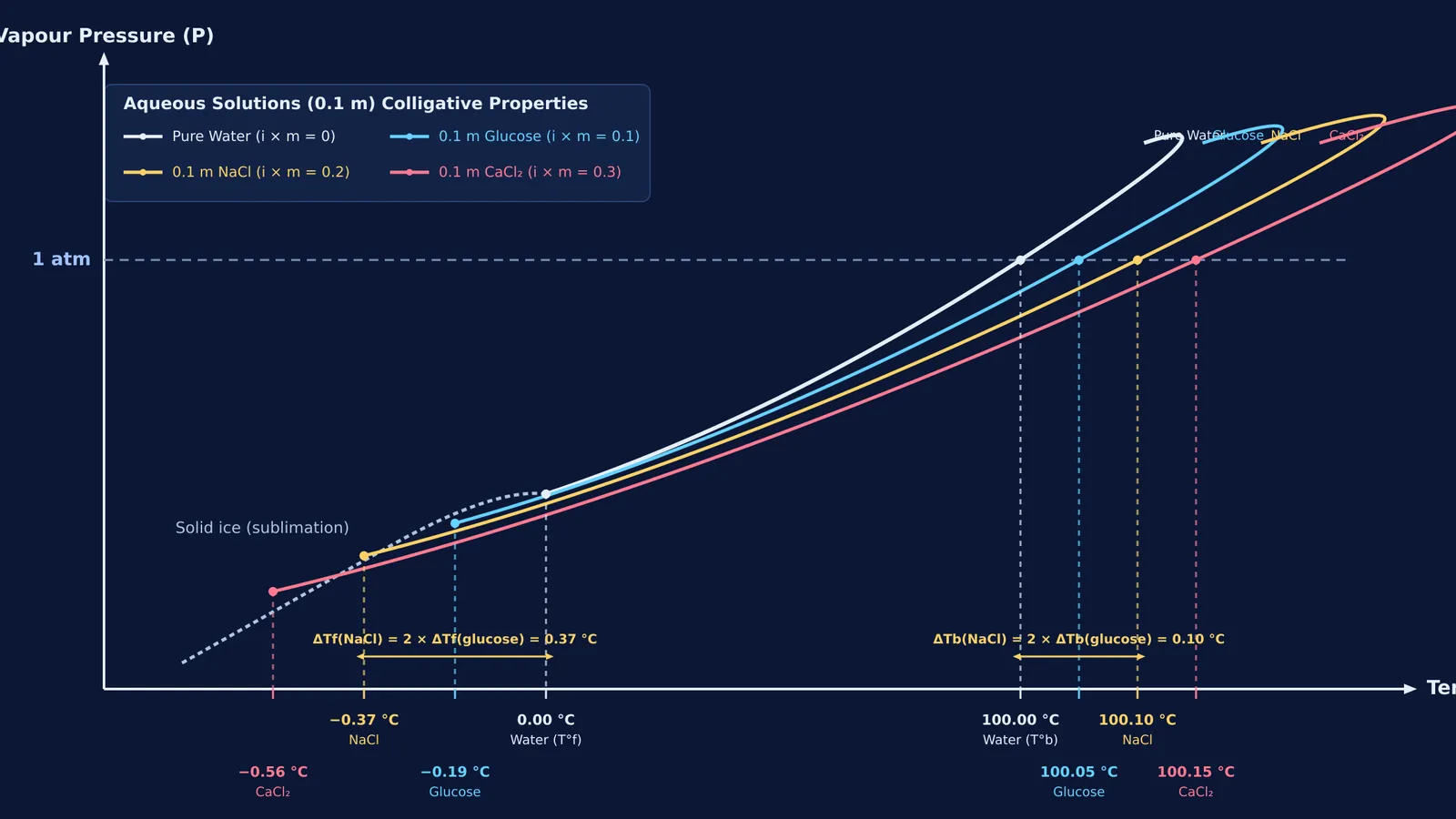
0.1 m glucose: ΔTb = 1 × 0.512 × 0.1 = 0.0512 °C (boiling point 100.05 °C).
0.1 m NaCl: ΔTb = 2 × 0.512 × 0.1 = 0.1024 °C (boiling point 100.10 °C).
Because 0.1 m NaCl produces twice as many particles, it lowers vapour pressure more and boils higher.
How does the van 't Hoff factor quantify solute particles?
Jacobus Henricus van 't Hoff received the 1901 Nobel Prize in Chemistry for discovering the laws of chemical dynamics and osmotic pressure in solutions (NobelPrize.org). He introduced the factor i to correct for particle count.
According to Wikipedia's entry on the van 't Hoff factor, i equals the actual particle concentration divided by the formula concentration. For complete dissociation (α = 1):
Non-electrolytes (glucose): i = 1
Binary salts (NaCl): i = 2
Ternary salts (CaCl₂): i = 3
Quaternary salts (AlCl₃): i = 4
When working through multi-ion salts or incomplete dissociation in complex equilibrium problems, the Fermi Problem Library provides worked problems with a step-by-step solver that explains the reasoning rather than printing an answer.
Why do higher boiling points lead to lower freezing points?
A frequent exam error is assuming that the solution with the highest boiling point also has the highest freezing point. The opposite occurs. By definition of colligative properties, colligative changes increase with i × m, but solutes raise boiling points while lowering freezing points.
Water has a cryoscopic constant of Kf = 1.86 K kg/mol, roughly 3.6 times larger than its Kb constant (Freezing-point depression). Using ΔTf = i × Kf × m:
0.1 m glucose: ΔTf = 1 × 1.86 × 0.1 = 0.186 °C (freezes at −0.19 °C).
0.1 m NaCl: ΔTf = 2 × 1.86 × 0.1 = 0.372 °C (freezes at −0.37 °C).
0.1 m CaCl₂: ΔTf = 3 × 1.86 × 0.1 = 0.558 °C (freezes at −0.56 °C).
The solution with the largest depression (0.1 m CaCl₂) has the lowest freezing point. Conversely, 0.1 m glucose has the highest freezing point because it depresses the freezing point least.
How do osmotic pressure and vapour pressure fit into the ranking?
The other two colligative properties mirror this particle dependence. As described by Raoult's law and analyzed in Raoult's law for liquid mixtures, non-volatile solutes lower vapour pressure (ΔP = i × P° × x_solute). Higher i × m values cause greater reduction, so 0.1 m CaCl₂ has a lower vapour pressure than 0.1 m NaCl, which is lower than 0.1 m glucose.
Osmotic pressure (Π = i × C × R × T) scales directly with particle concentration according to the van 't Hoff equation (Osmotic pressure), as discussed in calculating molar mass from osmotic pressure. In dilute aqueous solutions, molarity C closely tracks molality m, as outlined in converting between molarity and molality.
For equal molalities (0.1 m glucose, NaCl, CaCl₂), the rankings are:
Boiling point: CaCl₂ > NaCl > glucose > pure water
Osmotic pressure: CaCl₂ > NaCl > glucose > pure water
Freezing point: pure water (0.00 °C) > glucose (−0.19 °C) > NaCl (−0.37 °C) > CaCl₂ (−0.56 °C)
Vapour pressure: pure water > glucose > NaCl > CaCl₂
How do you rank colligative properties step by step?
When solving ranking problems, follow this four-step sequence:
Confirm the solvent: ensure all solutions share the same solvent, since Kb and Kf are solvent-specific.
Find the van 't Hoff factor i: identify whether each solute is a non-electrolyte or dissociates into ions.
Compute effective molality: calculate i × m for each solution.
Apply the directional rule: for boiling points and osmotic pressures, rank by increasing i × m; for freezing points and vapour pressures, rank by decreasing i × m.
To review how molecular forces drive phase transitions across thermodynamics, the Fermi Concept Library provides lessons for every concept in physics, chemistry, biology, mathematics and computing, each with its own lesson and its place in the map.


