

On this page
When you leave a fresh cucumber on the kitchen counter, it usually softens and spoils within a week. But if you drop that exact same cucumber into a jar of heavily salted brine or spiced vinegar, it becomes a pickle and lasts for months without ever seeing the inside of a refrigerator. The secret to this extreme longevity is not an artificial chemical preservative, but a fundamental law of biology and chemistry that you first meet in Class 8 science: osmosis.
What happens inside the pickle jar?
Microbes, like all living things, need water to survive and multiply. However, just because a jar of food contains water does not mean that moisture is freely available for bacteria, yeasts, or molds to use.
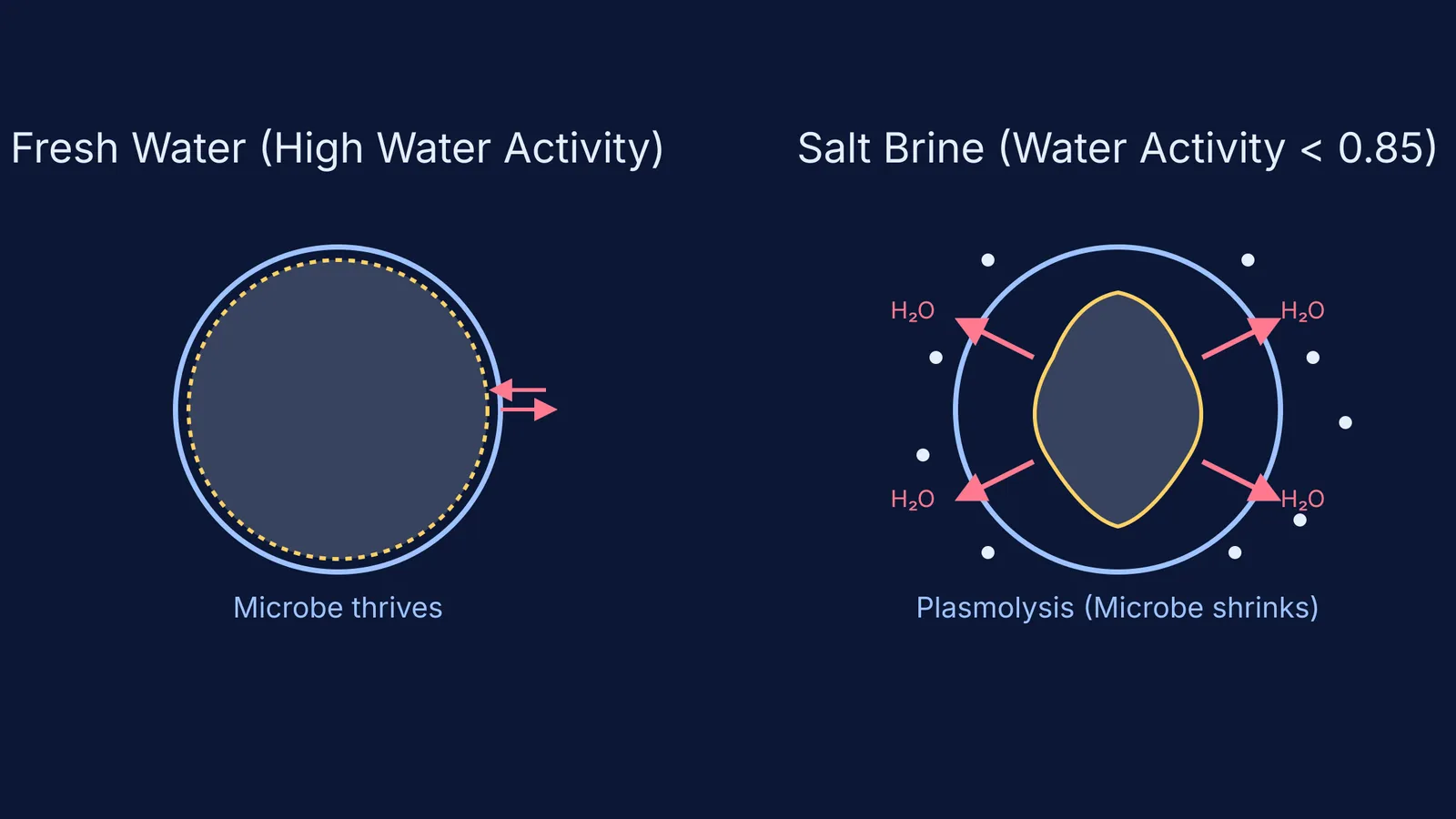
When a cucumber is submerged in a hypertonic solution—one with a much higher concentration of dissolved solutes like salt or sugar than the vegetable itself—the process of osmosis begins. Osmosis is the passive movement of water molecules across a semi-permeable membrane. The water always moves from an area of higher water concentration (inside the cucumber's cells and the microbes) to an area of lower water concentration (the surrounding salty brine).
This sudden, rapid loss of water has a devastating effect on single-celled organisms that happen to be in the jar. As water rushes out of a microbial cell to balance the concentration gradient, the cell shrinks and pulls its delicate membrane away from its rigid cell wall. This specific biological process is known as plasmolysis. Stripped of the internal moisture it strictly needs to run basic metabolic reactions, the microbe cannot reproduce and eventually dies. You can find this mechanism, and how particles cross membranes, covered in our guide to cell membrane transport.
How do scientists measure available moisture?
Scientists and food safety experts measure the moisture available to microbes as water activity (aw), using a specialized scale from 0 to 1.0.
Regulatory bodies rely heavily on this measurement to determine whether a packaged product is safe to sit on a grocery store shelf. According to the US FDA, most fresh foods have a natural water activity above 0.95, making them a perfect breeding ground for bacteria. However, foods are generally considered shelf-stable without refrigeration if their water activity is successfully controlled to 0.85 or less. At this specific level, hazardous microorganisms of public health significance, such as staphylococci, are controlled and cannot multiply. Other dangerous pathogens, like the spores of *Clostridium botulinum*, stop growing entirely when the water activity falls below 0.93.
Salt and sugar act as powerful humectants in this preservation process. They chemically bind to free water molecules through hydration shells, pulling them out of circulation and keeping them securely away from the microbes.
Salt is particularly effective at this task. Because it is an ionic compound, a single molecule of sodium chloride (NaCl) dissociates into two separate ions in water: a sodium ion (Na+) and a chloride ion (Cl-). This means that salt creates twice as many dissolved particles per mole as a covalent compound like sugar. In chemistry terms, this gives salt a much stronger effect on the water's colligative properties, allowing it to lower the water activity much faster.
Why does the pickle stay crunchy?
Osmosis does not just kill harmful bacteria; it also permanently changes the physical structure of the food you are preserving.
Plant cells, unlike animal cells, have a strong, rigid cellulose cell wall surrounding their delicate inner plasma membrane. When water leaves the plant cells in the cucumber to enter the brine, the large central vacuole shrinks, and the cells lose their internal turgor pressure. The rigid plant cell walls partially collapse inward but do not break completely apart. This controlled, microscopic collapse is exactly what gives a properly cured pickle its characteristic, satisfying crunch. If you are reviewing how plant and animal cells differ in their response to water loss, check out the lesson on cell structure in Class 8.
How can you see osmosis in action?
Understanding how concentration gradients work is much easier when you can actually watch the molecules move. The exact same principle of osmosis explains why doctors recommend gargling salt water for a sore throat to draw out swelling, why household plants wilt when placed in overly salty soil, and how your kidneys continuously filter waste out of your bloodstream.
If you want to change the salt concentration yourself and watch a simulated cell shrink in real time, run the interactive experiment in the Fermi Simulation Lab.


