On this page
Dhupa fat is a white, tallow-like fat pressed from the seed kernels of Vateria indica, the Indian copal tree of the Western Ghats. Its Bureau of Indian Standards specification, IS 8879:1980, does something most fat standards do not: its foreword lists the fat's main fatty acids. That lets you predict the saponification value and iodine value from the composition and check them against the standard's own limits. The same fat then poses a stereochemistry question: when does a triglyceride have a stereocentre?
What does the BIS standard say about dhupa fat?
The foreword of IS 8879 (First Revision, 1980) says the trees grow mostly in the moist evergreen forests of the Western Ghats, from North Kanara in Karnataka to Kerala, The kernels contain 19 to 23% of "a pale-yellow fat having a tallow-like consistency, which turns white on standing", known as Malabar tallow, Piney tallow or dhupa tallow. It may be used as "a cocoa butter substitute or extender after proper processing", and in yarn sizing, soaps and candles. Cocoa butter's own melting behaviour is covered in why chocolate melts in your hand.
The composition sentence is the one we need: "Stearic acid (38 to 47 percent), oleic acid (38 to 48 percent) and palmitic acid (9 to 15 percent) are the major fatty acids of dhupa fat."
Table 1 then sets, for every grade:
Iodine value (Wijs): 36 to 51.
Saponification value: 186 to 193.
How do you predict SV and IV from the fatty acids?
The formulas are the ones in our post on saponification value and iodine value: for a triglyceride of molar mass M carrying n C=C bonds, SV = 3 × 56.11 × 1000 ÷ M (mg KOH per g) and IV = n × 253.8 × 100 ÷ M (g I₂ per 100 g).
Worked example. Take the middle of each range: stearic 42.5, oleic 43, palmitic 12. These add to 97.5, so scale them to 100% by mass.
Molar masses. Stearic acid C₁₈H₃₆O₂ = 284.48; oleic acid C₁₈H₃₄O₂ = 282.47 (one cis C=C); palmitic acid C₁₆H₃₂O₂ = 256.43 g/mol.
Mole fractions. Divide each mass by its molar mass and normalise: stearic 0.429, oleic 0.437, palmitic 0.134.
Mean acid. 0.429 × 284.48 + 0.437 × 282.47 + 0.134 × 256.43 = 279.8 g/mol.
Mean triglyceride. Glycerol (92.09) + 3 acids − 3 H₂O (3 × 18.02) gives M = 877.6 g/mol.
C=C per molecule. n = 3 × 0.437 = 1.31.
SV = 3 × 56.11 × 1000 ÷ 877.6 = 191.8. The standard allows 186 to 193.
IV = 1.31 × 253.8 × 100 ÷ 877.6 = 37.9. The standard allows 36 to 51.
So an average dhupa triglyceride carries about 1.3 C=C bonds. No single pure triglyceride can give IV 37.9: one oleic chain gives about 29, two give about 57. The fat must be a mixture.
For comparison, here are some model triglycerides:
Stearic–oleic–stearic (SOS), C₅₇H₁₀₈O₆: M 889.5, SV 189.2, IV 28.5.
Palmitic–oleic–stearic (POS), C₅₅H₁₀₄O₆: M 861.4, SV 195.4, IV 29.5.
Stearic–oleic–oleic (SOO), C₅₇H₁₀₆O₆: M 887.5, SV 189.7, IV 57.2.
Tristearin, C₅₇H₁₁₀O₆: M 891.5, SV 188.8, IV 0.
Does the IV limit of 51 fit the stated composition?
Not quite. If stearic, oleic and palmitic acids make up all the acids, then every split inside the BIS ranges gives an IV between 32.7 (oleic 38, stearic 47, palmitic 15) and 41.3 (oleic 48, stearic 43, palmitic 9). Even 48% oleic with the other two at their minimums, scaled up to 100%, gives only 43.4. An IV of 51 would need about 1.76 C=C per molecule, the equivalent of 59 mol% oleic acid.
The standard calls these the "major" fatty acids, so small amounts of other acids, such as more unsaturated ones, could raise the IV. The standard does not list them, so we cannot check. Take it as an observation, not a correction: the composition in the foreword and the IV range in Table 1 do not fully match. The SV fits: the composition gives 191.1 to 192.4, inside 186 to 193.
When is a triglyceride chiral?
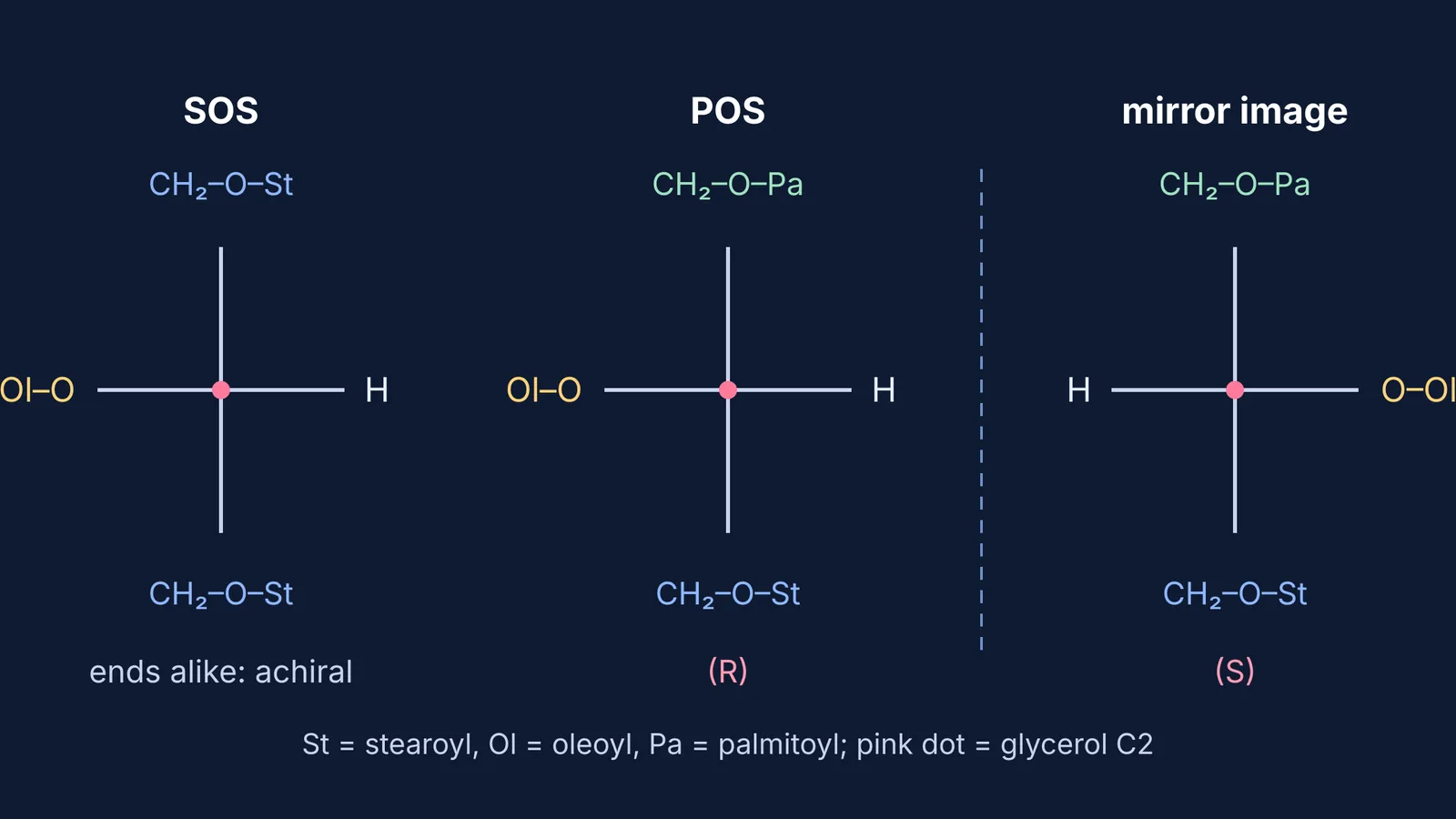
Look at C2 of the glycerol backbone. It carries H, the ester oxygen of the middle acid, and two CH₂–O–CO–R groups.
SOS. Both ends are CH₂–O–CO–C₁₇H₃₅. Two groups on C2 are identical, so C2 is not a stereocentre and SOS is achiral.
POS. One end is palmitoyl (CO–C₁₅H₃₁), the other stearoyl (CO–C₁₇H₃₅). All four groups on C2 differ, so C2 is a stereocentre and POS is chiral. It exists as a pair of enantiomers.
IS 8879 gives only total fatty acids. It does not say which acid sits on which glycerol carbon, so treat this as a structure exercise, not a claim about dhupa fat.
Assigning R or S. Biochemists number glycerol stereospecifically: draw a Fischer projection with the C2 oxygen on the left, and the top carbon is sn-1, the bottom one sn-3. Take POS with palmitate at sn-1 and stearate at sn-3.
Priorities. O–oleoyl is first (O beats C). The two CH₂ groups tie atom by atom along the chain, until the palmitoyl chain ends in CH₃ (H, H, H) where the stearoyl chain still has CH₂ (C, H, H). So CH₂ at sn-3 (stearoyl) is second, CH₂ at sn-1 (palmitoyl) third, H fourth.
Trace. Left (O) to bottom (sn-3) to top (sn-1) runs anticlockwise.
Correct for H. H is on a horizontal bond, pointing towards you, so reverse the answer: anticlockwise becomes R.
Its mirror image, with stearate at sn-1, is S.
How many triglycerides can you build from two or three fatty acids?
Fill the three positions sn-1, sn-2 and sn-3 independently. With 2 acids there are 2³ = 8 ways, and with 3 acids 3³ = 27. Because sn-1 and sn-3 are told apart in space, these counts list every possible triglyceride molecule, with each enantiomer counted separately.
2 acids (A, B): 4 achiral molecules whose ends match (AAA, BBB, ABA, BAB), plus 2 chiral ones (AAB and ABB), each as a pair of enantiomers. That is 6 different constitutions and 8 molecules.
3 acids: 9 achiral molecules with matching ends, plus 9 chiral constitutions, each as an enantiomer pair: 18 constitutions and 27 molecules.
For counting rules beyond glycerol, see how to count stereoisomers from chiral centres. If R/S questions are a weak spot in your JEE revision, Fermi Test Prep is for JEE Main and Advanced preparation, with an AI tutor, and the Concept Library covers lipids and chirality concept by concept.
Where is this in the syllabus?
Class 12 Biomolecules: triglycerides, saturated and unsaturated fatty acids.
Class 11 stoichiometry: SV and IV from molar mass.
Class 12 Haloalkanes and Haloarenes: chirality, enantiomers, R and S.
Quick checklist
IS 8879: stearic 38–47%, oleic 38–48%, palmitic 9–15%; IV 36–51; SV 186–193.
Mid-range composition: M 877.6, SV 191.8, IV 37.9, about 1.3 C=C per molecule.
The stated composition caps IV near 41 to 43, below the limit of 51.
SOS is achiral; POS is chiral, and the sn-1 palmitoyl isomer is R.
8 or 27 counts molecules from 2 or 3 acids, enantiomers included, not isomers of one molecule.