On this page
A bar that has sat on the shelf all afternoon snaps cleanly. Hold one square in your closed fist for a few minutes and it turns smeary. The difference is a few degrees, and where they fall against one number: the melting point of cocoa butter.
What temperature does chocolate melt at?
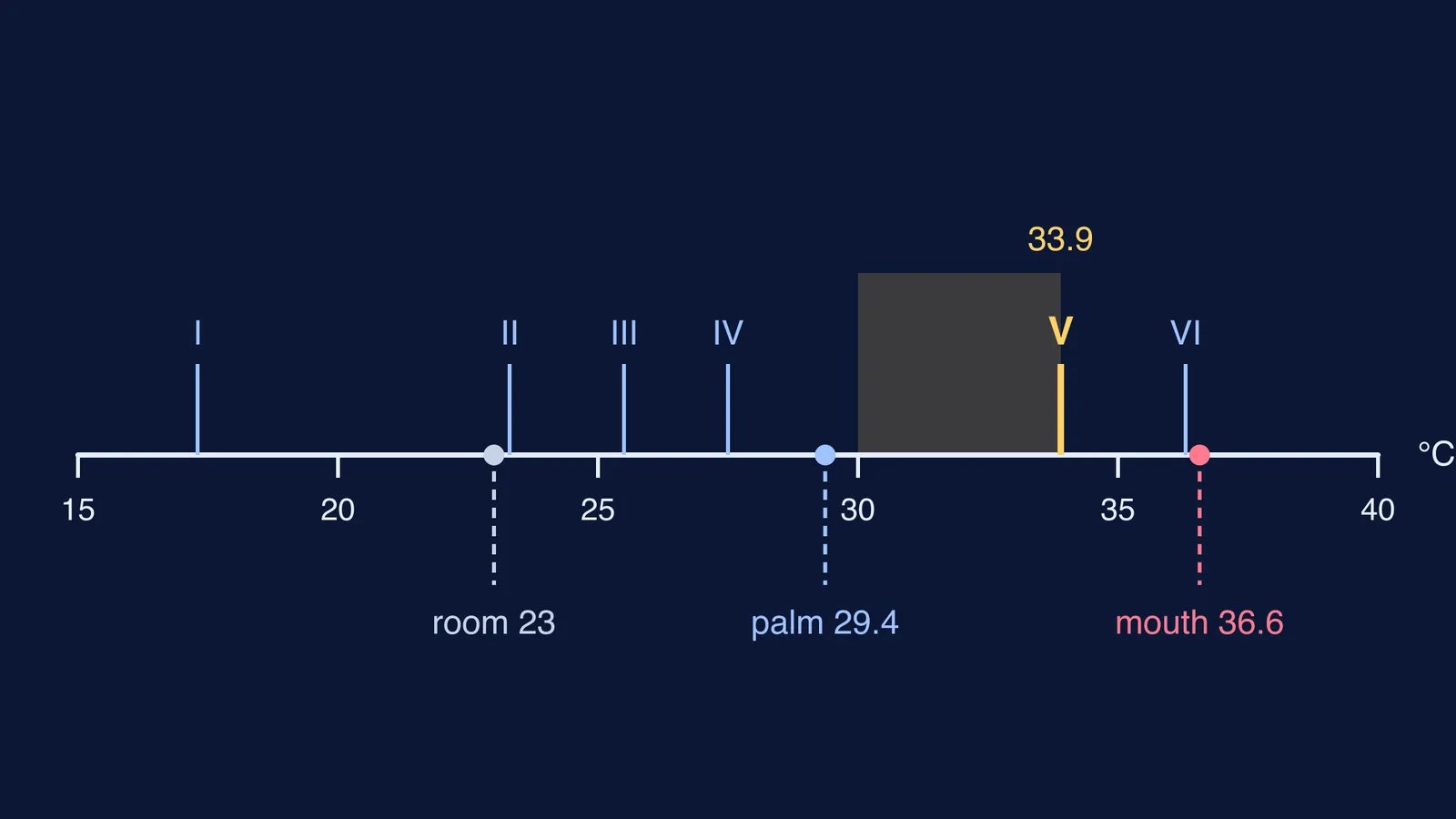
The snap and the melt both come from cocoa butter, the fat in chocolate. In 1966, R. L. Wille and E. S. Lutton, working largely by X-ray diffraction, identified six crystal forms of cocoa butter, numbered I to VI in order of rising melting point (Wille and Lutton, Journal of the American Oil Chemists' Society).
Wille and Lutton's melting temperatures for Forms I to VI are 17.3, 23.3, 25.5, 27.5, 33.9 and 36.3 °C, as listed in a 2021 Nature Communications paper (Chen et al., 2021). The same paper notes that another group, Lovegren and colleagues, measured lower values, with Form V melting at 30 °C. So think of Form V as melting somewhere between 30 and 34 °C, not at one sharp line.
Form V is the one chocolate makers want. Chen and colleagues write that chocolate structured by Form V has "the proper texture, gloss, snap, and melting profile". Tempering, the controlled cooling and stirring of melted chocolate, is how makers steer the fat into that form.
Why does chocolate melt in your hand but not on the shelf?
A solid melts when its surroundings are warmer than its melting point and keep supplying heat. Put three temperatures next to the Form V band of 30 to 34 °C (Chen et al., 2021):
A room: 23 °C, the room temperature used in a 2019 thermal-imaging study of hands (Gatt et al., Scientific Reports).
Your open palm: that study found a mean palm temperature of 29.37 °C in 51 healthy volunteers after 20 minutes of rest, just below the Form V band.
Inside your body: a systematic review of 36 studies found a pooled mean oral temperature of 36.57 °C and a mean rectal temperature of 37.04 °C (Geneva et al., Open Forum Infectious Diseases).
The shelf is several degrees below the melting point, so the crystals stay intact. A flat palm is close to the edge, so the surface softens slowly. Close your fist and the square is wrapped in skin fed by blood from a core near 37 °C, with less skin losing heat to the room, so it is likely to get warmer still. Your mouth is above the whole band, which is why chocolate melts on your tongue.
This also explains an Indian summer problem. If the room itself climbs past 34 °C on a hot May afternoon, the shelf is no longer below the melting point, and the bar goes soft untouched.
Why does it take minutes, not an instant?
Reaching the melting point is not enough. The fat also has to absorb latent heat to break up its crystals, and during that time its temperature barely rises. If plateaus on a heating curve confuse you, our guide to reading heat of transformation graphs walks through them.
Heat also flows faster when the temperature gap is bigger. A palm just below the band hands over heat slowly; a mouth above it hands over heat much faster.
For why some fats are solid at room temperature at all, read why fats are solid and oils are liquid. For what the particles do during melting, see our particle model of melting and boiling. If that picture is still hard to hold in your head, the Fermi Simulation Lab has interactive simulations for ideas that are easier to see than to read.
What happens when melted chocolate sets again?
Chen and colleagues note that bloom often shows up as a greyish-white film on the surface of chocolate, attributed to an uncontrolled change from Form V to Form VI (Chen et al., 2021). When a bar melts in a hot bag and sets again on its own, nothing controls which crystal forms appear. That control is the job tempering normally does.
Try it: a 20-minute melting test
You need one bar of plain chocolate, a timer and a notebook. Break off five equal squares.
Before you start, write a prediction: rank the five places below from fastest melt to slowest, and give a reason using the temperatures above.
Put one square in the fridge, one on a plate on the shelf, one on your open palm, one in your closed fist inside a small clean plastic bag, and let one rest on your tongue.
Every two minutes, press each square gently and note whether it is hard, soft at the surface, or melted through.
Stop at 20 minutes and compare your results with your prediction.
Explain any surprise in one sentence that uses the words melting point, temperature gap and latent heat.
A board question that asks why ice cools a drink uses the same three ideas. If any of the three still feels shaky, the Fermi Concept Library has a lesson for every concept in physics and chemistry, each with its place in the map.
Next time a bar goes soft in your pocket, check the temperature in the room before you blame the chocolate.