

On this page
In Cartesian form every conic is a separate formula to memorise. The polar form replaces them all with one equation, r = l/(1 + e cos θ), where one number, e, picks the curve. Astronomers use the same form for orbits, so learning it once helps in both maths and physics.
What is the polar equation of a conic?
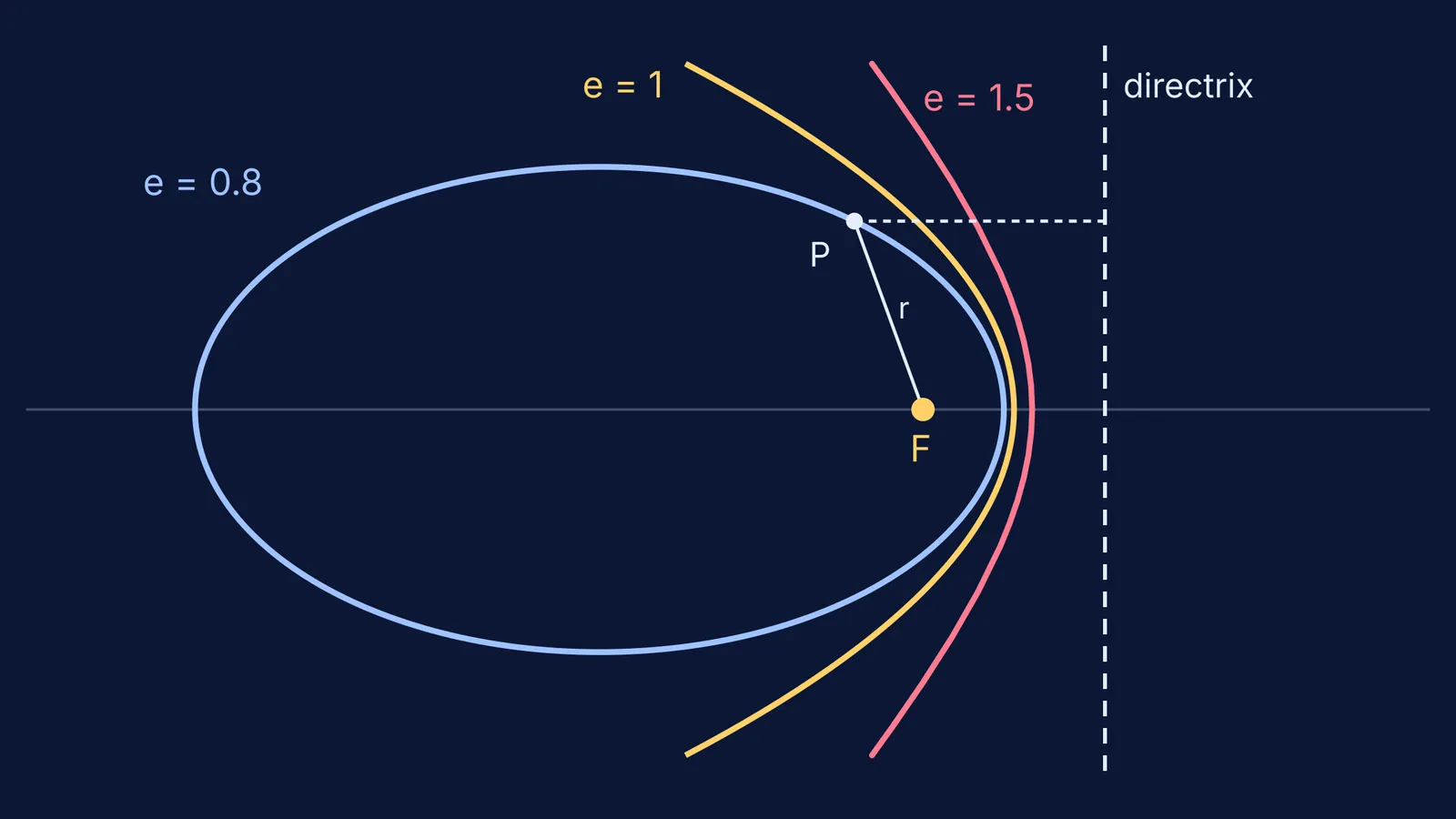
Start with the focus-directrix definition. A conic is the set of points whose distance from a fixed point, the focus, divided by their distance from a fixed line, the directrix, is always the same number e, the eccentricity (OpenStax Precalculus 2e, section 10.5).
Put the focus at the pole and the directrix at the line x = d to its right. Then every conic is r = l/(1 + e cos θ), where l = ed is the semi-latus rectum: at θ = 90° the cosine vanishes and r = l.
How do you derive r = l/(1 + e cos θ)?
Take a point P on the curve at distance r and angle θ from the focus.
The distance from P to the focus is r.
P has x-coordinate r cos θ, so its distance to the directrix x = d is d − r cos θ.
The definition says r = e(d − r cos θ).
Bring the r terms together: r + er cos θ = ed, so r(1 + e cos θ) = ed.
Divide: r = ed/(1 + e cos θ) = l/(1 + e cos θ).
Nothing about ellipses or hyperbolas went in; only the ratio e did.
How does e decide ellipse, parabola or hyperbola?
Watch the denominator, 1 + e cos θ, as cos θ swings between −1 and 1.
e < 1, ellipse. The denominator never reaches zero, so r is finite in every direction and the curve closes.
e = 1, parabola. At θ = 180° the denominator is zero, so r runs off to infinity in one direction and the curve never closes.
e > 1, hyperbola. The denominator is zero where cos θ = −1/e, the two asymptote directions. Between them r turns negative and traces the other branch.
e = 0, circle. As e shrinks to 0 the ellipse rounds into a circle.
To watch the ellipse stretch as e grows, try the ellipse eccentricity slider. For the Cartesian forms, see conic sections Class 11 formulas with worked examples and why a hyperbola's focal distances always differ by 2a.
Why are orbits written in polar form?
Kepler's first law says each planet moves in an ellipse with the Sun at one focus, and NASA notes that his laws describe the motion of comets as well (NASA Science, Orbits and Kepler's Laws). Put the Sun at the pole and r is simply the distance from the Sun; Cartesian form measures from the empty centre of the ellipse.
Worked example: Earth's orbit from two NASA numbers
NASA's Earth fact sheet gives a semimajor axis of 149.598 million km and an orbit eccentricity of 0.0167 (NASA Earth Fact Sheet). For an ellipse, l = a(1 − e²).
l = 149.598 × (1 − 0.0167²) ≈ 149.556 million km.
Closest approach, θ = 0: r = 149.556/1.0167 ≈ 147.10 million km.
Farthest point, θ = 180°: r = 149.556/0.9833 ≈ 152.10 million km.
The fact sheet lists perihelion as 147.095 and aphelion as 152.100 million km: a match.
Halley's comet and an interstellar visitor
NASA's JPL Small-Body Database gives Halley's comet an eccentricity of 0.968 and a perihelion distance of 0.575 au (JPL SBDB, 1P/Halley). So l = 0.575 × 1.968 ≈ 1.13 au and the far point is 1.13/0.032 ≈ 35 au; JPL lists 35.3.
The same database gives 'Oumuamua, found in 2017, an eccentricity of 1.2 and classes it as a hyperbolic object (JPL SBDB, 'Oumuamua). Setting 1 + 1.2 cos θ = 0 gives θ ≈ 146°: it arrived along one asymptote and left along the other, never to return.
How do you solve a polar conic question in three steps?
Take r = 10/(5 + 3 cos θ).
Make the constant 1. Divide top and bottom by 5: r = 2/(1 + 0.6 cos θ). So l = 2 and e = 0.6.
Read the type from e. 0.6 < 1, so it is an ellipse with a focus at the pole.
Plug in θ = 0, 90° and 180°. r = 2/1.6 = 1.25, r = 2, and r = 2/0.4 = 5. The major axis is 1.25 + 5 = 6.25, so a = 3.125. Check: l/(1 − e²) = 2/0.64 = 3.125.
Skipping step 1 and reading e as 3 is the usual slip. To check your working line by line, the Fermi Problem Library has worked problems with a step-by-step solver that explains the reasoning rather than printing an answer. If the focus-directrix idea itself is shaky, the Fermi Concept Library gives each mathematics concept its own lesson.
Next orbit question: write the polar form and read e first.


