On this page
Every formula below is from Chapter 10 of NCERT Class 11 Mathematics (Reprint 2026-27) and sits within the Conic Sections unit of the CBSE 2026-27 Mathematics curriculum. Not included: parabolas, ellipses and hyperbolas centred away from the origin, and tangents or normals, which this chapter does not cover.
For the chapter explained step by step, see our Conic Sections Class 11 guide with solved examples.
Which conic section do you get when a plane cuts a cone?
α: the semi-vertical angle of the double cone. β: the angle between the cutting plane and the cone's vertical axis (NCERT 10.2).
Plane not through the vertex: β = 90° gives a circle; α < β < 90° an ellipse; β = α a parabola; 0 ≤ β < α a hyperbola.
Plane through the vertex (degenerate cases): α < β ≤ 90° gives a point; β = α a straight line; 0 ≤ β < α a pair of intersecting lines.
Worked example: a cone has α = 30°. A plane at β = 50° that misses the vertex gives an ellipse, since 30° < 50° < 90°.
Watch for: β is measured from the axis, not from the base. A plane parallel to the base has β = 90°, which is why it gives a circle.
How do you find the centre and radius of a circle?
Centre (h, k), radius r > 0: (x − h)² + (y − k)² = r². Centre at the origin: x² + y² = r².
x² + y² + 2gx + 2fy + c = 0: completing the square gives centre (−g, −f) and radius √(g² + f² − c). Condition: g² + f² − c > 0.
Point (x₁, y₁): (x₁ − h)² + (y₁ − k)² less than r² means inside, equal means on, greater means outside.
Worked example: x² + y² − 6x + 4y − 12 = 0 has g = −3, f = 2, c = −12. Centre (3, −2), radius √(9 + 4 + 12) = 5. The point (6, 2) gives 3² + 4² = 25 = r², so it is on the circle.
Watch for: the sign flip. +4y means f = 2, so the centre's y-coordinate is −2.
Where are the focus and directrix of each parabola?
Vertex at the origin, a > 0 (NCERT 10.4):
y² = 4ax: focus (a, 0), directrix x = −a, opens right.
y² = −4ax: focus (−a, 0), directrix x = a, opens left.
x² = 4ay: focus (0, a), directrix y = −a, opens up.
x² = −4ay: focus (0, −a), directrix y = a, opens down.
Every point is as far from the focus as from the directrix.
Latus rectum (chord through the focus, perpendicular to the axis): length 4a; for y² = 4ax its ends are (a, ±2a).
Worked example: x² = −18y opens down, and 4a = 18 gives a = 4.5. Focus (0, −4.5), directrix y = 4.5, latus rectum 18. The point (6, −2) is on it, and is 6.5 from both the focus and the directrix.
Watch for: a is a quarter of the coefficient. In y² = 14x, a = 3.5, so the focus is (3.5, 0), not (14, 0).
How do you find a, b, c and e for an ellipse?
Centre at the origin, a > b > 0 (NCERT 10.5):
x²/a² + y²/b² = 1: major axis on the x-axis, foci (±c, 0), vertices (±a, 0).
x²/b² + y²/a² = 1: major axis on the y-axis, foci (0, ±c), vertices (0, ±a).
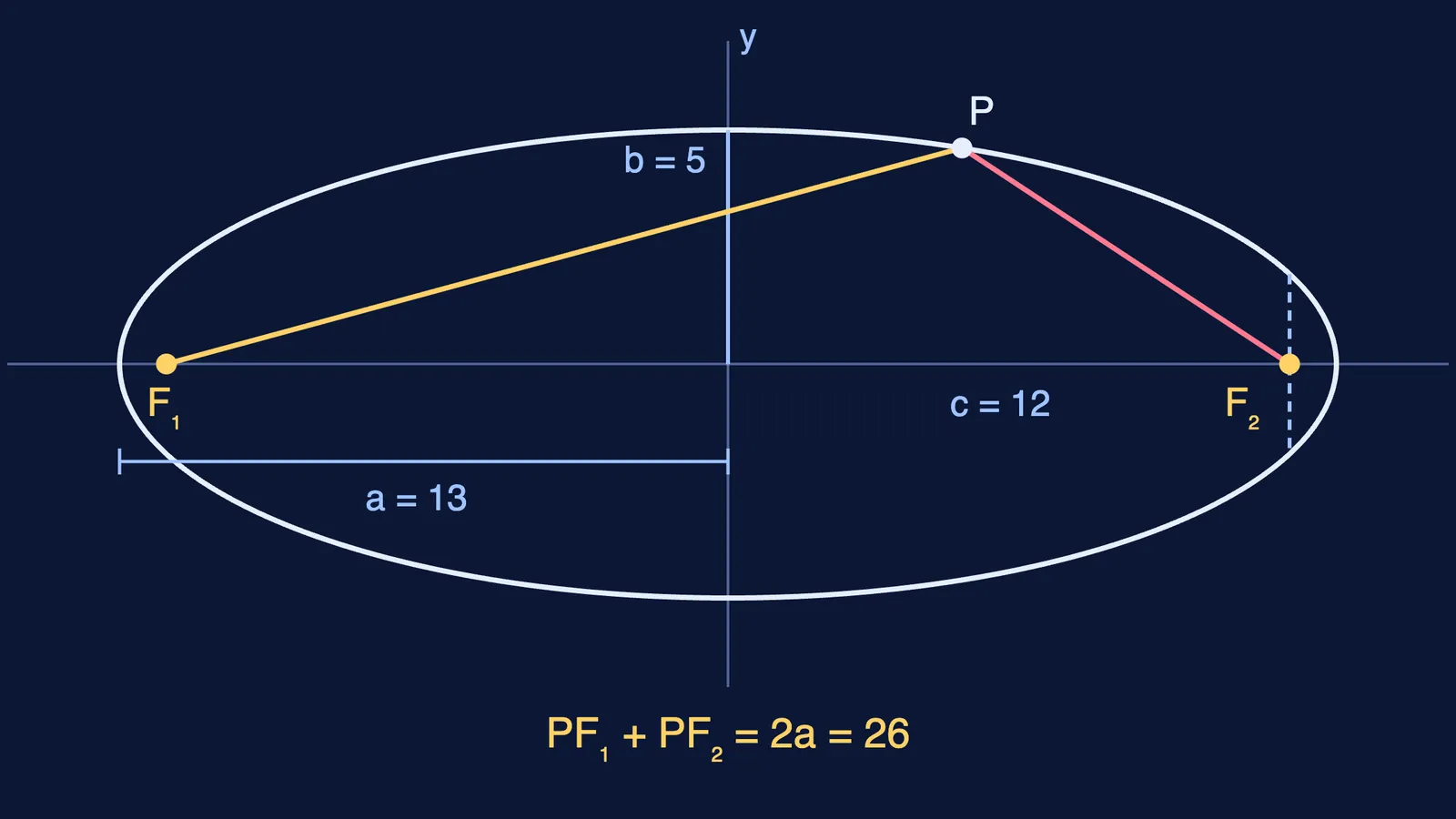
a = semi-major axis, b = semi-minor axis, c = centre-to-focus distance.
c² = a² − b².
Eccentricity e = c/a, with 0 < e < 1; each focus is ae from the centre.
Latus rectum: 2b²/a.
For every point P on it: PF₁ + PF₂ = 2a.
Worked example: 25x² + 169y² = 4225 becomes x²/169 + y²/25 = 1. So a = 13, b = 5, c = √(169 − 25) = 12. Foci (±12, 0), vertices (±13, 0), e = 12/13, latus rectum 50/13. The point (5, 60/13) is 229/13 and 109/13 from the foci, which add to 26 = 2a.
Watch for: a² is the larger denominator, whether it sits under x² or y². Assuming it is under x² puts the foci on the wrong axis.
How do the hyperbola formulas differ from the ellipse?
Centre at the origin, a > 0, b > 0 (NCERT 10.6):
x²/a² − y²/b² = 1: transverse axis on the x-axis, foci (±c, 0), vertices (±a, 0).
y²/a² − x²/b² = 1: transverse axis on the y-axis, foci (0, ±c), vertices (0, ±a).
Transverse axis 2a, conjugate axis 2b, foci 2c apart.
c² = a² + b², so c > a.
Eccentricity e = c/a, which is greater than 1.
Latus rectum: 2b²/a.
For every point P on it: |PF₁ − PF₂| = 2a.
a = b gives an equilateral hyperbola, with e = √2.
Worked example: y²/36 − x²/64 = 1 has the positive term in y², so the foci are on the y-axis. a = 6, b = 8, c = 10. Foci (0, ±10), vertices (0, ±6), e = 5/3, latus rectum 64/3. The point (6, 7.5) is 18.5 and 6.5 from the foci, a difference of 12 = 2a.
Watch for: in a hyperbola, a can be smaller than b. The positive term, not the larger denominator, decides the axis.
How to revise this formula sheet
Make one card per conic: equation, foci, the c relation, the range of e, the latus rectum.
Reduce every ellipse or hyperbola to "= 1" form before reading off a and b.
Check answers with one point: a vertex back in the equation, or focal distances that add or differ to 2a.
Rework NCERT Exercises 10.2 to 10.4 with the cards face down. If a method keeps going wrong, the Fermi Problem Library has worked problems with a step-by-step solver that explains the reasoning rather than printing an answer.
Then try our conic sections assertion-reason questions and the conic sections case study questions with answers.