

On this page
Three original cases, four graded parts each, with worked answers. For chapter notes, read our Conic Sections Class 11 guide.
What do these conic sections case study questions cover?
Class 11 exams are set by your school, so treat these as case-based practice.
Every fact follows Chapter 10 of NCERT Class 11 Mathematics (Reprint 2026-27) and the CBSE 2026-27 Class XI Mathematics syllabus (sections of a cone, the circle, and standard equations of the parabola, ellipse and hyperbola). NCERT defines a hyperbola as the set of points whose distances from two fixed points differ by a constant, and that constant equals 2a.
Case 1: A torch beam on the bedroom wall
During a power cut in Bhopal, Riya shines a torch at her wall. The light leaves the torch as a cone whose semi-vertical angle is 15°. Held 1.5 m away and pointed straight at the wall, it makes a round patch. On axes drawn on the wall in metres, the patch's centre is at (2, 1.5) and its radius measures 0.4 m. A light switch sits at (2.3, 1.8) and a photo hook at (2.2, 1.2). She then tilts the torch.
(i) With the beam's axis perpendicular to the wall, the patch is: (a) a circle (b) an ellipse (c) a parabola (d) a hyperbola
(ii) Write the equation of the patch's edge in general form.
(iii) Which of the switch and the hook lies inside the lit patch?
(iv) Riya tilts the torch until the wall makes an angle of 40° with the beam's axis, then 15°. Name the shape of the patch each time.
Answers.
(i) (a) The wall cuts the cone at β = 90°, which gives a circle.
(ii) (x − 2)² + (y − 1.5)² = 0.4², which expands to x² + y² − 4x − 3y + 6.09 = 0.
(iii) Switch: √(0.3² + 0.3²) ≈ 0.424 m > 0.4 m, so it is outside. Hook: √(0.2² + 0.3²) ≈ 0.361 m < 0.4 m, so it is inside.
(iv) Here α = 15°. At β = 40°, α < β < 90°, so the patch is an ellipse. At β = 15°, β = α, so its edge is a parabola and the patch never closes.
Case 2: A solar cooker for a school in Leh
A school in Leh builds a solar cooker from a dish whose cross-section is a parabola. The dish's rim is 1.2 m across and it is 15 cm deep at the centre. Take the dish's lowest point as the origin and its axis as the y-axis, pointing up, in metres. The pot must sit at the focus. A deeper dish of the same width, 22.5 cm deep, is also on offer.
(i) The cross-section has the standard form: (a) y² = 4ax (b) y² = −4ax (c) x² = 4ay (d) x² = −4ay
(ii) Find a, and say where the pot should sit.
(iii) Write the equation of the directrix and the length of the latus rectum. Is the focus inside the dish or above its rim?
(iv) Where should the pot sit in the deeper dish, and how far does it move compared with the first dish?
Answers.
(i) (c) The dish opens upward along the y-axis.
(ii) The rim point (0.6, 0.15) lies on x² = 4ay: 0.36 = 4a × 0.15, so a = 0.6. The focus is (0, 0.6): the pot sits 60 cm above the lowest point.
(iii) Directrix y = −0.6. Latus rectum 4a = 2.4 m. The rim is only 0.15 m high, so the focus is 0.45 m above the rim.
(iv) 0.36 = 4a × 0.225 gives a = 0.4, so the pot sits 40 cm above the lowest point, 20 cm lower than before.
Case 3: Where did the quarry blast happen?
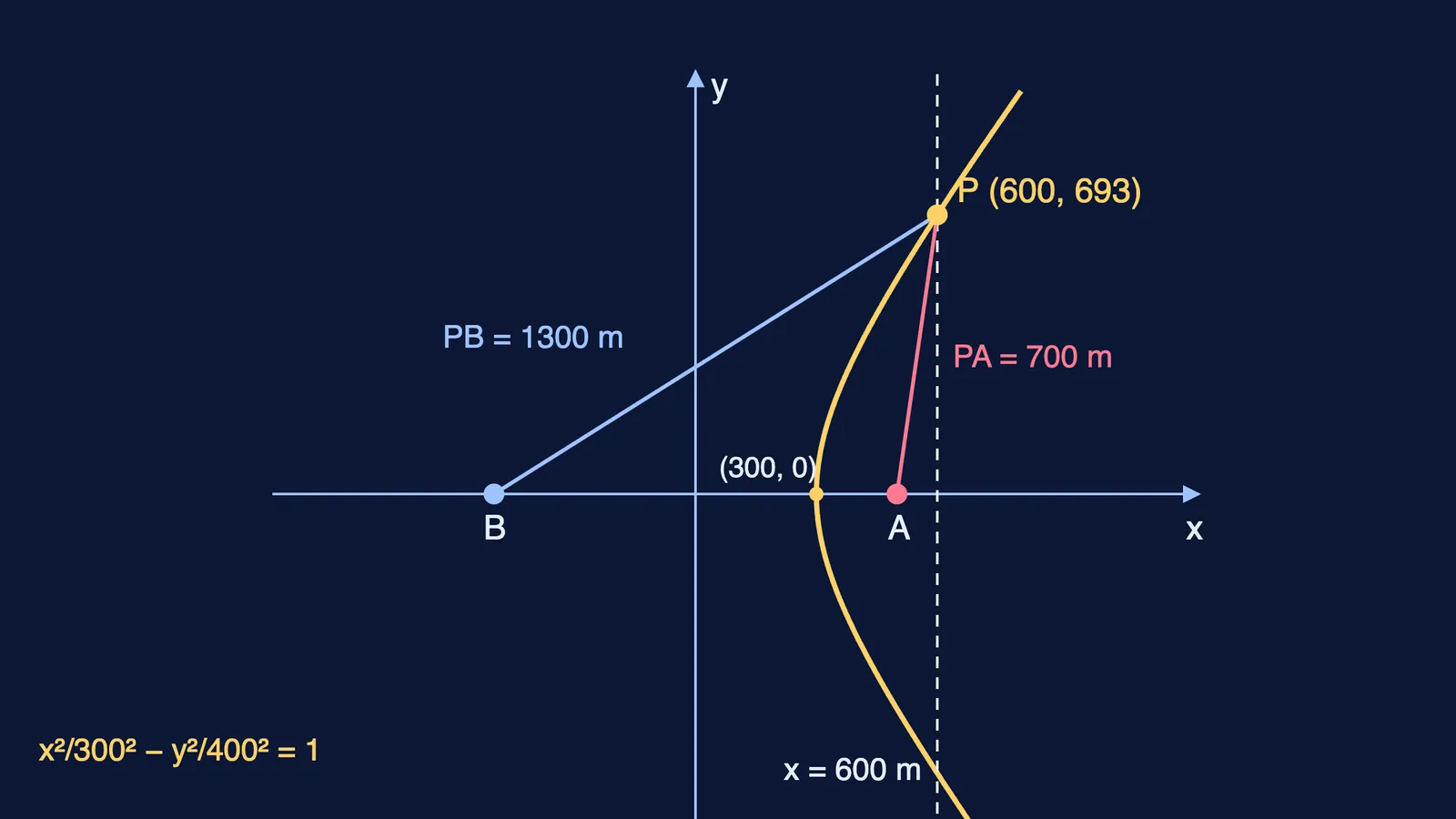
A noise-monitoring team at a stone quarry near Jodhpur places microphones A and B 1,000 m apart on a straight east-west road. With the midpoint as origin and the road as the x-axis, A is at (500, 0) and B at (−500, 0), in metres. After a blast, the gap in arrival times shows that the blast point is 600 m closer to A than to B. The quarry face runs along x = 600, north of the road.
(i) All points that are 600 m closer to A than to B lie on: (a) a circle (b) an ellipse (c) a parabola (d) one branch of a hyperbola
(ii) Find a, b and c, and write the equation of the curve.
(iii) Find the eccentricity, and the point on the road that fits this data.
(iv) Locate the blast on the quarry face and check it using distances to A and B.
Answers.
(i) (d) The difference of distances from two fixed points is constant.
(ii) 2c = 1,000, so c = 500. 2a = 600, so a = 300. b² = c² − a² = 250,000 − 90,000 = 160,000, so b = 400. The curve is x²/300² − y²/400² = 1, with x > 0.
(iii) e = c/a = 500/300 = 5/3. On the road it meets the vertex (300, 0), which is 200 m from A and 800 m from B.
(iv) Put x = 600: y² = 160,000 × (360,000/90,000 − 1) = 480,000, so y = 400√3 ≈ 693 m. The blast was at about (600, 693). Check: PA = √(100² + 480,000) = 700 m and PB = √(1,100² + 480,000) = 1,300 m; the difference is 600 m.
How to attack case-study questions
Turn the story into axes first: origin, axis directions, units.
For sections of a cone, write α and β side by side and compare them before naming the curve.
Plug a known point, such as a rim, into the standard form to find a.
In ellipse and hyperbola cases, find c from the distance between the foci, then use c² = a² − b² for an ellipse and c² = a² + b² for a hyperbola.
Finish with a distance check, as in Case 3 (iv).
For tougher problems, see our five-step method for conic sections, and read how to handle case-based questions. If the way a plane slices a cone is hard to picture, the Fermi Simulation Lab has interactive simulations for the ideas that are easier to see than to read.


