On this page
Most slips in this chapter come from putting the foci on the wrong axis or treating a true fact as the reason for another. These 10 original questions target both.
What do these conic sections questions cover?
Treat this as practice, not a model of any exam paper. Every item stays inside the CBSE 2026-27 Class XI Mathematics syllabus. Each statement was checked against Chapter 10 of NCERT Class 11 Mathematics, Reprint 2026-27. For notes, read our Conic Sections Class 11 guide.
How do you answer assertion-reason questions?
Judge each statement alone first. If both are true, read "A, because R" and ask whether R is the actual cause. See our assertion-reason strategy guide.
Keys for Q1 to Q6:
(A) Both A and R are true and R is the correct explanation of A.
(B) Both A and R are true but R is NOT the correct explanation of A.
(C) A is true but R is false.
(D) A is false but R is true.
Keys for Q7 to Q10:
(A) Both statements are correct.
(B) Both statements are incorrect.
(C) Statement I is correct, Statement II is incorrect.
(D) Statement I is incorrect, Statement II is correct.
Assertion-reason questions with answers
Q1 (easy). Assertion (A): The circle x² + y² − 10x + 6y + 9 = 0 has centre (5, −3) and radius 5. Reason (R): Completing the squares turns the equation into (x − 5)² + (y + 3)² = 25.
Answer: (A). −9 + 25 + 9 = 25, so R is correct, and R, read as (x − h)² + (y − k)² = r², gives A directly.
Trap: reading the centre as (−5, 3) from the signs of −10x and +6y.
Q2 (easy). Assertion (A): The focus of the parabola y² = −20x is (−5, 0). Reason (R): The latus rectum of y² = −20x has length 20.
Answer: (B). From y² = −4ax, a = 5, so the focus is (−5, 0) and the latus rectum is 4a = 20. R is true but is a separate consequence of a = 5, not the reason for the focus.
Trap: choosing (A) because both facts come from the same a.
Q3 (medium). Assertion (A): The foci of the ellipse x²/20 + y²/36 = 1 lie on the x-axis. Reason (R): The foci of an ellipse always lie on its major axis.
Answer: (D). R is NCERT's own observation. A is false: the larger denominator, 36, sits under y², so the major axis is the y-axis and, with c² = 36 − 20 = 16, the foci are (0, ±4).
Trap: assuming the first denominator always belongs to the major axis.
Q4 (medium). Assertion (A): The eccentricity of the hyperbola x²/144 − y²/25 = 1 is 13/12. Reason (R): For a hyperbola, c² = a² − b².
Answer: (C). For a hyperbola c² = a² + b² = 169, so c = 13 and e = c/a = 13/12; A is true. R is the ellipse relation, so it is false.
Trap: carrying the ellipse formula across.
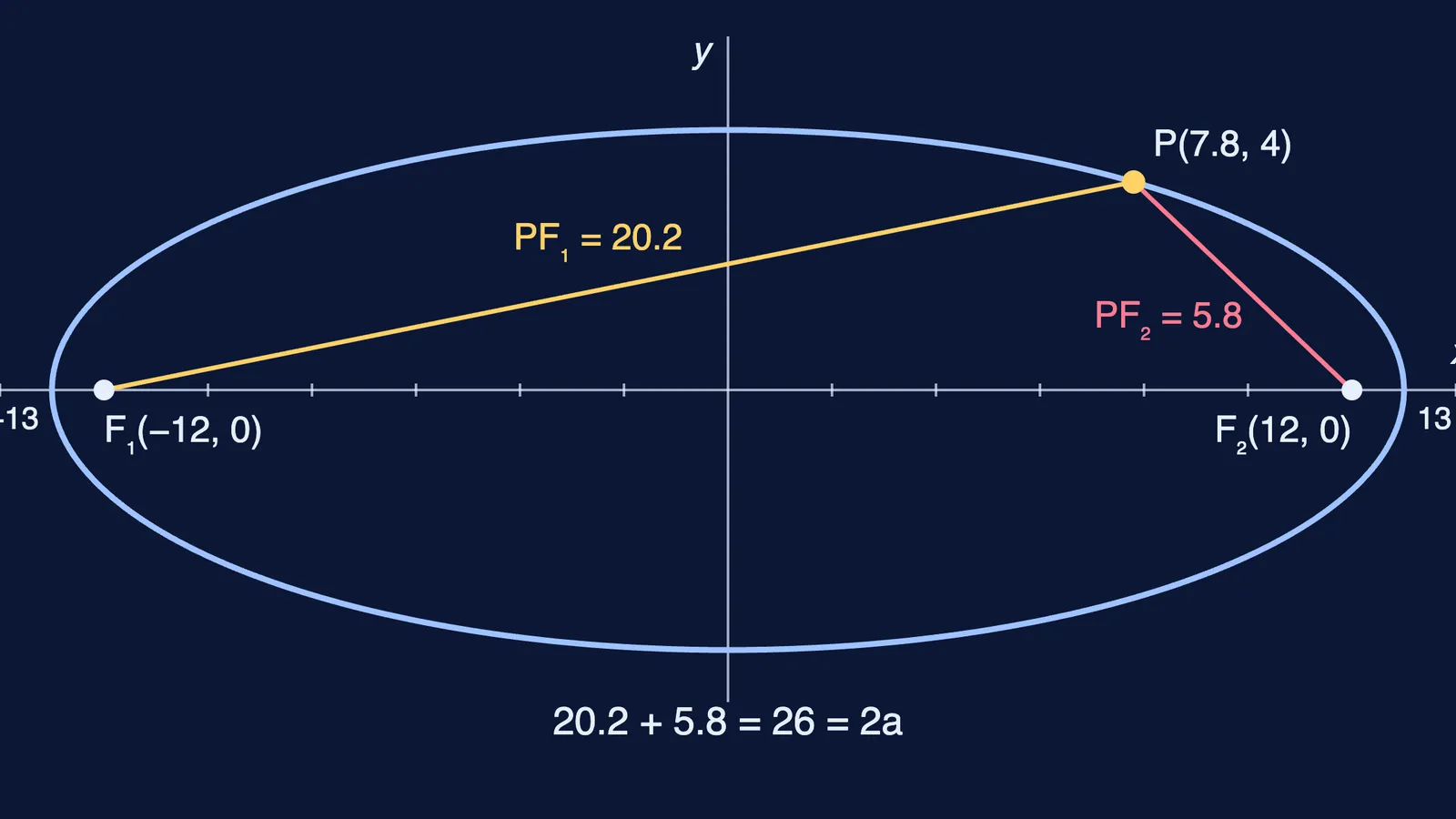
Q5 (medium). Assertion (A): For every point P on x²/169 + y²/25 = 1, the distances from P to (12, 0) and (−12, 0) add up to 26. Reason (R): For any point on an ellipse, the sum of its distances from the two foci equals 2a, the length of the major axis.
Answer: (A). c² = 169 − 25 = 144, so (±12, 0) are the foci and 2a = 26. R is the defining property, and it directly gives A; at P(7.8, 4), 20.2 + 5.8 = 26.
Trap: answering 24, the distance between the foci.
Q6 (hard). Assertion (A): A hyperbola with eccentricity √2 is an equilateral hyperbola. Reason (R): For a hyperbola, e² = 1 + b²/a².
Answer: (A). R follows from e = c/a and c² = a² + b². With e² = 2, R gives b² = a², so a = b: NCERT's equilateral hyperbola.
Trap: thinking an "equilateral" hyperbola needs e = 1.
Statement I and II questions with answers
Q7 (easy). Statement I: The parabola y² = 4ax is symmetric about the x-axis. Statement II: The directrix of x² = 28y is y = 7.
Answer: (C). If (x, y) lies on y² = 4ax, so does (x, −y): I is correct. For x² = 28y, 4a = 28 gives a = 7, so the directrix is y = −7: II is incorrect.
Trap: giving the directrix the focus's sign.
Q8 (medium). Statement I: The eccentricity of an ellipse x²/a² + y²/b² = 1 with a > b can equal 1. Statement II: The latus rectum of x²/64 + y²/28 = 1 has length 7.
Answer: (D). c = √(a² − b²) < a, so e < 1 and I is incorrect. II: 2b²/a = 2 × 28/8 = 7, correct.
Trap: forgetting that e = 1 is never reached by an ellipse.
Q9 (medium). Statement I: A plane not passing through the vertex, making an angle β equal to the cone's semi-vertical angle α with its axis, cuts the cone in an ellipse. Statement II: A pair of intersecting straight lines is the degenerate case of a parabola.
Answer: (B). With β = α the section is a parabola; an ellipse needs α < β < 90°. A pair of intersecting lines is the degenerate case of a hyperbola.
Trap: matching "pair" with the parabola's two arms.
Q10 (hard). Statement I: Exactly two circles of radius 10 with centres on the y-axis pass through (6, 1). Statement II: The hyperbola with vertices (0, ±6) and foci (0, ±10) is y²/36 − x²/64 = 1.
Answer: (A). With centre (0, k), 36 + (1 − k)² = 100 gives k = 9 or −7: two circles. For II, a = 6, c = 10, b² = 64, and y² comes first because the foci are on the y-axis.
Trap: keeping one root in I, or writing x² first in II.
How should you use this set?
Attempt all ten in 15 minutes without notes.
Label each miss: wrong fact or wrong link.
Redo the misses two days later.
If one method mistake keeps returning, the Fermi Problem Library has worked problems with a step-by-step solver that explains the reasoning rather than printing an answer. For harder problems, try our conic sections JEE Advanced practice questions.