On this page
Eight original JEE Advanced-style conic questions, easy to hard, each with a worked solution and the most tempting wrong answer.
How should you use this conic sections set?
The official JEE (Advanced) 2026 syllabus lists the parabola, ellipse and hyperbola in standard form, their foci, directrices and eccentricity, parametric equations, tangents and normals, plus locus problems. Every question stays inside that list.
Allow about 30 minutes in one sitting.
Write each point in parametric form first.
Test every multiple-correct option separately; see how partial marking works in multiple-correct questions.
New to the chapter? Start with how to prepare conic sections for JEE Advanced.
Easy: can you read a conic from its focus and directrix?
Q1 (easy, single correct). An ellipse x²/a² + y²/b² = 1 (a > b) has a focus (3, 0) and directrix x = 25/3. The length of its latus rectum is
(A) 32/5 (B) 8 (C) 18/5 (D) 25/2
Answer: (A). ae = 3 and a/e = 25/3 multiply to a² = 25, so a = 5, e = 3/5 and b² = 25 − 9 = 16. The latus rectum is 2b²/a = 32/5. Trap: (C), which uses c² = 9 in place of b².
Q2 (easy, numerical). PQ is a focal chord of y² = 8x with focus S. If SP = 6, find PQ.
Answer: 9. With a = 2, 1/SP + 1/SQ = 1/a gives 1/SQ = 1/3, so SQ = 3 and PQ = 9. Trap: 12, assuming S bisects every focal chord.
Medium: can you combine foci, tangents and parameters?
Q3 (medium, one or more options correct). P(3, √15) lies on x²/36 + y²/20 = 1, with foci S (positive x-axis) and S′. Which are true?
(A) SP + S′P = 12
(B) SP = 4
(C) The tangent at P meets the directrix x = 9 at K with angle PSK = 90°
(D) The normal at P meets the x-axis at (2, 0)
Answer: (A), (B), (C). e = 2/3 and S = (4, 0). (A) is 2a. (B): SP = a − ex₁ = 6 − 2. (C): the tangent x/12 + √15y/20 = 1 meets x = 9 at K(9, √15/3); vectors SP = (−1, √15) and SK = (5, √15/3) have dot product 0. (D): the normal meets the x-axis at e²x₁ = 4/3. Trap: (D), which uses e instead of e².
Q4 (medium, single correct). The tangent at any point of x²/9 − y²/4 = 1 meets the axes at A and B. The locus of the midpoint of AB is
(A) 9/(4x²) − 1/y² = 1 (B) 9/(4x²) + 1/y² = 1 (C) 9/(4x²) − y² = 1 (D) 9/x² − 4/y² = 1
Answer: (A). At (3 sec θ, 2 tan θ) the tangent (x sec θ)/3 − (y tan θ)/2 = 1 gives A = (3 cos θ, 0) and B = (0, −2 cot θ). For the midpoint (h, k), sec²θ = 9/(4h²) and tan²θ = 1/k²; use sec²θ − tan²θ = 1. Trap: (D), forgetting to halve.
Q5 (medium, list match). For P(27, 18) on y² = 12x, match List-I: (P) SP; (Q) the length of the focal chord through P; (R) the tangent's y-intercept; (S) the normal's x-intercept, with List-II: (1) 30 (2) 100/3 (3) 9 (4) 33 (5) 27.
(A) P→1, Q→2, R→3, S→4 (B) P→5, Q→2, R→3, S→4 (C) P→1, Q→2, R→3, S→1 (D) P→5, Q→2, R→3, S→1
Answer: (A). a = 3 and t = 3. SP = x + a = 30; the focal chord is a(t + 1/t)² = 100/3; the tangent ty = x + at² cuts the y-axis at at = 9; the normal y = −tx + 2at + at³ cuts the x-axis at 2a + at² = 33. Trap: (C), taking the normal's intercept as x + a.
Hard: can you solve multi-step conic problems?
Q6 (hard, numerical). The normal to y² = 8x at P(2, 4) meets the parabola again at Q; the tangents at P and Q meet at R. Find the area of triangle PQR.
Answer: 128. With a = 2 and t₁ = 1, the normal meets the curve again at t₂ = −t₁ − 2/t₁ = −3, so Q = (18, −12). The tangents meet at (at₁t₂, a(t₁ + t₂)) = (−6, −4). The area is (a²/2)|t₁ − t₂|³ = 2 × 64 = 128. Trap: 48, the area of triangle OPQ.
Q7 (hard, one or more options correct). Hyperbola H has the same foci as ellipse E: x²/25 + y²/16 = 1, and the product of their eccentricities is 1. Which are true?
(A) The transverse axis of H is 24/5
(B) E and H meet at the ends of the latera recta of E
(C) At every common point, the tangents to E and H are perpendicular
(D) The directrices of H are x = ±25/3
Answer: (B), (C). E has e = 3/5 and foci (±3, 0), so H has e = 5/3, a = 9/5 and b² = 9 − 81/25 = 144/25. Solving gives (±3, ±16/5), the latus-rectum ends of E, so (B) holds. At (3, 16/5) the normals (6/25, 2/5) and (50/27, −10/9) have dot product 0, as for all confocal conics: (C) holds. (A) gives the conjugate axis; the transverse is 18/5. Trap: (D), E's directrices; H's are x = ±27/25.
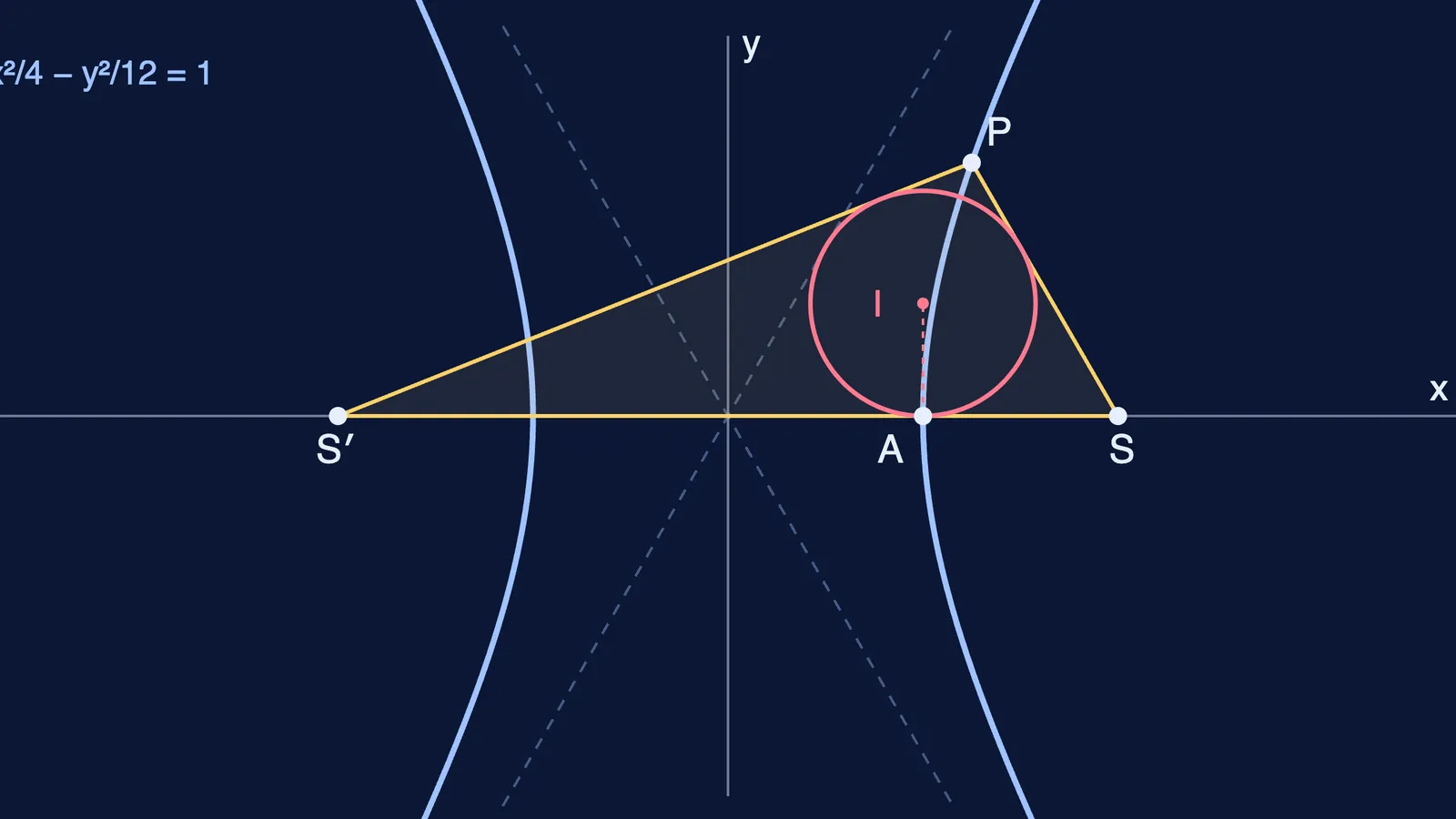
Q8 (hard, numerical). P is on the right branch of x²/4 − y²/12 = 1, and SP = 3, where S(4, 0) and S′(−4, 0) are the foci. If r is the inradius of triangle PSS′, find 3r².
Answer: 4. e = 2, and SP = ex − a gives x = 5/2 and (taking P above the axis) y = 3√3/2. Then S′P = SP + 2a = 7 and SS′ = 8, so the area is 6√3, the semi-perimeter is 9, r = 2√3/3 and 3r² = 4. Trap: 81/4, from taking r as P's height, 3√3/2.
What should you do after this set?
Label each mistake (wrong formula, algebra slip, missed case) and redo those questions later. For the formats, see JEE Advanced question types.
Stuck on the same step? The Fermi Problem Library has worked problems with a step-by-step solver that explains the reasoning rather than printing an answer.