On this page
These eight original questions sit inside the Hydrogen, s-Block and periodicity units of the official JEE (Advanced) 2026 syllabus. The current NCERT Class 11 Chemistry book (Reprint 2026-27) has no hydrogen or s-block chapter, so facts follow NIOS Senior Secondary Chemistry, Lesson 17. Molar masses use IUPAC abridged atomic weights. For the chapter plan, read how to prepare periodicity, hydrogen and s-block for JEE Advanced.
How should you use this practice set?
Allow 30 minutes, on paper, solutions covered.
Write an oxidation state, electron count or balanced equation before reading the options.
In "one or more options correct" questions, judge each option alone; see JEE Advanced question types.
Easy: hydrides, heavy water and the diagonal relationship
Q1 (easy, single-correct). Which list gives an ionic, a covalent and an interstitial hydride, in that order?
(A) LiH, NH₃, ZrH₁.₉₂ (B) NH₃, LiH, TiH₁.₇₃ (C) CaH₂, TiH₁.₇₃, HCl (D) ZrH₁.₉₂, H₂S, NaH
Answer: (A). Only group 1 and 2 metals are electropositive enough to make H⁻, so LiH is ionic. NH₃ is covalent, and zirconium holds hydrogen in its lattice with no fixed formula. Trap: (B) calls LiH covalent because lithium compounds are "more covalent"; NIOS still lists group 1 hydrides as ionic.
Q2 (easy, one or more options correct). At one temperature the ionic product of H₂O is 1.0 × 10⁻¹⁴ and that of D₂O is 3.0 × 10⁻¹⁵. Which statements are correct?
(A) Long electrolysis leaves the remaining water enriched in D₂O. (B) Pure D₂O at this temperature has pD below 7.00. (C) CaC₂ reacts with D₂O to give C₂D₂. (D) [OD⁻] in pure D₂O is lower than [OH⁻] in pure H₂O.
Answer: (A), (C), (D). NIOS Lesson 17: O–H bonds break faster than O–D bonds, so H₂ leaves first. [OD⁻] = √(3.0 × 10⁻¹⁵) = 5.5 × 10⁻⁸ M, so pD is 7.26. Trap: (B), assuming "neutral" always means 7.
Q3 (easy, single-correct). Which pair of nitrates both give the metal oxide, NO₂ and O₂ on heating?
(A) LiNO₃ and Mg(NO₃)₂ (B) NaNO₃ and KNO₃ (C) LiNO₃ and NaNO₃ (D) NaNO₃ and Mg(NO₃)₂
Answer: (A). Li⁺ and Mg²⁺ have comparable polarising power (the diagonal relationship), so both nitrates decompose to the oxide. Trap: (C) groups lithium with sodium, but NaNO₃ stops at NaNO₂ + ½O₂.
Medium: gypsum, group 2 trends and hydrogen as a fuel
Q4 (medium, numerical-value). Gypsum, CaSO₄·2H₂O, changes to plaster of Paris, CaSO₄·½H₂O, on heating. A 10.00 g sample of pure gypsum loses 1.20 g of water. If the residue holds only plaster and unchanged gypsum, what is the mass percentage of plaster in it, to two decimal places?
Answer: 73.24. Each mole converted loses 1.5 mol of water (27.02 g), so 0.04441 of 0.05808 mol converted. That is 0.04441 × 145.14 = 6.45 g of plaster in 8.80 g of residue. Full conversion would lose only 1.57 g. Trap: 76.45, the mole percentage converted.
Q5 (medium, one or more options correct). Which statements about group 2 are correct?
(A) MgCO₃ decomposes at a lower temperature than CaCO₃. (B) Solubility in water: BaSO₄ > CaSO₄ > MgSO₄. (C) BeO reacts with both acids and alkalis; MgO is only weakly basic. (D) Beryllium reacts with steam to give BeO and H₂, as magnesium does.
Answer: (A), (C). NIOS Lesson 17 gives 813 K for MgCO₃ and 1173 K for CaCO₃; BeO is amphoteric. (B) is reversed: the high hydration energy of Mg²⁺ makes MgSO₄ soluble. (D) fails: beryllium resists water and steam even at red heat. Trap: (B), carrying the carbonate trend (stability rises down the group) over to sulphate solubility.
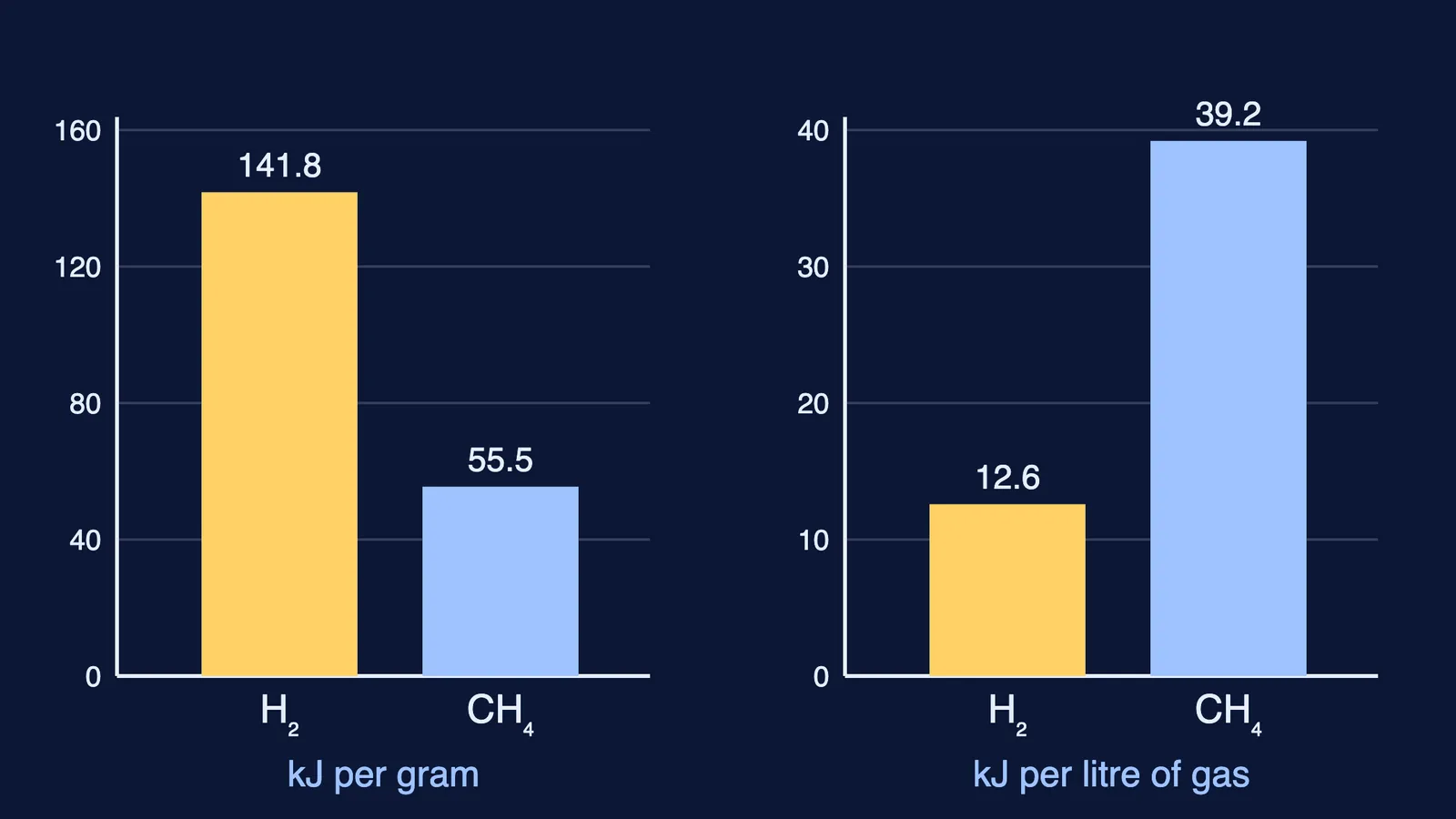
Q6 (medium, numerical-value). Enthalpies of formation (kJ/mol) from the NIST Chemistry WebBook: H₂O(l) −285.83, CO₂(g) −393.51, CH₄(g) −74.87. Products are CO₂(g) and H₂O(l). Find (heat per gram of H₂) ÷ (heat per gram of CH₄), to two decimal places.
Answer: 2.55. H₂ gives 285.83 kJ/mol, or 141.8 kJ/g. CH₄ gives 393.51 + 2(285.83) − 74.87 = 890.30 kJ/mol, or 55.5 kJ/g. Per litre the order reverses: CH₄ gives 3.1 times as much, as the diagram at the top shows. Trap: 0.32, the ratio per mole.
Hard: hydrogen peroxide and the oxygen anions
Q7 (hard, one or more options correct). In acid, 2MnO₄⁻ + 6H⁺ + 5H₂O₂ → 2Mn²⁺ + 5O₂ + 8H₂O. In alkali, 2KMnO₄ + 3H₂O₂ → 2MnO₂ + 3O₂ + 2H₂O + 2KOH. Which statements are correct?
(A) In alkali, H₂O₂ converts Mn²⁺ to MnO₂, acting as an oxidant. (B) Per mole of MnO₄⁻, the alkaline reaction releases 1.5 mol O₂ and the acid reaction 2.5 mol. (C) In PbS + 4H₂O₂ → PbSO₄ + 4H₂O, the oxidation state of sulphur rises by 6. (D) A fixed amount of H₂O₂ uses 5/3 times as many moles of MnO₄⁻ in alkali as in acid.
Answer: (A), (B), (D). Oxygen in H₂O₂ is −1, between O₂ and water, so it can go either way. Manganese gains 5 electrons going to Mn²⁺ but 3 going to MnO₂: (2/3) ÷ (2/5) = 5/3. Trap: (C). Sulphide is −2 and sulphate +6, a rise of 8, matching the 8 electrons taken by four H₂O₂.
Q8 (hard, list-match). Match each product of burning the metal in oxygen with its oxygen species.
List-I: (P) Li₂O (Q) Na₂O₂ (R) KO₂ (S) BaO₂
List-II: (1) paramagnetic anion, O–O bond order 1.5 (2) diamagnetic anion, O–O bond order 1 (3) no O–O bond (4) metal in the +4 state with two oxide ions
(A) P→3, Q→2, R→1, S→2 (B) P→3, Q→1, R→2, S→4 (C) P→3, Q→2, R→1, S→4 (D) P→2, Q→2, R→1, S→3
Answer: (A). Li₂O holds O²⁻. Peroxide, O₂²⁻, has 14 valence electrons: π* full, bond order 1. Superoxide, O₂⁻, has 13: one unpaired electron, bond order 1.5. NIOS notes barium forms a peroxide, so BaO₂ is Ba²⁺ with O₂²⁻. Trap: (C), giving barium +4. Why cation size decides the oxide: lithium's oxide versus potassium's superoxide.
What should you do after checking your answers?
Missed Q1, Q2 or Q7: rewrite the hydrogen unit as balanced equations with oxidation states.
Missed Q3, Q5 or Q8: tabulate group 1 and 2 trends, one reason per row.
Missed Q4 or Q6: check units and a limiting case before trusting a number.
If a step still does not click, the Fermi Problem Library has worked problems with a step-by-step solver that explains the reasoning rather than printing an answer. Redo every miss in three days.