On this page
Eight new JEE Advanced-style questions on units, dimensions and errors, easy to hard, in single-correct, one-or-more-correct, numerical-value and list-match formats. Each combines two ideas.
The official JEE (Advanced) 2026 syllabus opens Physics with units and dimensions, dimensional analysis, least count, significant figures and error analysis for named experiments, including Vernier callipers, g from a simple pendulum, Young's modulus and the u-v method for a convex lens. Every question stays inside the syllabus.
How should you use this set?
Allow 35 minutes and cover the answers.
In "one or more options correct" questions, test each option on its own. See JEE Advanced question types.
Write dimensions as [M L T A K]. Treat a maximum error as the sum of the fractional errors.
If the basics feel shaky, read how to prepare units, dimensions and errors for JEE Advanced first.
Easy: can you read dimensions and scales without slipping?
Q1 (easy, single-correct). σ is the Stefan-Boltzmann constant and b is Wien's displacement constant. What are the dimensions of σb⁴?
(A) [M L⁶ T⁻³] (B) [M L⁴ T⁻³] (C) [M L⁴ T⁻³ K⁻⁴] (D) [M L⁴ T⁻²]
Answer: (B). σ is power per area per K⁴, so [M T⁻³ K⁻⁴]. b = λT is [L K], so b⁴ is [L⁴ K⁴]. Kelvins cancel, leaving [M L⁴ T⁻³]. Trap: (C) treats b as a plain length.
Q2 (easy, numerical-value). A Vernier calliper has 0.5 mm main-scale divisions, and 20 Vernier divisions match 19 of them. With the jaws closed, the Vernier zero sits left of the main-scale zero and the 8th Vernier division coincides. For a rod, the main scale reads 24.0 mm and the 14th division coincides. What is the corrected length, in mm?
Answer: 24.65. Least count = 0.5/20 = 0.025 mm. Reading = 24.0 + 14 × 0.025 = 24.35 mm. The zero error is negative: −(20 − 8) × 0.025 = −0.30 mm. Corrected = 24.35 + 0.30 = 24.65 mm. Trap: 24.55 counts the zero error as 8 × 0.025.
Q3 (easy, one or more options correct). Which of these have the dimensions of length? (e is electron charge, m the electron mass.)
(A) e²/(4πε₀mc²) (B) h/(mc²) (C) ε₀h²/(πme²) (D) h/(mc)
Answer: (A), (C), (D). e²/(4πε₀) is energy × length, so dividing by the energy mc² leaves length. ε₀h²/(πme²) is the Bohr radius. h/(mc) is h divided by a momentum, a length. Trap: (B) is h divided by an energy, which is a time.
Medium: can you combine errors correctly?
Q4 (medium, list-match). Match each quantity in List-I with the quantity in List-II that has the same dimensions.
List-I: (P) Planck's constant h; (Q) ε₀E², E an electric field; (R) μ₀; (S) magnetic moment of a current loop.
List-II: (1) torque divided by magnetic field (2) angular momentum (3) Young's modulus (4) force divided by current squared (5) power per unit area
(A) P→2, Q→5, R→4, S→1 (B) P→2, Q→3, R→1, S→4 (C) P→2, Q→3, R→4, S→1 (D) P→2, Q→5, R→1, S→4
Answer: (C). h and angular momentum are both [M L² T⁻¹]. ε₀E² is an energy density, which matches pressure and Young's modulus. From the force between parallel wires, μ₀ has the dimensions of F/I². Torque = mB, so m = torque/B. Trap: (A) confuses energy density with intensity.
Q5 (medium, numerical-value). In the u-v method, a convex lens forms a sharp image 100.0 cm away when the object is 25.0 cm away. Both distances carry an error of ±0.1 cm. What is the maximum error in the focal length, in mm?
Answer: 0.68. f = uv/(u + v) = 20.0 cm. Differentiating 1/f = 1/u + 1/v gives Δf/f² = Δu/u² + Δv/v² = 0.1/625 + 0.1/10000, so Δf = 400 × 1.7 × 10⁻⁴ = 0.068 cm. Trap: 1.0 mm adds the percentage errors of u and v, ignoring that u + v appears below.
Q6 (medium, one or more options correct). A Young's modulus experiment uses Y = 4MgL/(πd²l). L = 200.0 ± 0.1 cm, d = 0.800 ± 0.010 mm and extension l = 1.00 ± 0.01 mm. Take M and g as exact. Which are correct?
(A) The maximum error in Y is 3.55%. (B) The diameter term alone is larger than the other two together. (C) Doubling the load (wire still elastic) cuts the maximum error to 3.05%. (D) A wire of diameter 0.400 mm, same load and length, lowers the maximum error.
Answer: (A), (B), (C). Terms: 0.05% + 2.5% + 1.0% = 3.55%. Doubling the load makes l = 2.00 mm: 0.05 + 2.5 + 0.5 = 3.05%. Halving d gives 2Δd/d = 5% while l quadruples: 5.3%. Trap: (D), because d is squared.
Hard: can you use dimensions and errors to design an answer?
Q7 (hard, numerical-value). The power P radiated by a point charge q with acceleration a depends only on q, a, ε₀ and c, as P ∝ qˣ aʸ ε₀ᶻ cʷ. Find x + y − w.
Answer: 7. With four base dimensions (M, L, T, A) and four unknowns, the exponents are fixed. M: −z = 1, so z = −1. A: x + 2z = 0, so x = 2. L: y − 3z + w = 2. T: x − 2y + 4z − w = −3. So y = 2, w = −3, P ∝ q²a²/(ε₀c³) and x + y − w = 7. Trap: 1 is x + y + w.
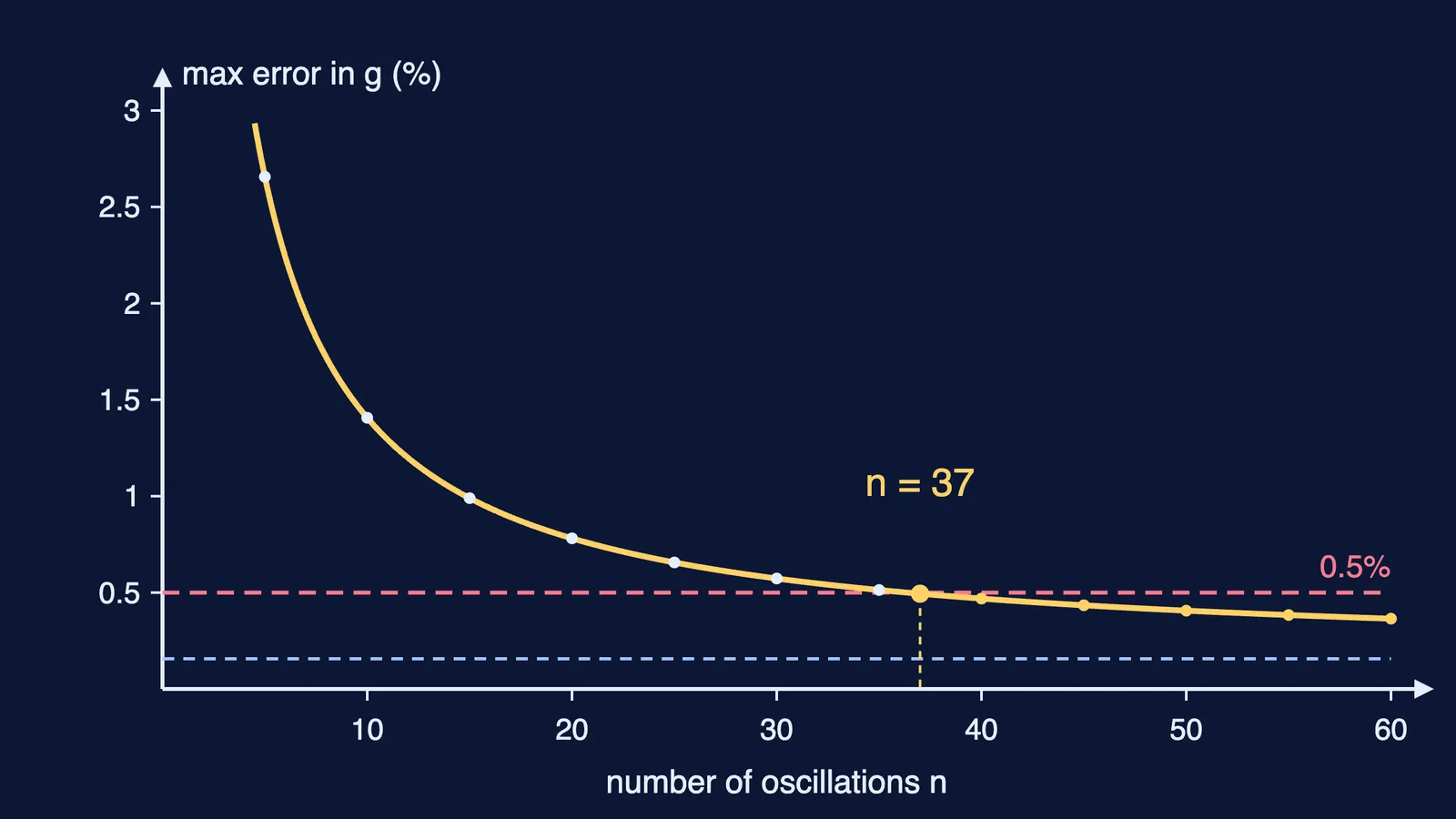
Q8 (hard, numerical-value). A pendulum's length, 64.0 cm, is measured to ±0.1 cm, and its period is close to 1.60 s. The total time for n oscillations is read to ±0.1 s. What is the smallest n that keeps the maximum percentage error in g = 4π²L/T² at or below 0.5%?
Answer: 37. Length: 0.1/64.0 = 0.156%. Timing: 2 × 0.1/(1.60n) = 12.5/n %. So 12.5/n ≤ 0.344, n ≥ 36.4, and n = 37 (0.494%; 36 gives 0.503%). Trap: 25 ignores the length error.
What should you do after checking your answers?
Sort each miss: wrong dimensions of a constant, wrong error rule, or a scale-reading slip. Redo that bin. For a slower walk through Q8's idea, see percentage error in g from a simple pendulum.
For more practice, the Fermi Problem Library has worked problems with a step-by-step solver that explains the reasoning rather than printing an answer.
Redo the set, timed, in a week.