On this page
The p-block section of the official JEE (Advanced) 2026 syllabus names every compound used here, from diborane to the oxoacids of halogens. The current NCERT books have no p-block chapter, so the facts below come from NIOS Senior Secondary Chemistry lessons 19, p-block compounds I and 20, p-block compounds II, with redox equations from NCERT's Class 11 Redox Reactions unit (Reprint 2026-27). For the chapter plan, see how to prepare p-Block Elements for JEE Advanced.
How should you use this p-block practice set?
Allow 30 minutes. Write the structure or balanced equation before reading the options.
In "one or more correct" questions, judge each option alone; our guide to JEE Advanced question types explains the formats.
Easy: structures you should draw, not memorise
Q1 (easy, single-correct). Which oxoacid of sulphur has sulphur in the +6 state and an S–O–S linkage?
(A) H₂S₂O₈ (B) H₂S₂O₇ (C) H₂SO₅ (D) H₂SO₃
Answer: (B). NIOS Lesson 20 (Fig. 20.2) draws pyrosulphuric acid as HO–SO₂–O–SO₂–OH: 2x + 2 − 14 = 0 gives +6. Trap: (A) is also +6 and has two sulphurs, but the same figure joins them through a peroxide, S–O–O–S. H₂SO₃ is only +4.
Q2 (easy, numerical-value). For B₂H₆, add the atoms in the plane of the four terminal hydrogens, the number of 3c–2e bonds and the total valence electrons.
Answer: 20. NIOS Lesson 19 puts both borons and the four terminal hydrogens in one plane, bridging hydrogens above and below (6); the two B–H–B bridges are 3c–2e bonds (2); valence electrons 2(3) + 6(1) = 12. Sum 20. Trap: drawing it flat like ethylene puts all 8 atoms in the plane and gives 22.
Q3 (easy, one or more options correct). Which statements about oxides of nitrogen are correct?
(A) NO₂ is an odd-electron molecule and is bent. (B) In N₂O₄, the two nitrogen atoms are bonded directly to each other. (C) N₂O₃ is the anhydride of nitric acid. (D) NO has no unpaired electron.
Answer: (A), (B). NO₂ has 23 electrons, an odd count, and NIOS Lesson 19 draws it bent and its dimer as O₂N–NO₂. (C) fails: N is +3 in N₂O₃, so N₂O₃ + H₂O → 2HNO₂ gives nitrous acid; the anhydride of nitric acid is N₂O₅ (N +5). (D) fails: NO has 15 electrons, so one is unpaired.
Medium: count shared atoms and moles
Q4 (medium, single-correct). A cyclic silicate anion is a ring of six SiO₄ tetrahedra, each sharing two oxygens with its neighbours. What is its formula?
(A) [Si₆O₁₈]¹²⁻ (B) [Si₆O₂₄]²⁴⁻ (C) [Si₆O₁₅]⁶⁻ (D) [Si₆O₁₈]⁶⁻
Answer: (A). Each Si owns 2 unshared oxygens plus half of 2 shared ones: 3 per Si, so Si₆O₁₈, charge 6(+4) + 18(−2) = −12. NIOS Lesson 19 gives the same 1:3 ratio for two shared oxygens (ring Si₃O₉⁶⁻, chain (SiO₃)ₙ²ⁿ⁻). Trap: (B) ignores sharing; (C) uses the 2:5 ratio of sheets (Si₄O₁₀⁴⁻); (D) miscounts the charge.
Q5 (medium, numerical-value). 1.00 L of ozonised oxygen at 300 K and 1 bar contains 4.0% ozone by volume. It is bubbled through 50.0 mL of 0.100 M FeSO₄ in dilute H₂SO₄, and the Fe²⁺ left over is titrated with 0.0200 M K₂Cr₂O₇. Find the volume of dichromate, in mL (R = 0.08314 L bar mol⁻¹ K⁻¹).
Answer: 14.9. n = PV/RT = 0.04009 mol, so O₃ = 1.604 mmol. NIOS Lesson 20 gives O₃ + 2FeSO₄ + H₂SO₄ → Fe₂(SO₄)₃ + H₂O + O₂, so 3.207 mmol Fe²⁺ is oxidised and 1.793 of 5.000 mmol remains. NCERT equation 7.58 uses 6Fe²⁺ per Cr₂O₇²⁻: 0.2988 mmol, or 14.9 mL. Trap: a 1:1 O₃ to Fe²⁺ ratio gives 28.3; titrating the oxidised iron instead of the leftover gives 26.7.
Hard: disproportionation, oxoacids and Lewis acids
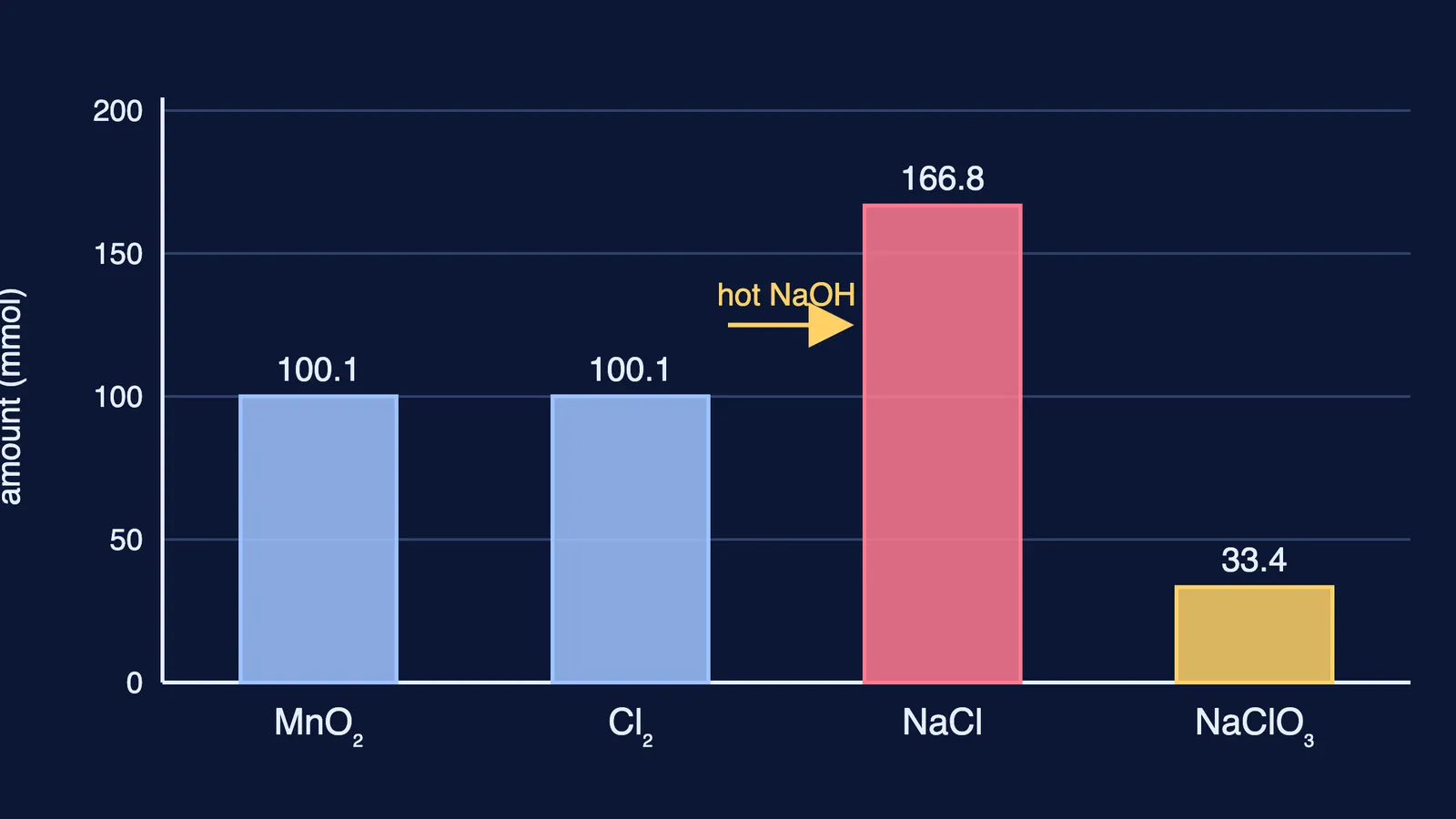
Q6 (hard, numerical-value). 8.70 g of MnO₂ (86.94 g/mol) is warmed with excess concentrated HCl, and all the chlorine is passed into hot, concentrated NaOH, which converts it fully to chloride and chlorate. Find the mass of NaClO₃ formed, in g (106.44 g/mol).
Answer: 3.55. NIOS Lesson 20 prepares chlorine as MnO₂ + 4H⁺ + 2Cl⁻ → Mn²⁺ + Cl₂ + 2H₂O, giving 0.1001 mol Cl₂. NCERT gives both alkali steps: Cl₂ + 2OH⁻ → ClO⁻ + Cl⁻ + H₂O, then 3ClO⁻ → 2Cl⁻ + ClO₃⁻. Overall: 3Cl₂ + 6OH⁻ → 5Cl⁻ + ClO₃⁻ + 3H₂O. NaClO₃ = 0.1001/3 × 106.44 = 3.55 g, as the chart above shows. Trap: stopping at the cold-alkali product and assuming one ClO₃⁻ per Cl₂ gives 10.65.
Q7 (hard, list-match). Match each acid in List-I with List-II.
List-I: (P) H₃PO₂ (Q) H₃PO₃ (R) H₄P₂O₇ (S) H₄P₂O₆
List-II: (1) contains a P–O–P linkage (2) contains a P–P bond, P in +4 (3) monobasic (4) dibasic (5) tribasic
(A) P→3, Q→4, R→1, S→2 (B) P→3, Q→5, R→1, S→2 (C) P→3, Q→4, R→2, S→1 (D) P→4, Q→5, R→1, S→2
Answer: (A). Only P–OH hydrogens ionise. NIOS Table 19.10 lists H₂P(OH)O as monobasic and HPO(OH)₂ as dibasic, and draws pyrophosphoric acid with a P–O–P bridge. Hypophosphoric acid is (HO)₂P(O)–P(O)(OH)₂, with a direct P–P bond (PubChem), and 2x = 12 − 4 gives P +4. Trap: (C) swaps the two "di-phosphorus" acids; (B) counts every H in H₃PO₃ as acidic.
Q8 (hard, one or more options correct). Which statements are correct?
(A) In Al₂Cl₆, each aluminium is surrounded roughly tetrahedrally by four chlorines. (B) Aluminium in monomeric AlCl₃ already has a complete octet. (C) BF₃ is a weaker Lewis acid than BBr₃. (D) BF₃ is a stronger Lewis acid than BCl₃, because fluorine is more electronegative.
Answer: (A), (C). NIOS Lesson 19: Al in AlCl₃ has only six valence electrons, so (B) fails; in the dimer, dative bonds from bridging chlorines complete its octet, roughly tetrahedrally. The measured Lewis acidity of the boron trihalides is BF₃ < BCl₃ < BBr₃ < BI₃, so (C) is true and (D) false. Trap: (D) follows electronegativity; NIOS notes B–F multiple-bond character, and this π-bonding, strongest for fluorine, is lost when BF₃ bends to accept a base.
What should you revise after this set?
Structure slips (Q1, Q2, Q4, Q7): draw before counting.
Stoichiometry slips (Q5, Q6): balance, then chain ratios.
Property slips (Q3, Q8): tie each fact to an electron count.
The p-Block JEE Main practice set has 8 different questions on the trends. For more practice, the Fermi Problem Library has worked problems with a step-by-step solver that explains the reasoning rather than printing an answer.