On this page
You have probably heard that a habit takes 21 days. If your daily study slot still feels like a fight after three weeks, that number is the problem, not you. Here is what the research measured, and how to use it for a JEE or NEET routine.
How long does it take to form a habit, according to research?
The study usually quoted on this question is by Phillippa Lally and colleagues at University College London, published in the European Journal of Social Psychology in 2010. In it, 96 volunteers each chose one eating, drinking or exercise behaviour, tied it to a daily cue such as "after breakfast", and rated how automatic it felt every day for 12 weeks.
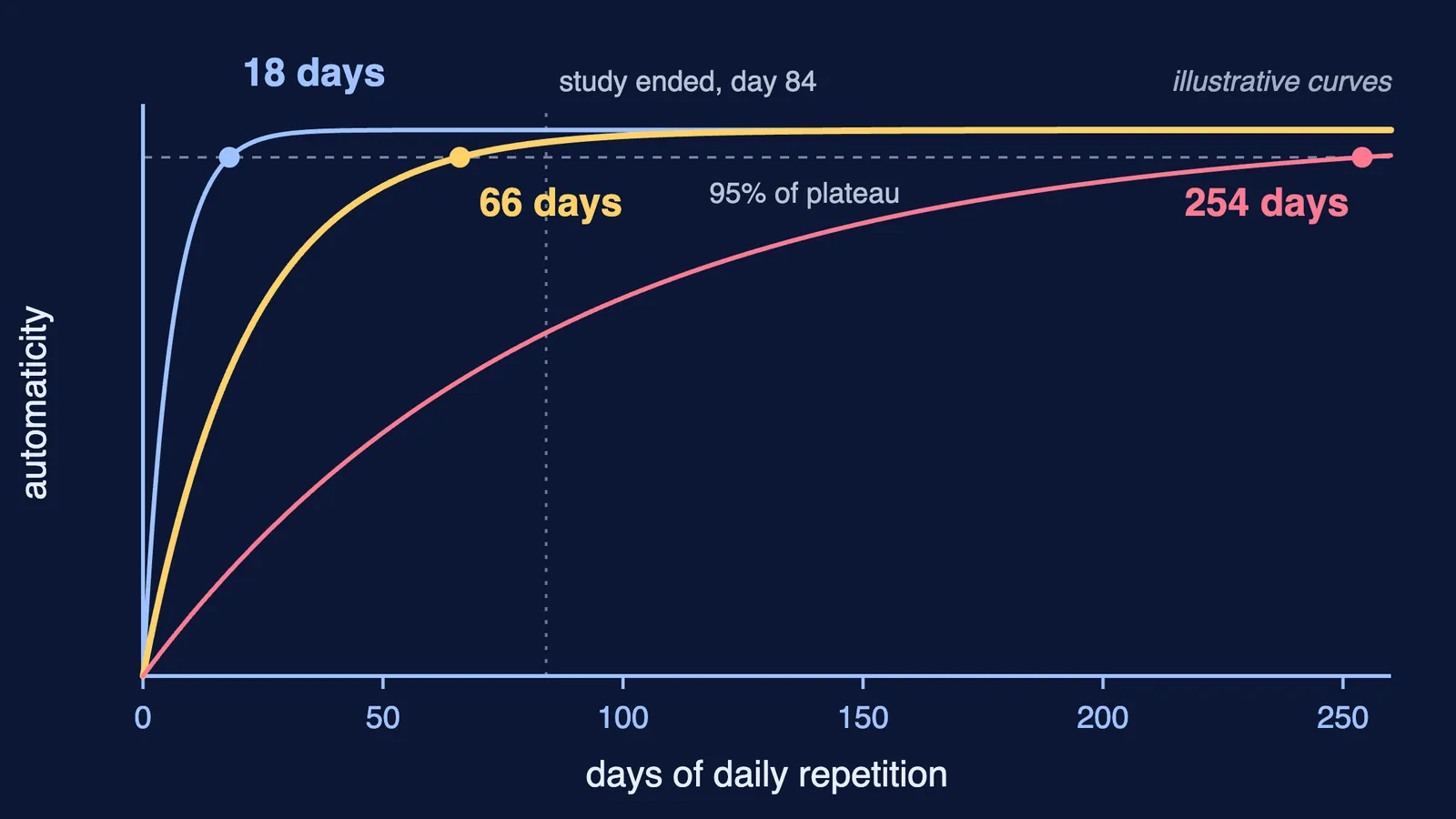
The researchers fitted a curve to each person's scores and asked how long it took to reach 95% of that person's own plateau. That time ranged from 18 to 254 days, according to the paper's abstract.
The median time was 66 days: half the people with a fitted curve got there sooner, half took longer, as a 2024 systematic review in Healthcare reports from the paper. Popular summaries, such as a UCL Behavioural Science and Health blog post, call it an average. That UCL post also calls the 21-day rule a myth.
What do the 66 days actually mean?
The 66 days is a middle value, not a deadline. Three details from the paper matter more than the headline number:
The curve is steep first, then flat. Automaticity rose along an asymptotic curve, the abstract reports, so early repetitions add the most and later ones add less and less.
The study was small and the data were noisy. Of 96 people, 82 gave enough data, the model fitted 62 of them, and only 39 showed a good fit, the abstract reports. The 254-day figure is a forecast beyond the 84 days actually observed.
Consistency mattered. People who performed the behaviour more consistently had curves that fitted better, the abstract notes. The volunteers were adults choosing health behaviours, not students building study routines.
Later work points the same way. A 2024 systematic review in Healthcare of 20 studies with 2,601 participants found median times of 59 to 66 days, mean times of 106 to 154 days, and individual times from 4 to 335 days, though most included studies had a high risk of bias. A 2023 study in PNAS of gym and hospital handwashing data found that the gym habit typically took months while handwashing took weeks.
A daily study session is closer to exercise than to drinking water: effortful and easy to postpone. Plan for the longer end.
Does missing a day break a habit?
No. In Lally's study, missing one opportunity did not materially affect the habit formation process, the abstract states. The study does not say a long break is harmless, so treat a single miss as normal and get straight back to it.
A simple rule of thumb: never miss twice in a row. One skipped day is a blip. A week off is a restart.
What does a 10-week study habit tracker look like?
Ten weeks (70 days) takes you just past the typical 66 days. Pick one behaviour, one cue and one place, and keep them fixed. For example: "After I come back from coaching and eat, I sit at my desk and solve five physics problems."
Weeks 1-2: make it tiny. Five problems or 20 minutes, no more.
Weeks 3-4: expect the dip. The novelty fades and the habit is not automatic yet. Keep the size small and keep the time fixed.
Weeks 5-6: grow slowly. Add five minutes or two problems only if the start now feels easy.
Weeks 7-8: test it. On a busy day, do the small version instead of skipping.
Weeks 9-10: check automaticity. Each Sunday, rate one line from 1 to 5: "I start this without having to think about it."
Draw a 10 by 7 grid in the back of a notebook. Tick each day you showed up, circle a small-version day, and leave a miss blank. Your only rule is no two blanks side by side. A grid of ticks is also a done-list, the idea behind the small wins method for studying.
If you do not know which problems to start with, the Fermi Problem Library has worked problems with a step-by-step solver that explains the reasoning, so your five-problem slot has a ready first task.
What if it still feels hard after 10 weeks?
That is within the range the research found, not a sign of failure. Keep the cue and the size the same, and review the plan at natural breaks: our guide to the fresh start effect shows how to use a new month to reset without guilt. For the full weekday plan around this one habit, read how to build a study routine that lasts.
If low mood or stress stays with you for weeks and makes daily life hard, talk to a parent, teacher or school counsellor, or call Tele MANAS on 14416.