On this page
Are polymers still in the JEE Advanced 2026 syllabus?
Yes. The official JEE (Advanced) 2026 syllabus lists Polymers as its own chemistry topic: addition and condensation polymerisation, homo- and copolymers, natural rubber, cellulose, nylon, Teflon, Bakelite, PVC and biodegradable polymers. Every question stays inside it.
Amine facts follow Unit 9 of NCERT Class 12 Chemistry Part II and biomolecule facts follow Unit 10, both Reprint 2026-27. Polymers left NCERT, so polymer facts follow NIOS Chemistry Lesson 31. We checked every answer and every option in Python. For theory, read how to prepare amines, biomolecules and polymers for JEE Advanced.
How should you use this practice set?
Allow 30 minutes on paper, solutions covered.
In "one or more options correct" questions, judge each option alone. Our guide to JEE Advanced question types explains the formats.
Easy: carbon counts, sugars and copolymers
Q1 (easy, single-correct). Each route starts from a four-carbon compound. Which one ends with an amine that also has four carbons?
(A) Butanamide, then Br₂ and aqueous NaOH (B) 1-Bromobutane, then KCN, then LiAlH₄ (C) Butanamide, then LiAlH₄ (D) Butanenitrile, then H₃O⁺ and heat, then NH₃ and heat, then Br₂ and NaOH
Answer: (C). LiAlH₄ reduces amides to amines without losing carbon (NCERT), giving butan-1-amine. Hoffmann degradation loses a carbon, so (A) and (D) give propan-1-amine. Trap: (B). Nitrile reduction keeps carbons, but KCN has already added one, giving pentan-1-amine.
Q2 (easy, one or more options correct). Which statements are correct?
(A) Sucrose joins C1 of α-D-glucose to C2 of β-D-fructose, so it is non-reducing. (B) A free aldehyde can form at C1 of maltose's second glucose unit, so maltose reduces Tollens' reagent. (C) Hydrolysis of lactose gives two molecules of β-D-glucose. (D) α-D-glucose and β-D-glucose differ only at C5, the carbon whose –OH closes the ring.
Answer: (A), (B). Both match NCERT Unit 10; lactose gives β-D-galactose and β-D-glucose, so (C) fails. Trap: (D). The C5 –OH does close the ring, but anomers differ at C1, the anomeric carbon.
Q3 (easy, numerical-value). How many of these are copolymers: nylon-6,6, PVC, Teflon, Bakelite, Buna-S, PHBV, polythene, neoprene, natural rubber?
Answer: 4. A copolymer has more than one kind of monomer unit (NIOS). That fits nylon-6,6 (diamine and diacid), Bakelite (phenol and formaldehyde), Buna-S (styrene and butadiene) and PHBV (two hydroxy acids). Trap: 3, from counting only condensation polymers and missing Buna-S, an addition copolymer.
Medium: classify first, then calculate
Q4 (medium, numerical-value). Amine X, C₃H₉N, gives no carbylamine test but reacts with benzenesulphonyl chloride. X is treated with excess CH₃I, with a base to remove HI, until no further reaction occurs. Find the molar mass (g mol⁻¹) of the final product (C = 12, H = 1, N = 14, I = 127).
Answer: 215. Per NCERT, only primary amines give the carbylamine test and tertiary amines ignore benzenesulphonyl chloride, so X is secondary: N-methylethanamine. Excess CH₃I takes it to the quaternary salt C₂H₅N(CH₃)₃⁺ I⁻ (C₅H₁₄NI). Trap: 229 if you take X as propylamine, or 201 if you take it as trimethylamine.
Q5 (medium, single-correct). D-Glucose is heated with methanol and dry HCl to give methyl α-D-glucopyranoside, X. Which is correct?
(A) X reduces Tollens' reagent, since it comes from an aldose. (B) The rotation of a fresh solution of X changes until it matches glucose's equilibrium value. (C) Warming X with dilute aqueous acid gives a solution that reduces Fehling's solution. (D) X forms an oxime with hydroxylamine.
Answer: (C). C1 of methyl glucoside is an acetal, and acetals cannot easily become free aldehydes, so (A), (B) and (D) fail. Acid hydrolyses the glycosidic bond, releasing glucose, which reduces Fehling's. Trap: (B); mutarotation needs the ring to open, which the methyl group blocks.
Q6 (medium, list-match). Match List-I with List-II.
List-I: (P) keratin (Q) insulin (R) RNA (S) cellulose
List-II: (1) fibrous protein, water-insoluble, chains held by hydrogen and disulphide bonds (2) globular protein, usually water-soluble (3) contains β-D-ribose and uracil (4) straight chain of β-D-glucose units linked C1–C4 (5) contains β-D-2-deoxyribose and thymine
(A) P→1, Q→2, R→3, S→4 (B) P→1, Q→2, R→5, S→4 (C) P→2, Q→1, R→3, S→4 (D) P→1, Q→2, R→3, S→5
Answer: (A). Every description is from NCERT Unit 10. Trap: (C); NCERT names insulin as globular.
Hard: track every atom through the sequence
Q7 (hard, one or more options correct). Aromatic amine A, C₇H₉N, gives the carbylamine test. Excess bromine water turns A into D, C₇H₆Br₃N. A is diazotised at 273–278 K. One portion is treated with HBF₄ and the precipitate is heated to give B, C₇H₇F. Another portion couples with alkaline phenol to give azo dye C. Which are correct?
(A) A is 3-methylaniline. (B) B is 1-fluoro-4-methylbenzene. (C) The molar mass of C is 212.3 g mol⁻¹. (D) D is 2,4,6-tribromo-3-methylaniline.
Answer: (A), (C), (D). –NH₂ directs bromine to its ortho and para positions (NCERT). Only with methyl at C3 are all three free, giving a tribromide (PubChem lists it as C₇H₆Br₃N). The fluoroborate route puts F where N was, giving 1-fluoro-3-methylbenzene. Phenol couples at its para position, giving C₁₃H₁₂N₂O, 212.25 g mol⁻¹. Trap: (B), from assuming the para isomer, which would give only a dibromide.
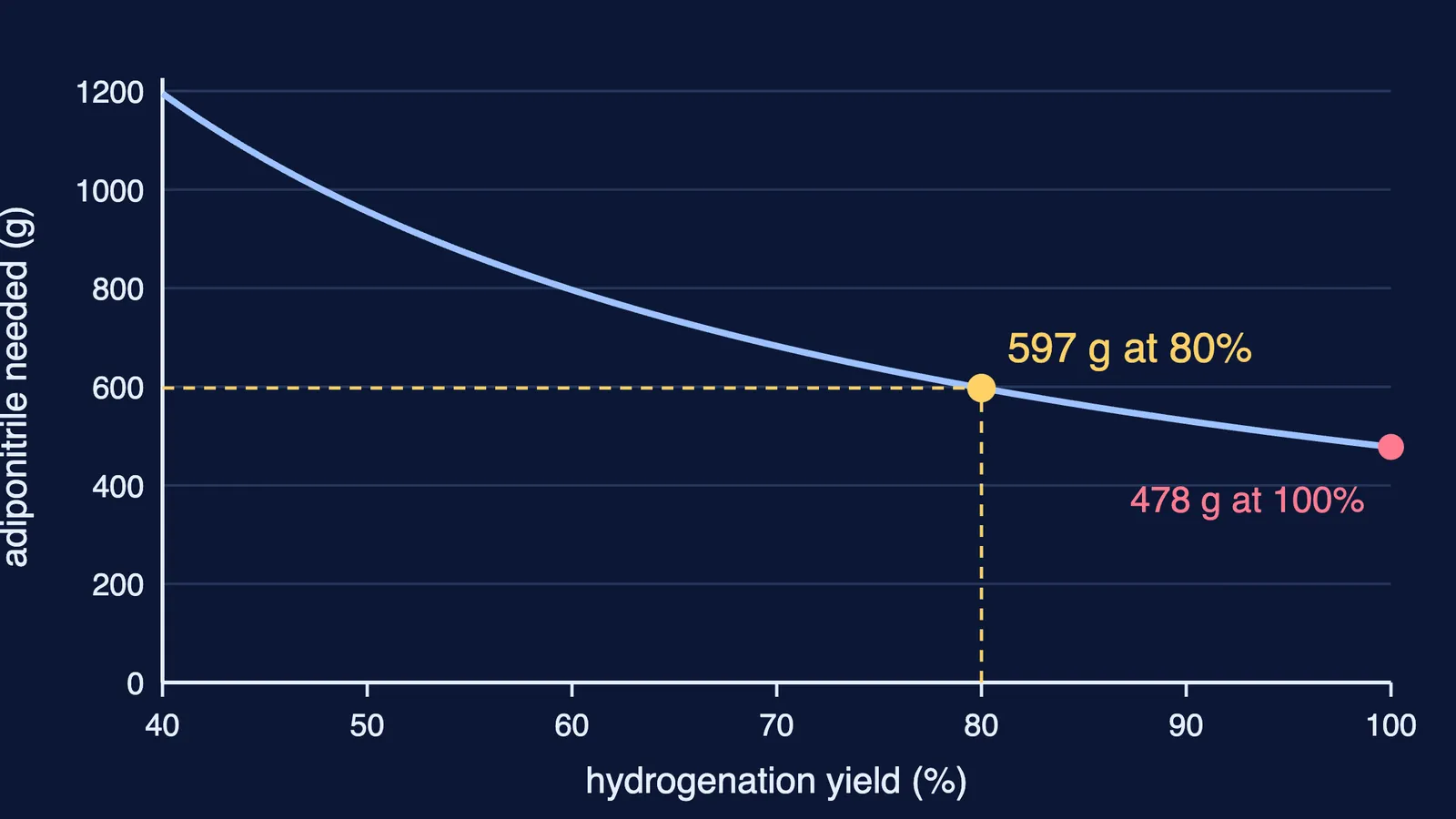
Q8 (hard, numerical-value). Hexamethylenediamine is made by hydrogenating adiponitrile, NC(CH₂)₄CN, and then condensed with adipic acid to give nylon-6,6, repeat unit C₁₂H₂₂N₂O₂. Hydrogenation gives an 80% yield and polymerisation is complete; ignore chain ends. What mass of adiponitrile (g, nearest integer) is needed for 1.00 kg of nylon-6,6? (C = 12, H = 1, N = 14, O = 16)
Answer: 597. Each repeat unit (226 g mol⁻¹) holds one diamine, so 1000 ÷ 226 = 4.425 mol is needed, from 4.425 ÷ 0.80 = 5.531 mol of adiponitrile (108 g mol⁻¹): 597 g. Trap: 478, which ignores the yield, or 382, from multiplying by 0.80.
What should you do after checking your answers?
Missed Q1, Q4 or Q7: at each step, write the carbon count and what sits on nitrogen.
Missed Q2, Q5 or Q6: draw C1 of each sugar and mark it hemiacetal, acetal or glycosidic link.
Missed Q3 or Q8: list each polymer's monomers first. Our explainer on PHBV and nylon-2–nylon-6 covers the biodegradable ones.
If you can follow a solution but could not have started it, the Fermi Problem Library has worked problems with a step-by-step solver that explains the reasoning rather than printing an answer.
Redo every miss in three days.