On this page
When a chemistry question asks which polymer is biodegradable, two names keep coming up: PHBV and nylon-2–nylon-6. Both pairs of monomers appear in NCERT Exemplar Problems, Class 12 Chemistry, Unit 15: Polymers, where question 15 asks which monomers form biodegradable polymers and the answer key picks "3-hydroxybutanoic acid + 3-hydroxypentanoic acid" and "Glycine + amino caproic acid". Here are both pairs, how they join, and why those joins can be undone.
What are the monomers of PHBV?
PHBV stands for poly(3-hydroxybutyrate-co-3-hydroxyvalerate). A 2023 review by Jin, del Valle and Puiggalí in the International Journal of Molecular Sciences describes PHBV as a copolymer built from 3-hydroxybutyrate and 3-hydroxyvalerate units (Jin et al., 2023). The two monomers are:
3-hydroxybutanoic acid, CH3–CH(OH)–CH2–COOH, formula C4H8O3 (PubChem)
3-hydroxypentanoic acid, CH3CH2–CH(OH)–CH2–COOH, formula C5H10O3 (PubChem)
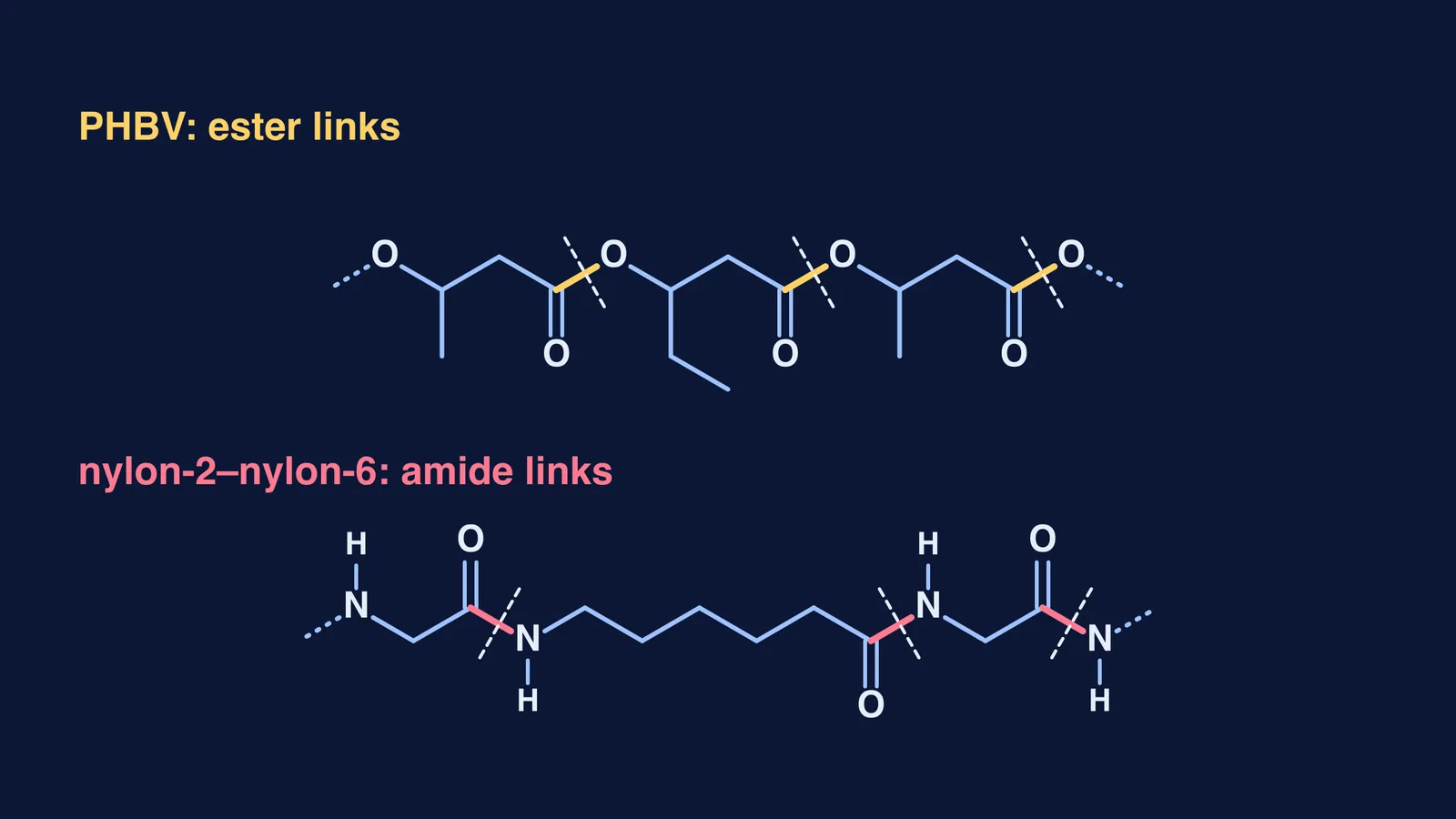
Each monomer carries an –OH group on carbon 3 and a –COOH group on carbon 1. The –OH of one molecule condenses with the –COOH of the next, water is lost, and an ester link, –CO–O–, forms. So PHBV is a polyester. The two units differ only in a methyl versus an ethyl side group, and the same review notes that the melting temperature of PHBV falls as the share of 3-hydroxyvalerate rises.
PHBV was not dreamt up in a lab from nothing. The review describes polyhydroxyalkanoates, the family PHBV belongs to, as natural polyesters that many bacteria make and store inside their cells as an energy reserve.
What are the monomers of nylon-2–nylon-6?
Glycine (2-aminoacetic acid), H2N–CH2–COOH, formula C2H5NO2 (PubChem)
Aminocaproic acid (6-aminohexanoic acid), H2N–(CH2)5–COOH, formula C6H13NO2 (PubChem)
The numbers in the name count carbons: glycine has two, aminocaproic acid has six. This time the –NH2 of one monomer condenses with the –COOH of the next, water is lost, and an amide link, –CO–NH–, forms. Nylon-2–nylon-6 is therefore a polyamide, with the two amino acids alternating along the chain. The same NCERT Exemplar unit answers its question 36 by pointing out that proteins and polyamides both contain the amide linkage.
Why do ester and amide links break down?
Both links were made by removing water, so adding water back, hydrolysis, can split them:
Ester: –CO–O– + H2O → –COOH + HO–
Amide: –CO–NH– + H2O → –COOH + H2N–
Fully hydrolysed, PHBV gives back its two hydroxy acids, and nylon-2–nylon-6 gives back glycine and aminocaproic acid.
Water alone is slow; microbes speed it up with enzymes. Jin and colleagues describe enzymes attacking PHBV first in its disordered (amorphous) regions and only then in its crystalline regions, with breakdown happening mostly at the surface (Jin et al., 2023). For polyamides, a 2024 Nature Communications study of nylon-6 enzymes by Bell and colleagues notes that amide bonds, and enzymes that hydrolyse them, are common in nature (Bell et al., 2024).
Amide links are the tougher of the two. Without an enzyme, hydrolysis of an amide bond proceeds about three orders of magnitude (roughly 1,000 times) more slowly than hydrolysis of an ester bond, because of resonance stabilisation (Biundo et al., 2019, RSC Advances). The nitrogen's lone pair is shared with the C=O group, which gives the C–N bond partial double-bond character.
Compare PVC (polyvinyl chloride), whose repeat unit is –CH2–CH(Cl)–: an all-carbon backbone with no C=O, no ester and no amide for water to add across. For more on what microbes can and cannot digest, read biodegradable vs non-biodegradable: what microbes can break down.
How do you find the breaking point in an exam question?
Write one join at a time. Worked example 1, one 3-hydroxybutanoic acid plus one 3-hydroxypentanoic acid:
HO–CH(CH3)–CH2–COOH + HO–CH(C2H5)–CH2–COOH → HO–CH(CH3)–CH2–CO–O–CH(C2H5)–CH2–COOH + H2O
Worked example 2, glycine plus aminocaproic acid:
H2N–CH2–COOH + H2N–(CH2)5–COOH → H2N–CH2–CO–NH–(CH2)5–COOH + H2O
Now run any repeat unit through this four-step check:
Find every C=O in the backbone.
Look at the atom on its far side: O means an ester, NH means an amide.
Split that bond. Put OH on the carbonyl carbon and H on the O or N.
Name the pieces and count carbons: 4 and 5 for PHBV, 2 and 6 for nylon-2–nylon-6.
If step 4 does not give you the monomers back, you split the wrong bond. The mechanism behind step 3 is in acid vs base hydrolysis of esters, and addition and condensation polymers: monomers, examples and checks explains why only condensation polymers carry these links.
If esters and amides themselves feel shaky, the Fermi Concept Library has every chemistry concept with its own lesson and its place in the map, so you can step back before tackling polymers. For practice, the Fermi Problem Library has worked problems with a step-by-step solver that explains the reasoning rather than printing an answer.
Next time a question shows you a long repeat unit, find the C=O first: in polyesters and polyamides like these, the breaking point sits right next to it.