On this page
Eight new JEE Advanced-style questions on aldehydes, ketones and carboxylic acids, easy to hard, each with a solution and the trap behind the tempting wrong option.
Every question stays inside the Aldehydes and Ketones and Carboxylic Acids sections of the official JEE (Advanced) 2026 syllabus. Reaction facts follow NCERT Class 12 Chemistry, Unit 8 (Reprint 2026-27). For the chapter plan, read how to prepare carbonyl compounds and carboxylic acids for JEE Advanced.
How should you use this practice set?
Allow 35 minutes. Cover the solutions and draw every structure before reading the options.
In "one or more options correct" questions, judge each option on its own; our guide to JEE Advanced question types explains each format.
Easy: which reagent makes which carbonyl?
Q1 (easy, one or more options correct). Which give benzaldehyde as the main organic product?
(A) Toluene, alkaline KMnO₄, heat, then H₃O⁺ (B) Toluene, CrO₂Cl₂, then H₃O⁺ (C) Benzene, CO and HCl with anhydrous AlCl₃/CuCl (D) Toluene, Cl₂ in light to benzal chloride, then hydrolysis
Answer: (B), (C), (D). NCERT lists the Etard reaction (B), Gatterman-Koch (C) and benzal chloride hydrolysis (D). Each stops at the aldehyde. Trap: (A). Strong oxidants take the methyl group all the way to benzoic acid.
Q2 (easy, single-correct). Benzoyl chloride gives P with H₂ over Pd on BaSO₄, and Q with dimethylcadmium. Which is correct?
(A) P benzaldehyde, Q acetophenone (B) P benzyl alcohol, Q acetophenone (C) P benzaldehyde, Q 2-phenylpropan-2-ol (D) P benzaldehyde, Q benzophenone
Answer: (A). Rosenmund reduction stops at the aldehyde because the catalyst is poisoned. A dialkylcadmium adds one methyl to an acyl chloride and stops at the ketone, C₆H₅COCH₃. Trap: (C), which treats the cadmium reagent like a Grignard reagent adding twice.
Medium: addition, carbon counting and dimers
Q3 (medium, single-correct). Which statement is correct?
(A) Pentan-3-one and HCN (trace base) give a cyanohydrin with one stereocentre. (B) Butanal and HCN (trace base) give 2-hydroxypentanenitrile as a racemic mixture. (C) Propanal with excess methanol and dry HCl stops at the hemiacetal. (D) Acid hydrolysis of butanal's cyanohydrin gives pentanoic acid.
Answer: (B). Cyanide attacks the flat C=O equally from both faces, and the new carbon carries H, OH, CN and propyl: one stereocentre, both enantiomers equally. (A) fails: two ethyl groups make that carbon achiral. (C) fails: NCERT says the hemiacetal takes a second alcohol to give the acetal. Trap: (D) forgets the OH; the product is 2-hydroxypentanoic acid.
Q4 (medium, one or more options correct). Which sequences turn 1-bromopropane into butanoic acid?
(A) Aqueous KOH; then alkaline KMnO₄, heat; then H₃O⁺ (B) Mg in dry ether; then CO₂; then H₃O⁺ (C) Mg in dry ether; then CH₃CHO; then H₃O⁺; then K₂Cr₂O₇/H⁺ (D) KCN in ethanol; then H₃O⁺, heat
Answer: (B), (D). Butanoic acid has four carbons and the bromide three, so one step must add a carbon at the end. CO₂ (B) and cyanide (D) both add it as the future COOH. (C) adds two carbons and gives pentan-2-one. Trap: (A), which keeps three carbons and gives propanoic acid.
Q5 (medium, numerical-value). 0.60 g of ethanoic acid (M = 60 g mol⁻¹) in 50.0 g of benzene lowers the freezing point by 0.55 K (Kf = 5.12 K kg mol⁻¹). What percentage of the acid is dimerised? (one decimal place)
Answer: 92.6. NCERT notes that carboxylic acids exist as dimers in aprotic solvents. With no association, ΔTf = 5.12 × 0.200 = 1.024 K, so i = 0.55/1.024 = 0.537. For 2A ⇌ A₂, i = 1 − α/2, so α = 0.926. Trap: i = 1 − α gives 46.3.
Hard: equilibrium, condensation and matching
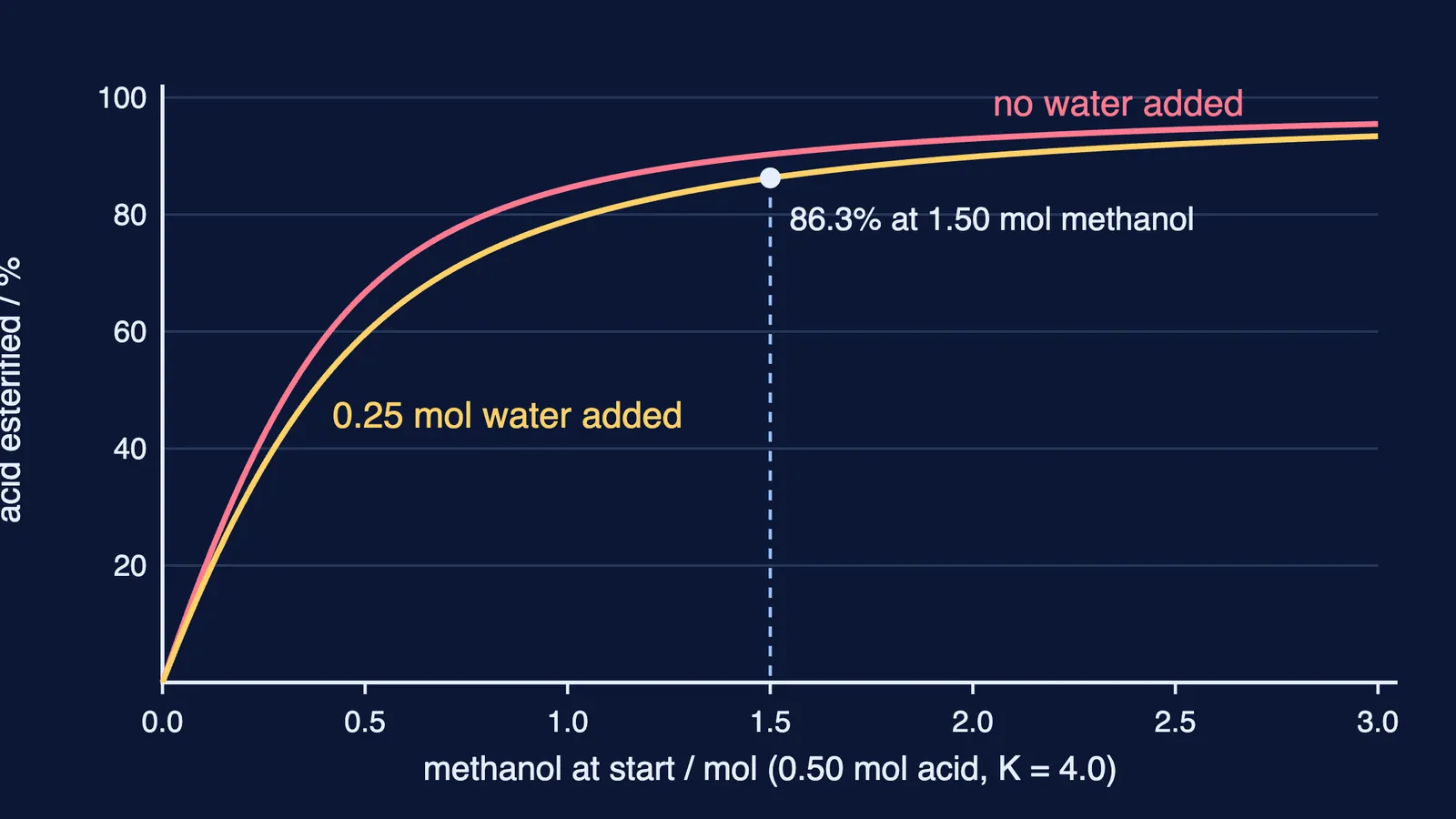
Q6 (hard, numerical-value). 0.50 mol propanoic acid, 1.50 mol methanol and 0.25 mol water are heated with a trace of acid until equilibrium; K = 4.0 for ester formation. What percentage of the acid is esterified? (nearest whole number)
Answer: 86. Volume cancels because moles do not change. With x mol ester, x(0.25 + x) = 4.0(0.50 − x)(1.50 − x), so 3x² − 8.25x + 3 = 0 and x = 0.431 mol, 86%. Trap: ignoring the added water gives 90; the 1:1 textbook ratio gives 67.
Q7 (hard, one or more options correct). Propanone is warmed with excess benzaldehyde in dilute NaOH. Which are correct?
(A) The main product is C₁₇H₁₄O. (B) One mole of water forms per mole of product. (C) The main product gives a yellow precipitate with I₂ and NaOH. (D) With excess propanone instead, the main product gives that precipitate.
Answer: (A), (D). Benzaldehyde has no α-hydrogen, so it is only the electrophile. Both methyl groups of propanone react in turn, each condensation losing water: C₆H₅CH=CHCOCH=CHC₆H₅, C₁₇H₁₄O, with two waters lost (not B). No CH₃CO group survives (not C). With excess propanone the main product is the single adduct C₆H₅CH=CHCOCH₃, still a methyl ketone (D). Trap: (C), reading "ketone" as "iodoform-positive".
Q8 (hard, list-match). Match each reaction in List-I with its product's property in List-II.
List-I: (P) cyclohexanone + NH₂OH, trace acid; (Q) ethyl benzoate + DIBAL-H, then H₂O; (R) benzamide + H₃O⁺, heat; (S) butanone + NaBH₄, then H₂O
List-II: (1) gives a silver mirror with Tollens' reagent (2) forms as a racemic mixture (3) formula C₆H₁₁NO (4) liberates CO₂ from NaHCO₃ (5) is a tertiary alcohol
(A) P→3, Q→5, R→4, S→2 (B) P→5, Q→1, R→4, S→2 (C) P→3, Q→1, R→4, S→2 (D) P→3, Q→1, R→2, S→4
Answer: (C). P is cyclohexanone oxime, C₆H₁₁NO. NCERT says DIBAL-H reduces esters to aldehydes, so Q is benzaldehyde. R is benzoic acid. S is butan-2-ol, whose new stereocentre forms from both faces. Trap: (A), which lets DIBAL-H add twice like a Grignard reagent.
What should you do after this set?
Q1, Q2 or Q8 missed: make a table of reagent, start group and the step where it stops.
Q3, Q4 or Q7 missed: redraw each product and check stereocentres and carbons.
Q5 or Q6 missed: write the equilibrium expression first. Our explainer on why carboxylic acids don't give carbonyl group reactions covers the acid's structure.
To practise the step you missed, the Fermi Problem Library has worked problems with a step-by-step solver that explains the reasoning rather than printing an answer.