

On this page
Aldehydes and ketones react with HCN, sodium hydrogensulphite and 2,4-DNP because of their C=O group. Ethanoic acid, CH3COOH, clearly has a C=O too, yet carboxylic acids do not give these typical carbonyl reactions. Explaining why is a standard 'give reason' question in Class 12 chemistry and a useful check in JEE Main options.
Why don't carboxylic acids give reactions of the carbonyl group?
Typical carbonyl reactions start the same way. In NCERT's words, “a nucleophile attacks the electrophilic carbon atom of the polar carbonyl group” (NCERT Class 12 Chemistry, Unit 8, section 8.4). Anything that makes that carbon less positive makes the attack harder. The same idea explains why aldehydes are more reactive than ketones to nucleophiles.
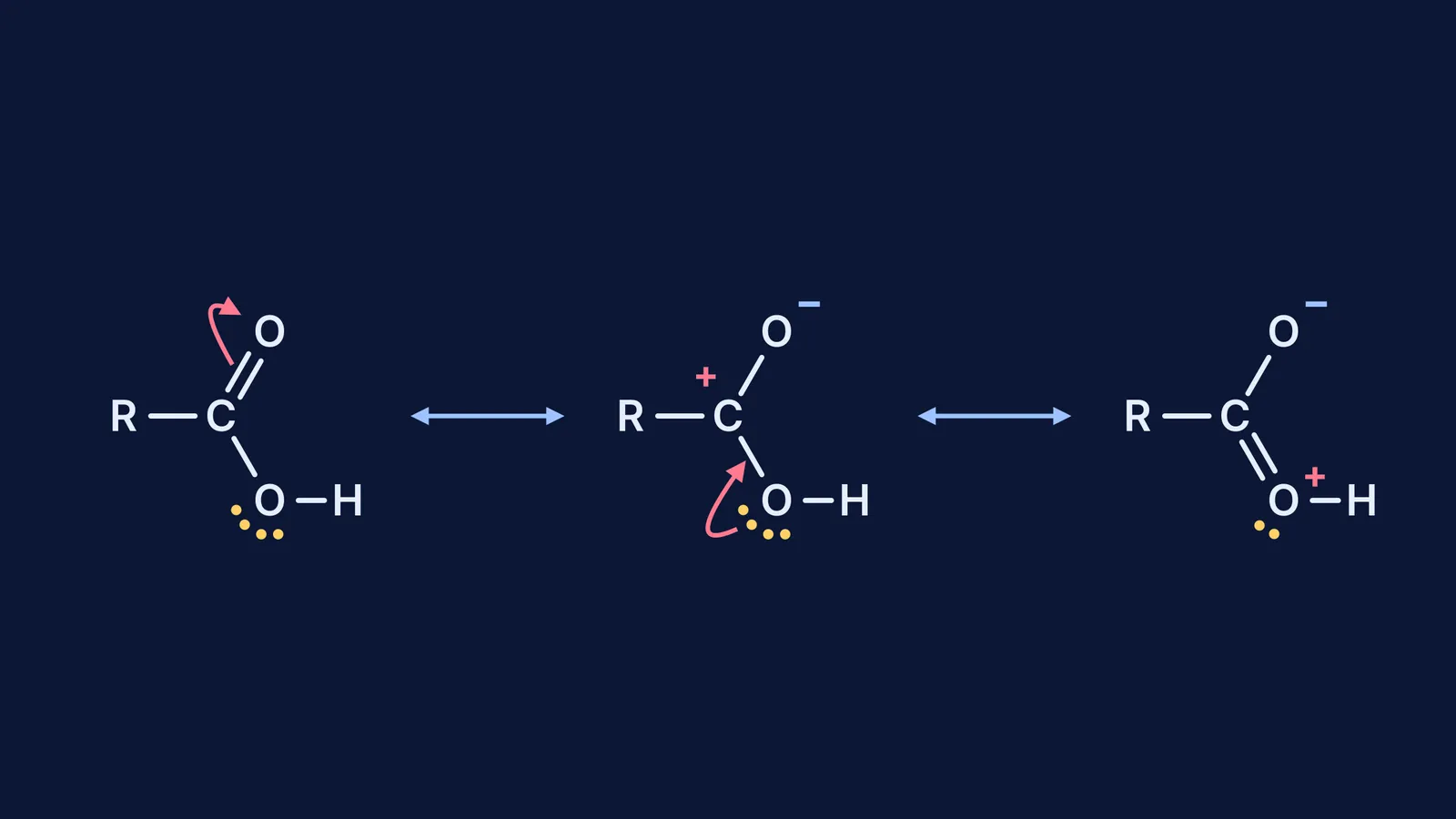
In a carboxylic acid, the carbonyl carbon's neighbour is an –OH oxygen with lone pairs, and one of them can be shared with the carbon through resonance. NCERT states the result: “The carboxylic carbon is less electrophilic than carbonyl carbon because of the possible resonance structure” (NCERT Unit 8, section 8.6.2).
Follow the three resonance structures in the diagram at the top of this page:
The usual structure, R–COOH.
The C=O π electrons shift onto oxygen, leaving a positive carbon: the feature that makes aldehydes and ketones reactive.
A lone pair from the –OH oxygen moves in to fill that gap, so the positive charge sits on oxygen, not carbon.
In acetone, neither neighbour of the carbonyl carbon has a lone pair to donate, so the carbon keeps more of its partial positive charge. In an acid, the –OH neighbour reduces it, and the carbon becomes a poorer target for nucleophiles.
Why does a carboxylic acid not give the 2,4-DNP test?
2,4-Dinitrophenylhydrazine (used in solution as Brady's reagent) adds to a C=O and then loses water. NCERT notes that 2,4-DNP derivatives are yellow, orange or red solids, useful for characterising aldehydes and ketones (NCERT Unit 8, Table 8.2).
The reagent does not react with carboxylic acids, esters or amides, because the lone pair next to the carbonyl carbon gives them resonance stability that would be lost if a reagent added to the C=O (2,4-Dinitrophenylhydrazine, Wikipedia). The same source gives a second reason for acids: once the acid loses its proton, the carboxylate is negatively charged and no longer open to nucleophilic attack.
That matters because acids really are acidic. NCERT gives the pKa of acetic acid as 4.76, against about 16 for ethanol (NCERT Unit 8, section 8.9.1). Nitrogen reagents such as ammonia, amines and hydrazines are bases. LibreTexts puts it plainly: “the basic amine would deprotonate the carboxylic acid to form a highly unreactive carboxylate” (LibreTexts, Condensation of Acids with Amines_Complete_and_Semesters_I_and_II/Map%3A_Organic_Chemistry_(Wade)/21%3A_Carboxylic_Acids/21.08%3A_Condensation_of_Acids_with_Amines)). NCERT shows the same with ammonia: the first product is an ammonium salt, and an amide forms only on further heating.
Does the C=O in a carboxylic acid ever react?
Yes, so avoid writing 'never'. Esterification is an alcohol attacking the same carbon, but it needs help. NCERT explains that “protonation of the carbonyl oxygen activates the carbonyl group towards nucleophilic addition of the alcohol” (NCERT Unit 8, section 8.9.2). That is why esterification uses concentrated H2SO4 or HCl gas as a catalyst, and why it ends in substitution, with –OH leaving as water.
Reduction shows the same pattern: NCERT notes that sodium borohydride reduces aldehydes and ketones but not the carboxyl group, which needs lithium aluminium hydride or diborane (sections 8.4 and 8.9.3). So the accurate statement is: acids do not give the characteristic addition reactions of aldehydes and ketones under the same conditions.
How do you use this in an exam question?
Use this four-step check:
Look at what is attached to the carbonyl carbon. Only H or C: aldehyde or ketone. An –OH, –OR or –NH2: an acid, ester or amide.
If that O or N neighbour has a lone pair, expect weaker carbonyl reactivity and no 2,4-DNP precipitate.
If there is an acidic O–H, ask whether the reagent is a base. If it is, salt formation comes first.
Write the reason in one chain: lone pair on the neighbour, resonance, less electrophilic carbon.
Worked example: compound X, C2H4O2, is acidic and gives no precipitate with 2,4-DNP. Compound Y, C3H6O, gives an orange precipitate but does not reduce Tollens' reagent. X has an –OH on its carbonyl carbon and an acidic proton, so X is ethanoic acid. Y is a carbonyl compound but not an aldehyde, so Y is propanone. Your reason for X comes straight from step 4.
One exception to watch: formic acid has an H on its carbonyl carbon, and we explain why formic acid reduces Tollens' reagent separately.
If resonance, acidity and carbonyl reactivity still feel like separate chapters, the Fermi Concept Library gives every chemistry concept its own lesson and its place in the map, so you can see how they connect. For practice, the Fermi Problem Library has worked problems with a step-by-step solver that explains the reasoning rather than printing an answer.
Next time an option says an acid 'gives an orange precipitate with 2,4-DNP', look at the –OH next to the C=O and cross it out.


