On this page
Practical organic chemistry is a short list in the official JEE (Advanced) 2026 syllabus: detect N, S and halogens, then identify hydroxyl, carbonyl, carboxyl, amino and nitro groups. Each of these eight new questions chains a test result to a structure or a number.
Every reaction follows NCERT: the Class 12 lab manual, Unit 8, Class 11 Chemistry, Unit 8 and Class 12 Chemistry, Unit 9. For the chapter plan, read how to prepare practical organic chemistry for JEE Advanced.
How should you use this practice set?
Allow 30 minutes; cover the solutions.
Note each question's type first; our guide to JEE Advanced question types explains the formats.
For each miss, note the test that would have caught it.
If a step keeps slipping, the Fermi Problem Library has a step-by-step solver that explains the reasoning rather than printing an answer.
Easy: can you read a test result correctly?
Q1 (easy, single-correct). An alcohol C₅H₁₂O separates into two layers with Lucas reagent after about 3 minutes and gives a yellow precipitate with KI–I₂ and NaOH. The alcohol is
(A) pentan-1-ol (B) pentan-3-ol (C) pentan-2-ol (D) 2-methylbutan-2-ol
Answer: (C). The lab manual says secondary alcohols separate in 1–5 minutes, tertiary at once, primary not at all; iodoform needs a CH₃CH(OH)R unit. Pentan-2-ol has both. Trap: (B) is secondary, but its –OH carbon carries two ethyl groups.
Q2 (easy, single-correct). The sodium fusion extract of Y gives neither Prussian blue nor blood red, but turns violet with sodium nitroprusside. After boiling with concentrated HNO₃, AgNO₃ gives a yellow precipitate insoluble in ammonium hydroxide. Y is
(A) 4-bromobenzenesulphonic acid (B) 4-iodoaniline (C) 4-iodobenzenesulphonic acid (D) 4-iodobenzenesulphonamide
Answer: (C). In NCERT Class 11, Unit 8, violet means sulphur, no blue or blood red means no nitrogen, and a yellow halide insoluble in ammonia means iodine. The acid first removes sulphide (why nitric acid is boiled first). Trap: (A); silver bromide is yellowish and only sparingly soluble. (B) and (D) contain nitrogen.
Medium: can you tell look-alikes apart?
Q3 (medium, one or more options correct). In which pairs is the named test positive for exactly one compound?
(A) benzaldehyde and propanal: Fehling's test
(B) methanol and ethanol: ceric ammonium nitrate test
(C) ethanol and propan-2-ol: iodoform test
(D) aniline and N-methylaniline: carbylamine test
Answer: (A), (D). Aromatic aldehydes fail Fehling's test (lab manual), so only propanal gives Cu₂O. Only the primary amine, aniline, gives the foul-smelling isocyanide (NCERT Class 12, Unit 9). Both alcohols in (B) give the red ceric complex. Trap: (C); propan-2-ol also carries CH₃CH(OH)–, so both are positive.
Q4 (medium, numerical-value). Each compound is warmed with iron and HCl, diazotised with NaNO₂/HCl at 273–278 K, then added to alkaline β-naphthol: nitrobenzene, 4-nitrotoluene, 3-nitrobenzoic acid, 1-chloro-2-nitrobenzene, 1-nitropropane, phenylnitromethane (C₆H₅CH₂NO₂), N,N-dimethylaniline. How many give a scarlet red dye?
Answer: 4. Metal and acid reduce –NO₂ to –NH₂; only aromatic amines give diazonium salts stable enough to couple, while aliphatic ones lose nitrogen (NCERT Class 12, Unit 9). The four ring-nitro compounds pass. Phenylnitromethane and 1-nitropropane give aliphatic amines; N,N-dimethylaniline has no nitro group. Trap: 5, counting phenylnitromethane for its benzene ring.
Q5 (medium, single-correct). Aniline, N-methylaniline and N,N-dimethylaniline are shaken with benzenesulphonyl chloride and excess aqueous KOH, then extracted with ether. What is in the aqueous layer?
(A) N,N-dimethylaniline (B) the sulphonamide from N-methylaniline (C) the potassium salt of the sulphonamide from aniline (D) anilinium chloride
Answer: (C). Per NCERT, a primary amine's sulphonamide keeps an acidic N–H and dissolves in alkali; a secondary amine's has none; tertiary amines do not react. Trap: (B); a sulphonamide forms, but with no N–H it stays in the ether.
Hard: can you chain a formula, a test and a number?
Q6 (hard, one or more options correct). X contains only C, H, N and O (molar mass 151 g mol⁻¹) and gives Prussian blue in Lassaigne's test. Burning 0.302 g gives 0.704 g CO₂ and 0.162 g H₂O. X dissolves in dilute HCl, fizzes with NaHCO₃, gives no FeCl₃ colour, and gives a scarlet dye after diazotisation and alkaline β-naphthol. Which are correct?
(A) X has five degrees of unsaturation.
(B) X gives a foul smell when heated with CHCl₃ and ethanolic KOH.
(C) X could be 4-(aminomethyl)benzoic acid.
(D) X could be methyl 4-aminobenzoate.
Answer: (A), (B). X = 0.302 ÷ 151 = 0.00200 mol, so C = (0.704 ÷ 44) ÷ 0.00200 = 8 and H = (2 × 0.162 ÷ 18) ÷ 0.00200 = 9. The remaining 46 must be N + 2O, so X is C₈H₉NO₂, with (2 × 8 + 2 + 1 − 9) ÷ 2 = 5 degrees of unsaturation. Fizzing means –COOH; the dye means a primary –NH₂ on the ring, so (B) holds. 4-Amino-3-methylbenzoic acid fits. Trap: (C) fits the formula, but –CH₂NH₂ gives no dye; (D), an ester, cannot fizz.
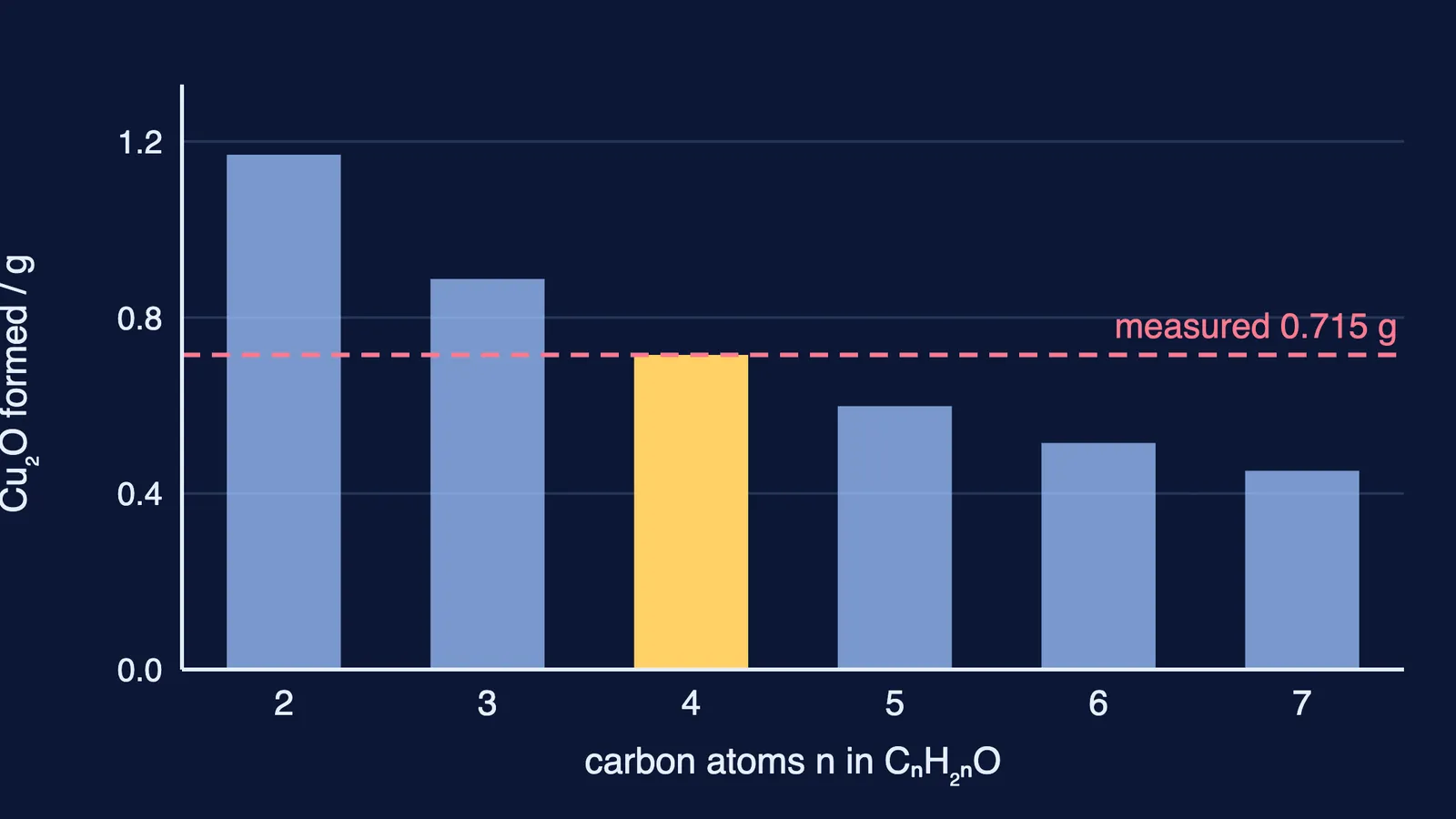
Q7 (hard, numerical-value). P is a saturated open-chain aldehyde. With Fehling's solution, 0.360 g of P gives 0.715 g of Cu₂O (Cu = 63.5, O = 16). How many carbon atoms are in P?
Answer: 4. The lab manual equation, RCHO + 2Cu²⁺ + 5OH⁻ → RCOO⁻ + Cu₂O + 3H₂O, gives one Cu₂O (143 g mol⁻¹) per aldehyde: 0.00500 mol, so M = 0.360 ÷ 0.00500 = 72 g mol⁻¹. For CₙH₂ₙO, 14n + 16 = 72 and n = 4. Trap: reading "2Cu²⁺" as two Cu₂O gives 144 g mol⁻¹ and n ≈ 9.1; a fractional n means recheck.
Q8 (hard, list-match). Match each compound to a test it passes.
List-I: (P) 4-methylphenol; (Q) 4-nitrobenzoic acid; (R) benzylamine; (S) 1-phenylethanol
List-II: (1) colour with neutral FeCl₃; (2) effervescence with NaHCO₃; (3) foul smell with CHCl₃ and ethanolic KOH; (4) yellow precipitate with KI–I₂ and NaOH; (5) scarlet azo dye after diazotisation and β-naphthol
(A) P→1, Q→2, R→5, S→4 (B) P→1, Q→2, R→3, S→4 (C) P→2, Q→1, R→3, S→4 (D) P→1, Q→5, R→3, S→4
Answer: (B). Cresols give a violet or blue FeCl₃ colour but are too weakly acidic to fizz; carboxylic acids fizz. Benzylamine's –NH₂ is primary but sits on CH₂: carbylamine yes, dye no. C₆H₅CH(OH)CH₃ has the CH₃CH(OH)R unit, so iodoform. Trap: (D) lets a nitro group pass the dye test without reduction; (A) treats benzylamine as aromatic.
Missed Q4, Q6 or Q8? All three test one idea: only –NH₂ on a benzene ring gives the azo dye.