On this page
JEE Advanced GOC questions make you combine ideas: hybridisation with geometry, aromaticity with basicity, symmetry with stereoisomer counts. Here are 8 original questions, easy to hard.
All questions stay inside GOC in the JEE (Advanced) 2026 syllabus, which excludes R,S and E,Z labels. Facts follow NCERT Class 11 Unit 8 and Unit 9 (Reprint 2026-27). Every option was checked in Python (RDKit, sympy). Chapter plan: GOC for JEE Advanced: how to prepare.
How should you use this JEE Advanced GOC set?
Cover the solutions; allow 25 minutes.
In "one or more options correct", judge each option on its own.
Read every trap line.
Formats explained: JEE Advanced question types.
Easy: are shape and aromaticity automatic?
Q1 (easy, single correct). In which molecule are all four carbons on one straight line?
(A) CH₃–C≡C–CH₃ (B) CH₃–CH₂–C≡CH (C) CH₂=CH–C≡CH (D) CH₃–CH=CH–CH₃
Answer: (A). Each sp carbon holds its neighbours at 180°. In but-2-yne both middle carbons are sp, so all four carbons lie on one line. Trap: (C). It has a triple bond, but the angle at sp² C2 is about 120°; in (B) sp³ C2 bends the chain.
Q2 (easy, one or more options correct). Which species are aromatic?
(A) cyclopentadienyl anion (B) tropylium cation, C₇H₇⁺ (C) cycloocta-1,3,5,7-tetraene (D) cyclohepta-1,3,5-triene
Answer: (A), (B). NCERT's conditions: a planar ring, complete delocalisation of π electrons, and (4n + 2) π electrons (Hückel rule). (A) and (B) each spread 6 π electrons over every ring carbon. (C) has 8 and is tub-shaped. Trap: (D). It has 6 π electrons, but its sp³ CH₂ breaks the ring of p orbitals. More: why the cyclopentadienyl anion and tropylium ion are aromatic.
Q3 (easy, single correct). A cyclopentane ring carries –COOH on one carbon and a ketone C=O on the adjacent ring carbon. Its IUPAC name is
(A) 2-oxocyclopentane-1-carboxylic acid (B) 2-carboxycyclopentan-1-one (C) 2-oxocyclohexane-1-carboxylic acid (D) 5-oxocyclopentane-1-carboxylic acid
Answer: (A). –COOH outranks the ketone, so it is the suffix "-carboxylic acid", and its carbon is not counted in the ring. Its ring carbon is C1; numbering towards the ketone gives "2-oxo". Trap: (B) makes the ketone the principal group. (C) counts the COOH carbon in the ring; (D) numbers backwards.
Medium: can you link data and effects?
Q4 (medium, numerical). 0.220 g of compound X (C, H, O only) burns to 0.440 g CO₂ and 0.180 g H₂O; its vapour density is 44. X gives no hydrogen with sodium metal, and aqueous NaOH hydrolyses it to a carboxylate salt and an alcohol. How many structures are possible for X?
Answer: 4. C: 0.440/44 = 0.0100 mol (0.120 g). H: 2 × 0.180/18 = 0.0200 mol (0.020 g). O by difference: 0.080 g, 0.0050 mol. Ratio 2 : 4 : 1 and M = 2 × 44 = 88 give C₄H₈O₂. Salt plus alcohol means an ester: propyl methanoate, propan-2-yl methanoate, ethyl ethanoate, methyl propanoate. Trap: 6 adds the two acids, which would give hydrogen with sodium; 3 misses propan-2-yl methanoate.
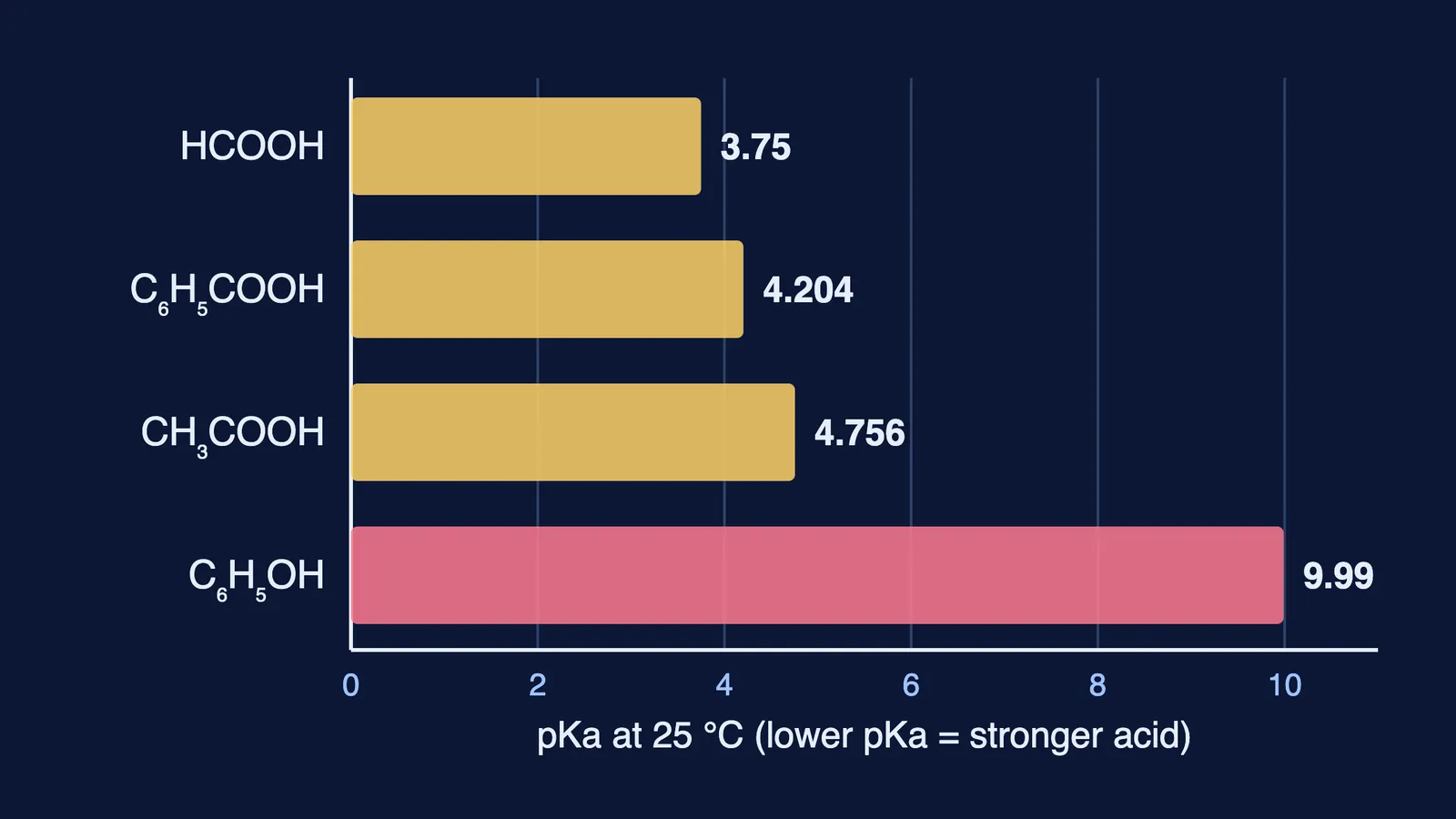
Q5 (medium, single correct). Arrange in decreasing order of acid strength: (I) HCOOH (II) CH₃COOH (III) C₆H₅COOH (IV) C₆H₅OH
(A) I > III > II > IV (B) III > I > II > IV (C) I > II > III > IV (D) III > II > I > IV
Answer: (A). Methyl's +I effect destabilises acetate, so acetic is weaker than formic. Phenyl bonds through an sp² carbon; NCERT notes that more s character means higher electronegativity, so benzoic beats acetic. Phenoxide spreads its charge onto ring carbons, not a second oxygen, so phenol is far weaker. The LibreTexts pKa table (CRC data, 25 °C) gives 3.75, 4.204, 4.756 and 9.99 (chart above). Trap: (B) overrates the ring's pull; formic acid is about 2.8 times stronger.
Q6 (medium, one or more options correct). Which statements are correct?
(A) n-Butylamine is a stronger base than pyridine; its lone pair has less s character. (B) Pyridine is a stronger base than aniline. (C) The nitrogen lone pair of pyridine is part of its aromatic π sextet. (D) Aniline is a stronger base than n-butylamine, as the ring pushes electrons onto nitrogen.
Answer: (A), (B). The LibreTexts base table gives pKb 3.40 for n-butylamine, 8.77 for pyridine and 9.4 for aniline; lower pKb, stronger base. An sp³ lone pair is held less tightly than an sp² one. Pyridine's lone pair lies in the ring plane, free to take a proton; aniline's is delocalised into the ring. Trap: (C). Pyridine's nitrogen gives one p electron to the sextet; its lone pair stays outside it.
Hard: can you combine symmetry with intermediates?
Q7 (hard, one or more options correct). Which statements are correct?
(A) cis-1,2-Dimethylcyclobutane has two asymmetric carbons yet is optically inactive. (B) trans-1,3-Dimethylcyclobutane is chiral. (C) 1,2-Dimethylcyclobutane has three stereoisomers in all. (D) cis- and trans-1,2-dimethylcyclobutane are enantiomers.
Answer: (A), (C). A mirror plane cuts the cis-1,2 ring between C1 and C2, so it is meso. Trans-1,2 has no such plane and is a pair of enantiomers: three stereoisomers. Trap: (B). In the 1,3 isomer, C1 and C3 each have two identical ring paths, so neither is asymmetric; a plane through them makes both forms achiral. (D): cis and trans are diastereomers.
Q8 (hard, list match). Match each species with the main reason it is stabilised.
List I: (P) CH₂=CH–CH₂⁺ (Q) (CH₃)₃C⁺ (R) cyclopropenyl cation, C₃H₃⁺ (S) ⁻CH₂–CHO
List II: (1) 2 π electrons in a planar conjugated ring (2) positive charge shared by two end carbons (3) hyperconjugation with nine C–H bonds (4) –I effect alone (5) negative charge delocalised onto oxygen
(A) P-2, Q-3, R-1, S-5 (B) P-1, Q-3, R-2, S-5 (C) P-2, Q-3, R-1, S-4 (D) P-2, Q-4, R-5, S-1
Answer: (A). The allyl cation has two equivalent resonance forms; tert-butyl has nine C–H bonds next to C⁺; cyclopropenyl fits Hückel with n = 0; the carbanion pushes its charge onto oxygen. Trap: (B) swaps P and R; both delocalise charge, but only R does it around a closed ring. (C) ignores resonance in S.
What should you revise after this set?
Missed Q1 to Q4: redo hybridisation, Hückel's rule, ring naming and combustion data.
Missed Q5 to Q8: write which effect wins, then re-solve without options in two days.
For more GOC problems, the Fermi Problem Library has worked problems with a step-by-step solver that explains the reasoning rather than printing an answer.