On this page
Every later organic chapter leans on basic principles of organic chemistry (GOC). JEE (Advanced) 2027 is on 23 May 2027, organised by IIT Delhi, according to the official JEE (Advanced) website. Its syllabus is not out yet, so this guide works from the 2026 one.
What does the JEE Advanced syllabus include in GOC?
The JEE (Advanced) 2026 syllabus notes that it is the same as 2025's. Under "Basic Principles of Organic Chemistry" it lists:
Hybridisation of carbon; σ and π-bonds; shapes of simple organic molecules; aromaticity
Structural and geometrical isomerism
Stereoisomers and stereochemical relationship (enantiomers, diastereomers, meso) of compounds containing only up to two asymmetric centres (R,S and E,Z configurations excluded)
Determination of empirical and molecular formulae of simple compounds by combustion method only
IUPAC nomenclature of organic molecules (hydrocarbons, including simple cyclic hydrocarbons and their mono-functional and bi-functional derivatives only)
Hydrogen bonding effects; inductive, resonance and hyperconjugative effects; acidity and basicity of organic compounds
Reactive intermediates produced during homolytic and heterolytic bond cleavage; formation, structure and stability of carbocations, carbanions and free radicals
Compare it with Unit 14 of the JEE (Main) 2027 syllabus. That unit says only "stereoisomerism"; the Advanced list names enantiomers, diastereomers and meso forms, and adds aromaticity, hydrogen bonding effects and acidity and basicity to the same unit. For the groundwork, see our GOC guide for JEE Main or the Class 11 chapter guide.
How is GOC tested differently at JEE Advanced?
The 2026 Information Brochure says the exam has two papers of three hours each, and appearing in both is compulsory. Question types and marking are announced in the paper itself, so expect no fixed pattern. Multiple-correct and numerical JEE Advanced question types reward one habit: judge every option on its own, and check a number before entering it.
Worked example 1: from combustion data to a structure
0.510 g of compound X (C, H, O only) burns to give 1.100 g CO2 and 0.450 g H2O. Its vapour density is 51. X gives CO2 with NaHCO3 and is optically active. Identify X.
Carbon: 1.100/44 = 0.025 mol C, 0.300 g.
Hydrogen: 2 × 0.450/18 = 0.050 mol H, 0.050 g.
Oxygen by difference: 0.510 − 0.300 − 0.050 = 0.160 g, 0.010 mol O.
Ratio 0.025 : 0.050 : 0.010 = 5 : 10 : 2, so C5H10O2 (M = 102 = 2 × 51). One degree of unsaturation.
NaHCO3 means a carboxylic acid. Of the four C5 acids (pentanoic, 2-methylbutanoic, 3-methylbutanoic, 2,2-dimethylpropanoic), only 2-methylbutanoic acid has a carbon with four different groups.
X is 2-methylbutanoic acid. Check: C, H and O masses add back to 0.510 g.
Worked example 2: a multiple-correct stereochemistry question
4,5-Dichlorooctane: which are correct? (A) It has two asymmetric carbons. (B) It has four stereoisomers. (C) Its meso form is optically inactive. (D) The meso form and either optically active form are diastereomers.
C4 and C5 each carry H, Cl, propyl and the rest of the chain, so A is true. The two halves are identical, so one combination is superimposable on its mirror image: a meso form. That gives three stereoisomers, not four, so B is false; C and D are true. Answer: A, C, D.
Worked example 3: acidity with a limiting-case check
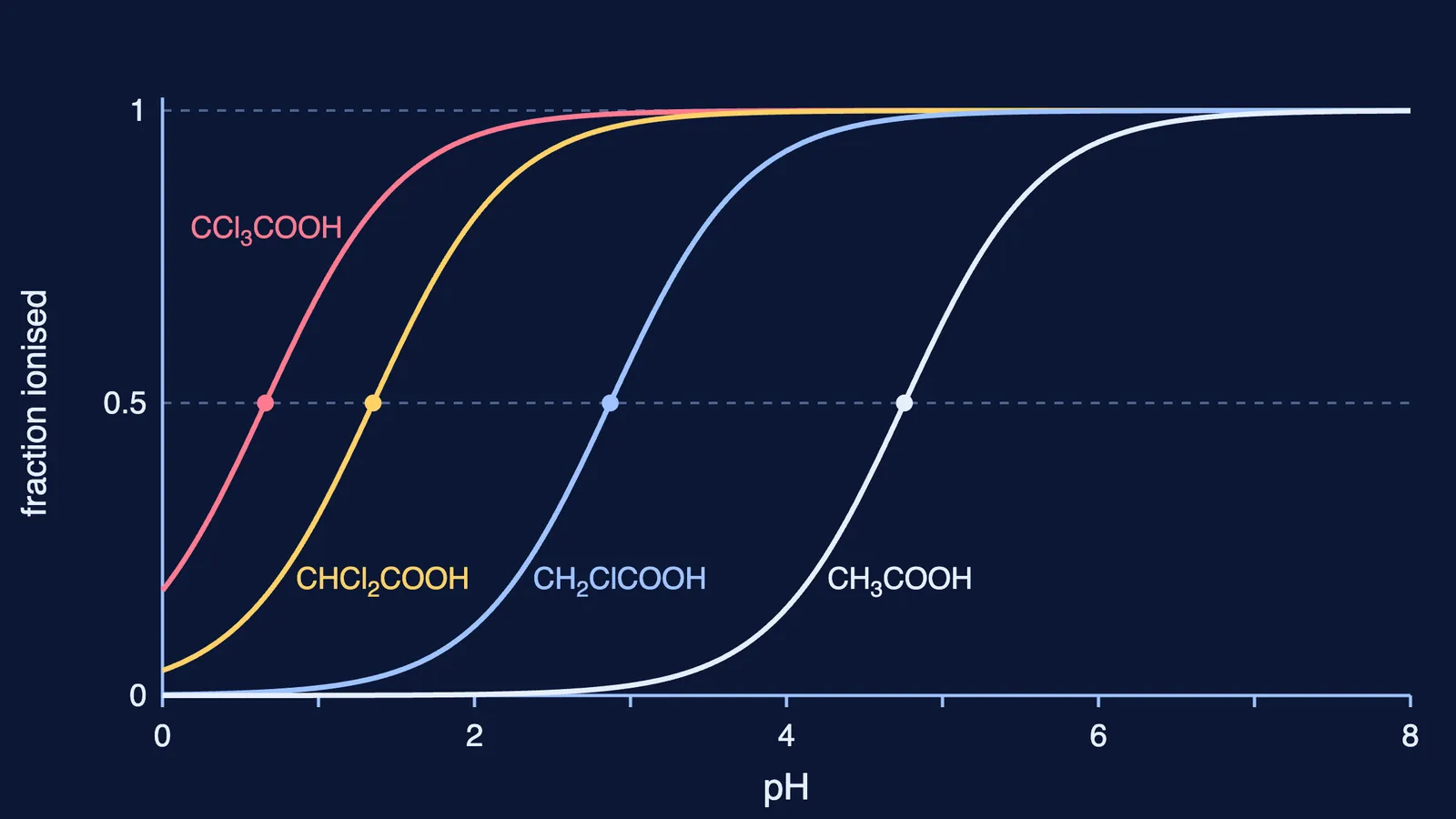
At pH 3.00, what fraction of chloroacetic acid and of acetic acid is ionised? The LibreTexts table of acid dissociation constants gives pKa 2.87 for chloroacetic acid and 4.756 for acetic acid.
Fraction ionised = 1/(1 + 10^(pKa − pH)). Chloroacetic acid: 1/(1 + 10^−0.13) = 0.574. Acetic acid: 1/(1 + 10^1.756) = 0.017. One chlorine's −I effect stabilises the carboxylate: about 33 times more ionised here. Limiting check: at pH = pKa it gives 0.5; far above pKa it tends to 1.
Stuck on a step? The Fermi Problem Library has worked problems with a step-by-step solver that explains the reasoning rather than printing an answer.
How should you practise GOC for JEE Advanced?
A two-week plan, an hour a day:
Days 1-3: hybridisation, shapes, aromaticity, IUPAC names of cyclic and bi-functional compounds.
Days 4-6: isomer and stereoisomer counts; for each, ask whether symmetry creates a meso form.
Days 7-9: inductive, resonance and hyperconjugative effects, then rank acids, bases and intermediates, with a reason for each step.
Days 10-11: combustion problems that end in a structure.
Days 12-14: mixed sets; mark each multiple-correct option true or false with a one-line reason.
Try these (answers in brackets):
How many stereoisomers does 3,5-dibromoheptane have? (Three, one of them meso.)
0.140 g of a hydrocarbon gives 0.440 g CO2 and 0.180 g H2O; its vapour density is 35. Molecular formula? (C5H10.)
At pH 1.00, what fraction of dichloroacetic acid and trichloroacetic acid is ionised? Use pKa 1.35 and 0.66 from the LibreTexts table. (0.31 and 0.69.)
Solve one example today; redo it tomorrow without notes.