On this page
JEE Advanced probability rewards one habit more than any formula: name the event you are conditioning on before you calculate. Here is what the official syllabus lists, three original worked examples and a four-week plan.
What does the JEE Advanced syllabus include for probability and statistics?
The official JEE (Advanced) 2026 syllabus lists, under Probability and Statistics: "Random experiment, sample space, different types of events (impossible, simple, compound), addition and multiplication rules of probability, conditional probability, independence of events, total probability, Bayes' Theorem, computation of probability of events using permutations and combinations."
Its statistics part covers mean, median, mode, mean deviation, standard deviation and variance of grouped and ungrouped data, frequency distributions with the same mean but different variance, and the mean and variance of a random variable. The PDF notes that the 2026 syllabus is the same as 2025.
The 2027 syllabus has not been published yet (as of 19 November 2026). The official JEE (Advanced) site says JEE (Advanced) 2027 will be held on 23 May 2027 (Sunday), organised by IIT Delhi.
What does JEE Advanced add beyond JEE Main?
The NTA syllabus for JEE (Main) 2027 covers probability of an event, the addition and multiplication theorems, Bayes' theorem, the probability distribution of a random variable, and measures of dispersion. The Advanced list names these items; Main does not, though its multiplication theorem already uses conditional probability:
conditional probability and independence of events
total probability
probability computed with permutations and combinations
frequency distributions with the same mean but different variance
the mean and variance of a random variable
Neither list names the binomial distribution, so treat repeated independent trials as the multiplication rule at work. If you want the core rules first, start with our probability guide for JEE Main.
Worked example 1: Bayes with total probability
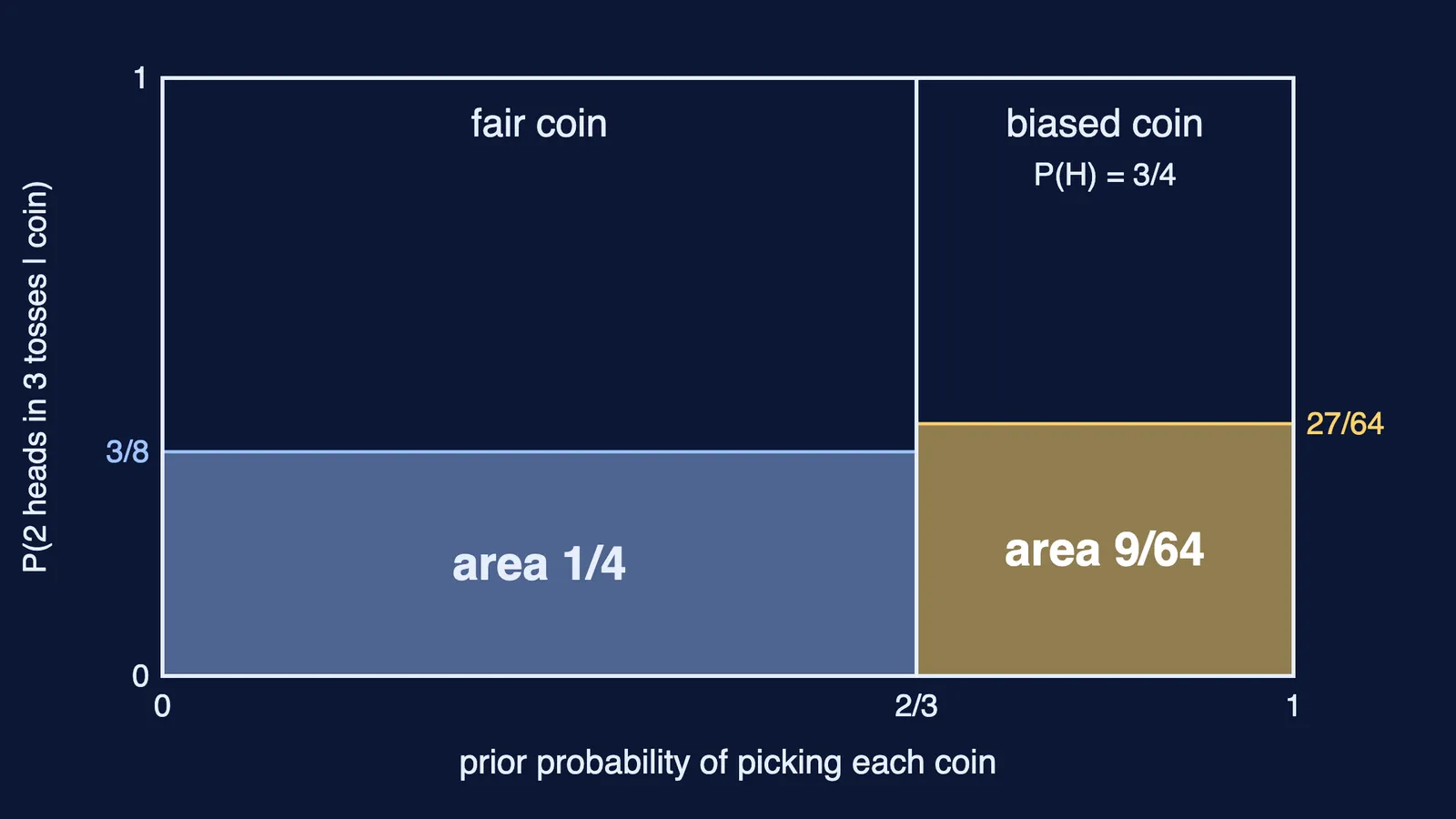
A bag holds two fair coins and one coin with P(H) = 3/4. You pick one at random and toss it three times: exactly two heads. (a) Find P(biased). (b) Find P(fourth toss is a head).
Likelihoods: P(2 heads | fair) = 3 × (1/2)³ = 3/8, and P(2 heads | biased) = 3 × (3/4)² × (1/4) = 27/64.
Total probability: P(2 heads) = (2/3)(3/8) + (1/3)(27/64) = 1/4 + 9/64 = 25/64.
Bayes: P(biased | 2 heads) = (9/64) ÷ (25/64) = 9/25.
Update, then predict: P(next head) = (16/25)(1/2) + (9/25)(3/4) = 59/100 = 0.59.
Limiting-case check: if the "biased" coin had P(H) = 1/2, the posterior must equal the prior, 1/3. It does. The usual slip in (b) is using the old weights 2/3 and 1/3, giving 7/12.
Worked example 2: independent is not the same as exclusive
Pick a number at random from 1 to 12. A = multiple of 2, B = multiple of 3, C = multiple of 4. Which statements are true?
A and B are independent: P(A ∩ B) = 2/12 = 1/6 = (1/2)(1/3).
B and C are independent: P(B ∩ C) = 1/12 = (1/3)(1/4).
A and C are not: P(A ∩ C) = P(C) = 1/4, not 1/8.
A, B, C are not mutually independent: P(A ∩ B ∩ C) = 1/12, not 1/24.
Change 12 to 10 and A and B become dependent (1/10 against 3/20): independence depends on the sample space. In a multiple-correct question, test every option this way; see our guide to JEE Advanced question types.
Worked example 3: same mean, different spread
Game A pays ₹0 or ₹20 with equal chance. Game B pays ₹5, ₹10 or ₹15 with probabilities 1/4, 1/2 and 1/4. Both have mean ₹10.
Var(A) = E[X²] − (E[X])² = 200 − 100 = 100, so the SD is ₹10.
Var(B) = 112.5 − 100 = 12.5, so the SD is about ₹3.54.
Same mean, but A's SD is about 2.8 times B's. Variance carries squared units (₹²); a variance quoted in rupees signals a slip.
Stuck partway through a problem? The Fermi Problem Library has worked problems with a step-by-step solver that explains the reasoning rather than printing an answer.
How should you practise this unit in four weeks?
Week 1: counting-based probability. Write the sample-space size first.
Week 2: conditional probability, independence and total probability. Write "given what?" in words first.
Week 3: Bayes and random variables. Draw a tree or area diagram.
Week 4: statistics and mixed timed sets, applying the three checks.
Original practice questions:
From 1 to 20, are "multiple of 4" and "multiple of 5" independent?
Two cards are drawn without replacement from cards numbered 1 to 9. Given that at least one is odd, find the probability that the sum is even.
Eight observations have mean 10 and variance 6. A ninth observation equal to 10 is added. Find the new variance.
Answers: yes (1/20 = 1/4 × 1/5); 1/3; 16/3.
For Bayes solved by counting people, read Bayes' theorem with a 10,000-person count.