On this page
In JEE Advanced, one electrochemistry question can ask you to read a conductivity, get a solubility, then predict a cell voltage. Below: the official topics, what goes beyond JEE Main, two original worked examples and a plan.
What does the JEE Advanced syllabus include in electrochemistry?
The official JEE (Advanced) 2026 Syllabus says it is unchanged from 2025. Its Electrochemistry section reads: "Electrochemical cells and cell reactions; Standard electrode potentials; Electrochemical work, Nernst equation; Electrochemical series, emf of galvanic cells; Faraday's laws of electrolysis; Electrolytic conductance, specific, equivalent and molar conductivity, Kohlrausch's law; Batteries: Primary and Secondary, fuel cells; Corrosion."
The 2027 syllabus is not published yet (as of 19 November 2026). The JEE (Advanced) 2027 website says the exam will be held on 23 May 2027 (Sunday), organised by IIT Delhi. To be eligible you must be among the top 2,50,000 candidates in the B.E./B.Tech. paper of JEE (Main) 2027, along with the other eligibility criteria.
What does JEE Advanced add beyond JEE Main?
Compare the list above with Unit 7 of the NTA's Syllabus for JEE (Main) - 2027. The JEE Advanced list names four things the JEE Main text does not:
Faraday's laws of electrolysis
specific and equivalent conductivity (JEE Main names molar conductivity)
the electrochemical series
corrosion
Keep the basics from our electrochemistry guide for JEE Main and add these. The bigger change is question style. The 2026 Information Brochure says the 2026 exam had two papers of three hours each, appearing in both was compulsory, and marking details were given in the paper's instructions at exam time, so do not rely on a fixed pattern. Practise single-correct, multiple-correct and numerical-answer thinking; our post on JEE Advanced question types explains each.
Worked example 1: how do conductance and the Nernst equation connect?
A saturated solution of a sparingly soluble salt MX has conductivity 2.30 × 10⁻⁶ S cm⁻¹ at 298 K. The water used has 0.20 × 10⁻⁶ S cm⁻¹. Limiting ionic conductivities: λ°(M⁺) = 62 and λ°(X⁻) = 78 S cm² mol⁻¹. Find Ksp, then the emf of M | M⁺ (saturated MX) || M⁺ (0.010 M) | M.
Salt's own conductivity: κ = 2.30 × 10⁻⁶ − 0.20 × 10⁻⁶ = 2.10 × 10⁻⁶ S cm⁻¹.
Kohlrausch's law: Λ°m = 62 + 78 = 140 S cm² mol⁻¹. The solution is so dilute that Λm ≈ Λ°m.
Solubility: s = 1000κ/Λ°m = 1000 × 2.10 × 10⁻⁶ / 140 = 1.5 × 10⁻⁵ mol L⁻¹.
Ksp = s² = 2.25 × 10⁻¹⁰.
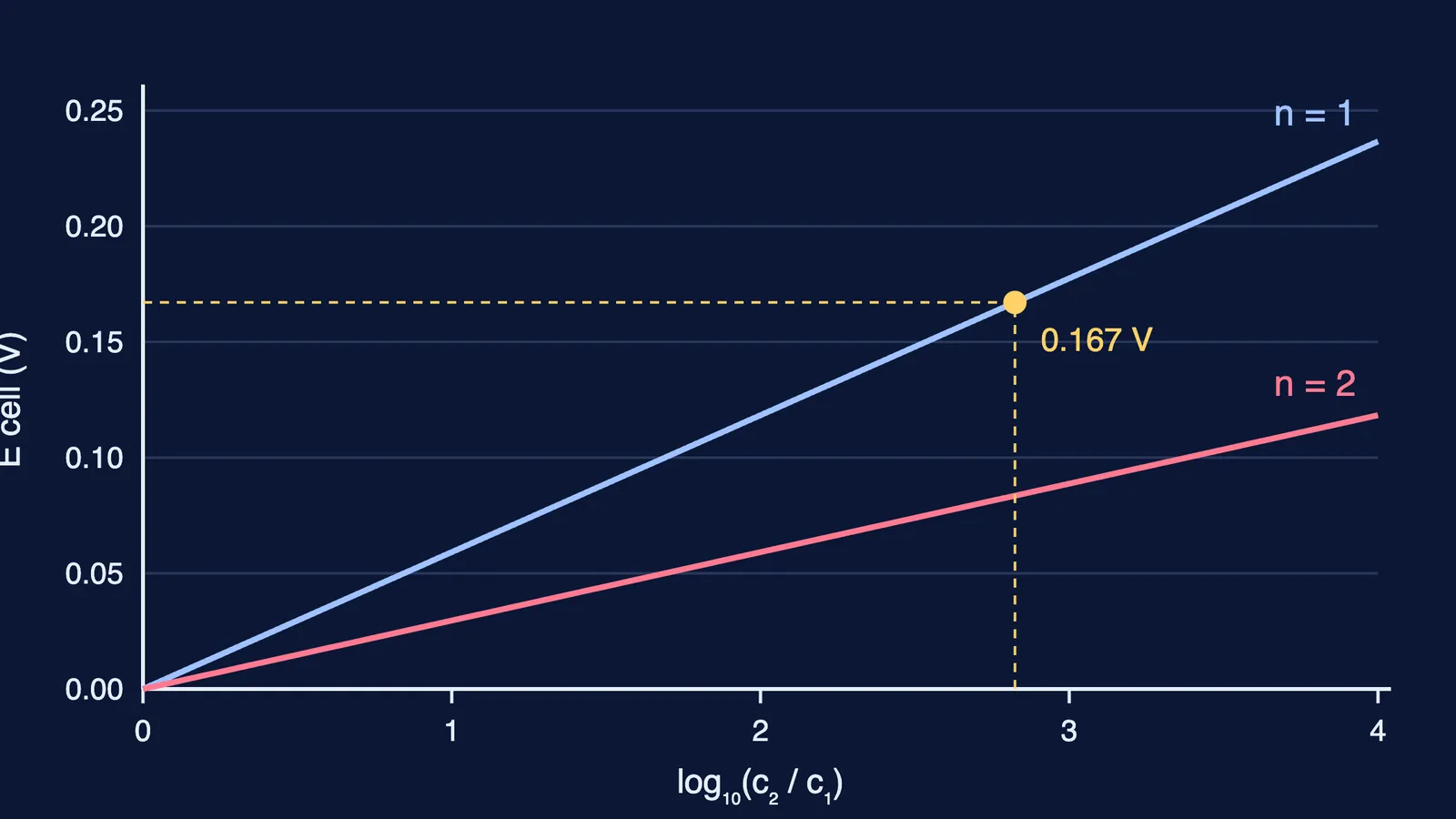
Concentration cell, n = 1: E = 0.0591 log(0.010 / 1.5 × 10⁻⁵) = 0.0591 × 2.824 = 0.167 V.
Check the limits. If both sides had equal concentration, E would be 0, as it should. E is positive only because the dilute side is the anode. Forgetting the water's share inflates s to 1.64 × 10⁻⁵ mol L⁻¹.
Worked example 2: what happens in electrolysis when a reactant runs out?
You electrolyse 0.500 L of 0.100 M CuSO₄ with platinum electrodes at 2.00 A for 40.0 minutes. Take F = 96,500 C mol⁻¹ and Cu = 63.5 g mol⁻¹.
Charge: Q = 2.00 × 2400 = 4800 C, so electrons = 4800 / 96,500 = 0.0497 mol.
Cathode, Cu²⁺ + 2e⁻ → Cu: 0.0249 mol Cu, or 1.58 g. Of 0.0500 mol Cu²⁺, 0.0251 mol remains.
Anode, 2H₂O → O₂ + 4H⁺ + 4e⁻: 0.0124 mol O₂ and 0.0497 mol H⁺, so the solution turns acidic.
Now the multi-concept trap. All the copper is gone after 0.100 mol of electrons, which is 4825 s or about 80.4 minutes. Beyond that, the cathode releases hydrogen instead. A multiple-correct question can hinge on this switch.
How should you practise electrochemistry for JEE Advanced?
Two weeks, about an hour a day:
Days 1-3: cells, the electrochemical series and the Nernst equation, including how E changes with pH.
Days 4-6: conductance in all three forms, Kohlrausch's law, degree of dissociation and solubility from conductivity.
Days 7-9: Faraday's laws, cells in series and "which reaction runs once a reactant is used up".
Days 10-11: batteries, fuel cells and corrosion, written as half-reactions.
Days 12-14: mixed timed sets; for each miss, note the step that failed.
Not sure where a solution went wrong? The Fermi Problem Library has worked problems with a step-by-step solver that explains the reasoning rather than printing an answer.
Try these original questions (298 K, 0.0591 V per decade):
A cell Pt | H₂ (1 bar) | H⁺ || Cu²⁺ (0.010 M) | Cu reads 0.575 V. Using E°(Cu²⁺/Cu) = +0.34 V from NCERT Class 12 Chemistry, Unit 2, find the pH of the hydrogen side. Answer: about 4.98.
A 0.010 M weak acid HA has Λm = 39 S cm² mol⁻¹ and Λ°m = 390 S cm² mol⁻¹. Find α and Ka. Answer: α = 0.10, Ka ≈ 1.1 × 10⁻⁴.